Seeing the Bible
Fourteen pictures made from the words of the Bible itself. Each one shows something about the whole Bible at once: its size, its shape, and how its parts are joined.
Tap any picture to open it large. Under each picture, tap How this picture was made to see exactly what was counted and how.
What is a data picture?
A data picture turns a very large amount of information into a shape you can see. Each mark in the picture stands for one real thing: a verse, a word, a place or a person. Nothing is drawn just to look nice.
The Bible has 31,102 verses in the King James numbering. Reading ten verses a minute, it would take about 52 hours to read them all. No one can hold all of that in mind at once. But the eye can take in a whole picture in a moment.
How a picture helps you see
- Size. A bigger stone or a taller tower means more words or more verses. You can compare at a glance.
- Shape. Peaks and valleys show where the text runs long and where it runs short.
- Colour. Colour shows which part of the Bible something belongs to, so you can see where things gather.
- Closeness. Lines and arcs show which verses and books are linked. Where many lines cross, the picture grows bright.
- Empty space. A dark gap is a finding too. It shows where something is not found.
A picture does not replace reading. It is a door into the text: it shows you where to look. Then you open the Bible and read the verses for yourself.
Now these were more noble than those in Thessalonica, in that they received the word with all readiness of mind, examining the scriptures daily, whether these things were so.Acts 17:11 (ASV)
How to read these pictures
Colours. Most pictures use the same colours for the parts of the Bible:
- Torah
- Prophets
- Writings
- Apocrypha
- New Testament
- Order. The Hebrew books are in the order of the Jewish Bible, the Tanakh: the Torah (the five books of Moses), then the Prophets, then the Writings. The New Testament comes after. It is the order of the Hebrew Bible itself.
- True scale. Unless a picture says otherwise, sizes are true: twice the words means twice the size. Two pictures say otherwise: Book Meets Book uses a log scale, and Four Words is smoothed. Their descriptions explain why.
- Names on the pictures. The pictures carry their titles and section names. The Bible by Weight also names each book on its stone. Single verses, words and numbers are not labelled. The numbers are in each description.
- Open it large. Tap a picture to open it on a page of its own, with everything about how it was made. Pinch to zoom in. Back and Next move through the pictures, the same way as the maps.
What these pictures do not do
- They do not tell you what a passage means. They count and place what is written. The meaning is found by reading.
- They do not prove anything about God. They show the text and the data, nothing more.
- Size is not importance. A short book or a short verse is not less. A large stone is only a long book.
- Every count rests on choices. Which text, which translation, what counts as a word, and how verses are numbered all change a count. Each description says exactly what was chosen.
- Some data is human judgement. Cross references were suggested by people. Places are scholars' best identifications. These are not Scripture.
- English is not Hebrew or Greek. English word counts differ from the words of the first languages. Each picture says which it counts.
- No dates or timelines. When books were written and when events happened is often debated, so these pictures do not draw time.
The pictures
-
 Open it large
1The Bible by Weight
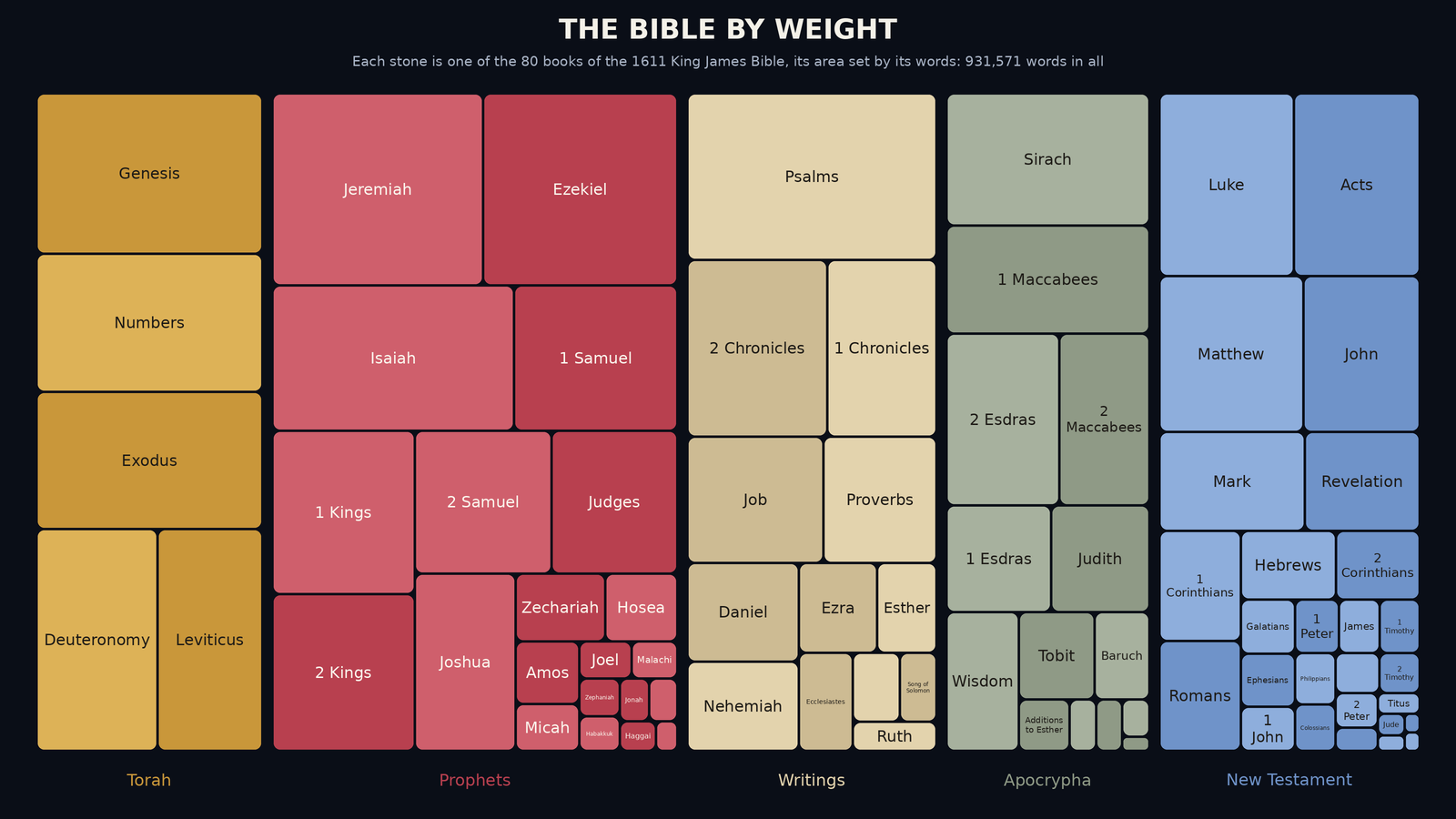
Each stone is one book, with its name on it. The bigger the stone, the more words the book holds. Five columns, one for each part of the Bible, each as wide as its share of all the words.
- Torah
- Prophets
- Writings
- Apocrypha
- New Testament
The grass withereth, the flower fadeth; but the word of our God shall stand forever.Isaiah 40:8 (ASV)
How this picture was made
The text
The 1611 King James Bible with the Apocrypha: 80 books and 36,819 verses. The Apocrypha is the group of 14 books the King James printed between the Old and New Testaments.
What was counted
Every English word. A word is any run of letters between two spaces, so a joined name like Beth-el counts as one word. In all: 931,571 words.
How it was drawn
The area of each stone is its book's word count on a true scale: twice the words, twice the area. Inside each column the stones are laid largest first, so no stone is squeezed thin. Where a stone sits in its column means nothing more. Two shades of each colour keep neighbouring stones apart.
Each stone carries its book's name, as large as the stone allows. Twelve stones are too small for even the smallest letters and carry no name: Nahum, Obadiah, Lamentations, 1 and 2 Thessalonians, Philemon, 2 and 3 John, and four short books of the Apocrypha (Susanna, the Prayer of Azariah, Bel and the Dragon, and the Prayer of Manasses).
What it shows
- Torah: 156,736 words (16.8%). Prophets: 280,882 (30.2%). Writings: 172,707 (18.5%). Apocrypha: 140,678 (15.1%). New Testament: 180,568 (19.4%).
- The largest book is Psalms (43,760 words). The smallest is 3 John (294 words).
What it does not show
It counts English words, not the Hebrew and Greek words underneath. A big stone is not a more important book. It is only a longer one.
-
 Open it large
2The Shape of Scripture
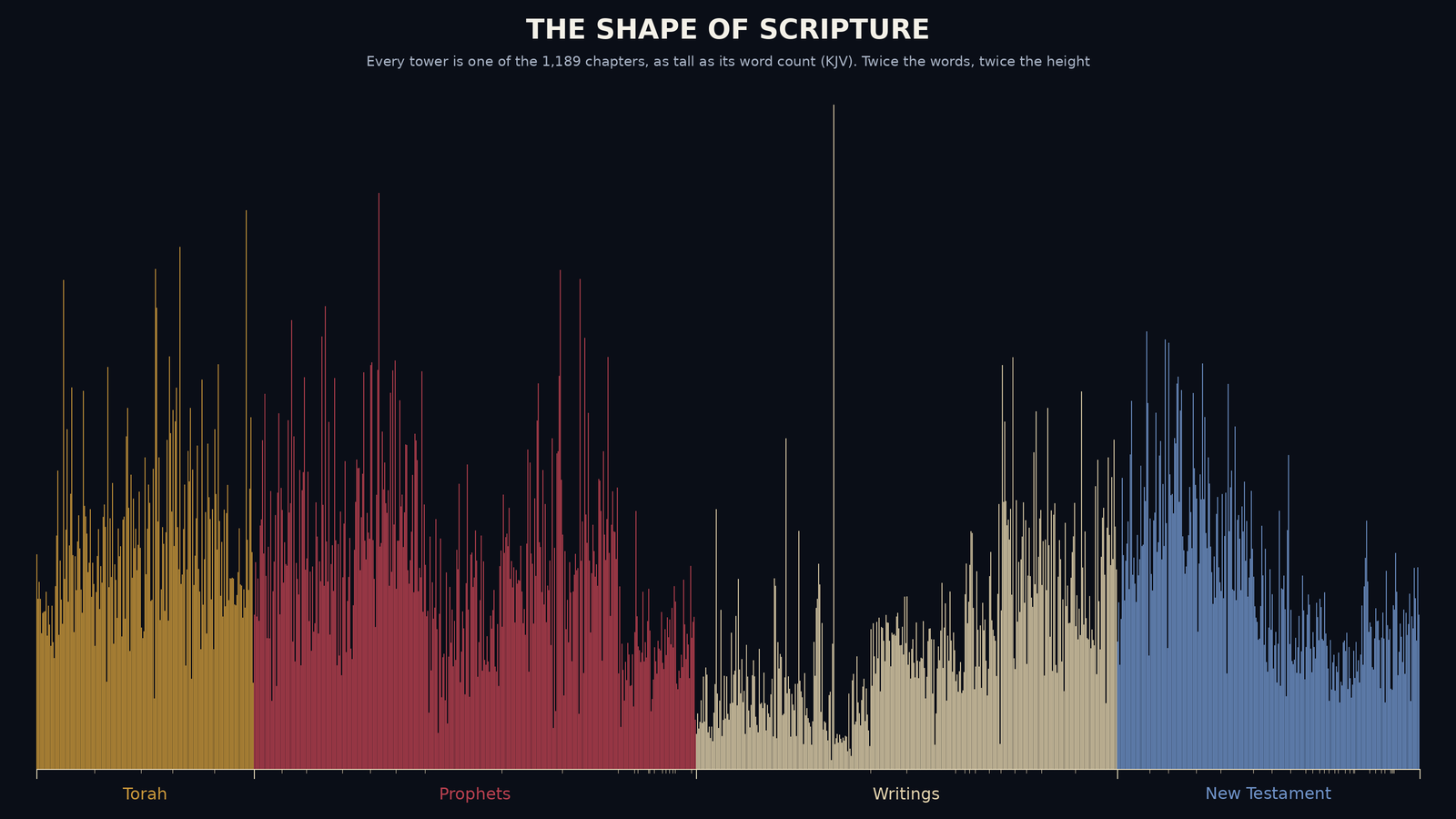
Each thin tower is one chapter. The taller the tower, the more words in that chapter. Read from left to right, the Bible rises and falls like a city skyline.
- Torah
- Prophets
- Writings
- New Testament
O praise Jehovah, all ye nations; Laud him, all ye peoples. For his lovingkindness is great toward us; And the truth of Jehovah endureth for ever. Praise ye Jehovah.Psalm 117, the shortest chapter (ASV)
How this picture was made
The text
The King James Version, 66 books, 1,189 chapters, 31,102 verses.
What was counted
The English words in every chapter (a word is any run of letters between spaces): 790,892 words in all. An average chapter has 665 words.
How it was drawn
The towers stand in Tanakh order: Torah, Prophets, Writings, then the New Testament. Height is on a true scale: a chapter with twice the words stands twice as tall. Small marks on the base line show where each book begins.
What it shows
- The single tall needle is Psalm 119, 2,467 words. Next come 1 Kings 8 (2,139) and Deuteronomy 28 (2,075).
- The shortest chapter is Psalm 117, only 33 words. It is printed above.
- Average chapter length: Torah 838 words, Prophets 739, Writings 477, New Testament 694. The Writings run low because the Psalms are many short chapters.
What it does not show
Chapter breaks were added to the Bible many centuries after it was written. Word counts are English, not Hebrew or Greek.
-
 Open it large
3Every Word a Grain
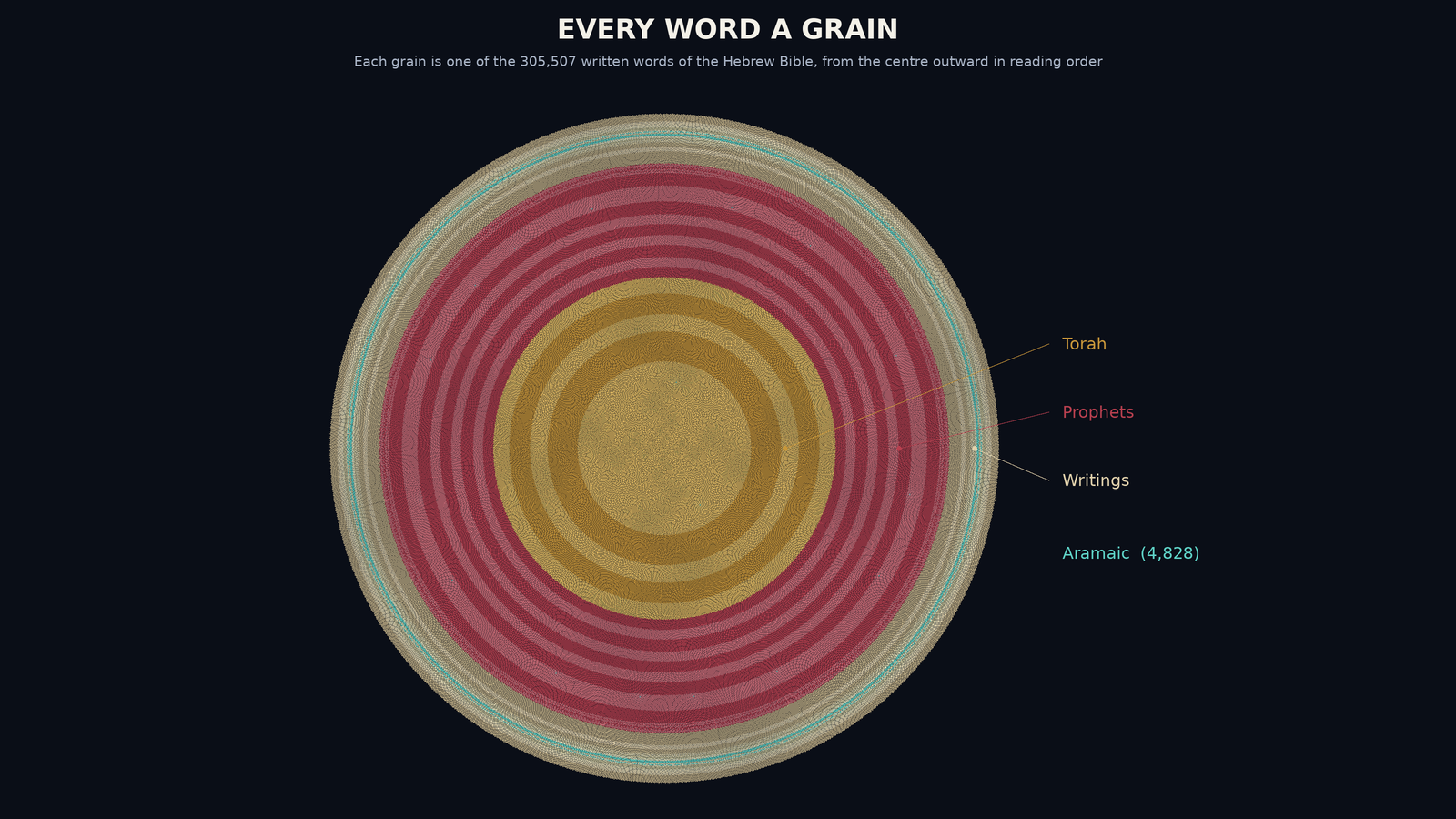
Every written word of the Hebrew Bible is one grain of sand. The first word of Genesis is at the centre, and the last word of Chronicles is at the edge. Each book makes its own ring, like the rings of a tree.
- Torah
- Prophets
- Writings
- Aramaic
How precious also are thy thoughts unto me, O God! How great is the sum of them! If I should count them, they are more in number than the sand: When I awake, I am still with thee.Psalm 139:17-18 (ASV)
How this picture was made
The text
The Hebrew Bible as kept in the Leningrad Codex (the oldest complete Hebrew Bible), from the Open Scriptures Hebrew Bible. Every word in it is marked as Hebrew or Aramaic.
What was counted
Every written word: 305,507. A word is counted as it is written, with any small joined parts (such as "and" or "the") as part of it. Readings written in the margin are left out.
How it was drawn
The grains are laid on a sunflower spiral in reading order, Tanakh order. Every grain takes the same space, so each ring is as wide as its words. Aramaic words shine in their own colour.
What it shows
- Torah 79,982 words (26.2%), Prophets 141,513 (46.3%), Writings 84,012 (27.5%).
- 4,828 words are Aramaic (1.58%): Daniel 3,599, Ezra 1,212, Jeremiah 15 (Jeremiah 10:11), and Genesis 2 (Genesis 31:47). Look for the small speck in the gold centre and the one in the crimson ring.
What it does not show
A grain does not show which word it is. The spiral only keeps the order.
-
 Open it large
4Every Greek Word a Grain
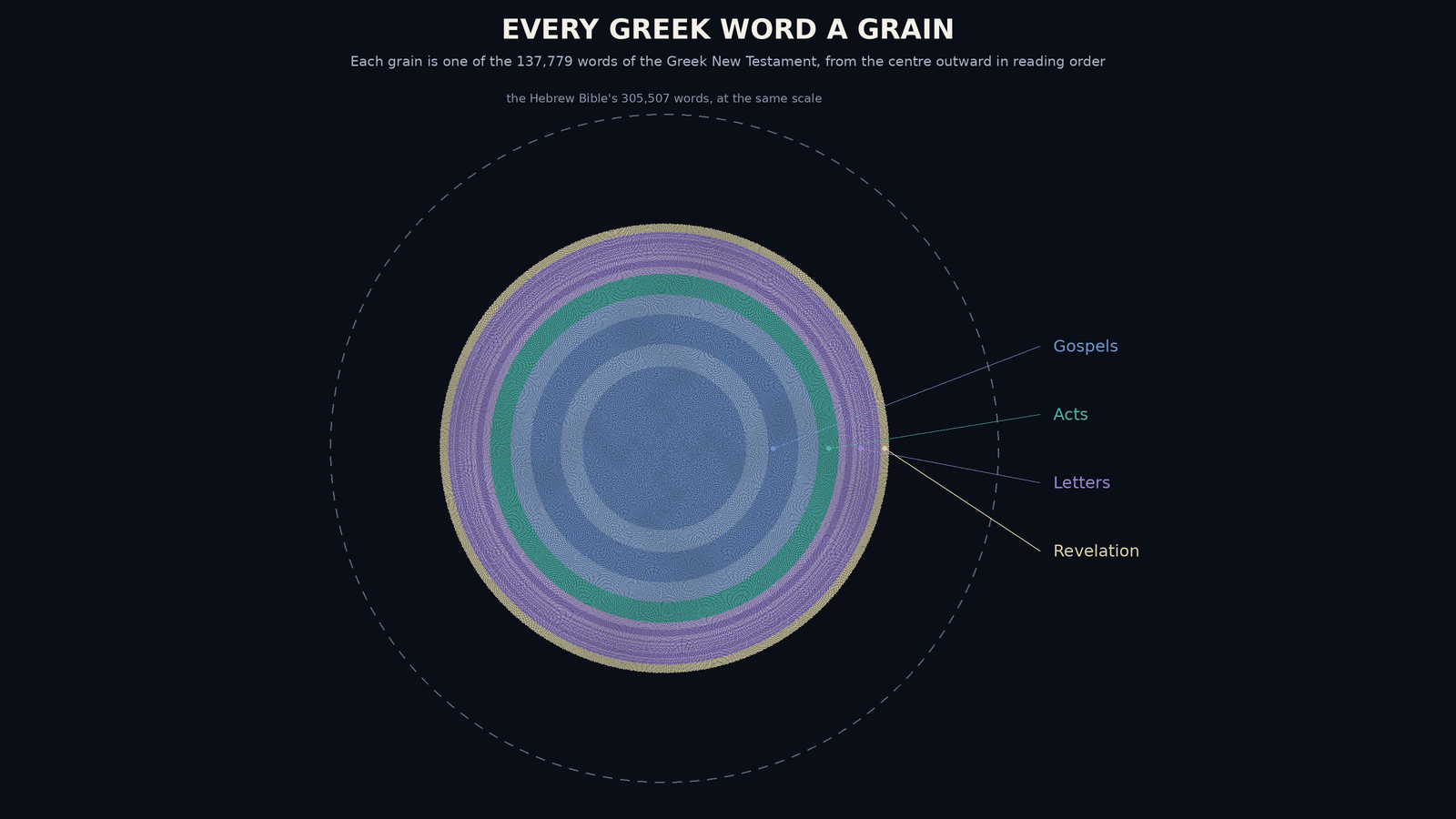
The same picture for the New Testament. Every Greek word is one grain, the same size as in the Hebrew picture. The dashed ring shows how big the Hebrew Bible would be at this same scale.
- Gospels
- Acts
- Letters
- Revelation
And there are also many other things which Jesus did, the which if they should be written every one, I suppose that even the world itself would not contain the books that should be written.John 21:25 (ASV)
How this picture was made
The text
The Greek New Testament, Nestle 1904 edition, one word per line.
What was counted
Every Greek word: 137,779. The Hebrew Bible has 305,507, so the New Testament is about 45 in every 100 of its size.
How it was drawn
Exactly as Every Word a Grain: a sunflower spiral from Matthew at the centre to Revelation at the edge. Each grain takes exactly the same space as in the Hebrew picture, so the two can be laid side by side. These four colours mark parts of the New Testament, not the sections used in the other pictures.
What it shows
- Gospels 64,675 words (46.9%), Acts 18,393 (13.3%), Letters, Romans to Jude, 44,879 (32.6%), Revelation 9,832 (7.1%).
What it does not show
Greek and Hebrew build words differently, so a word count is only a rough measure of size between the two.
-
 Open it large
5Threads of Scripture
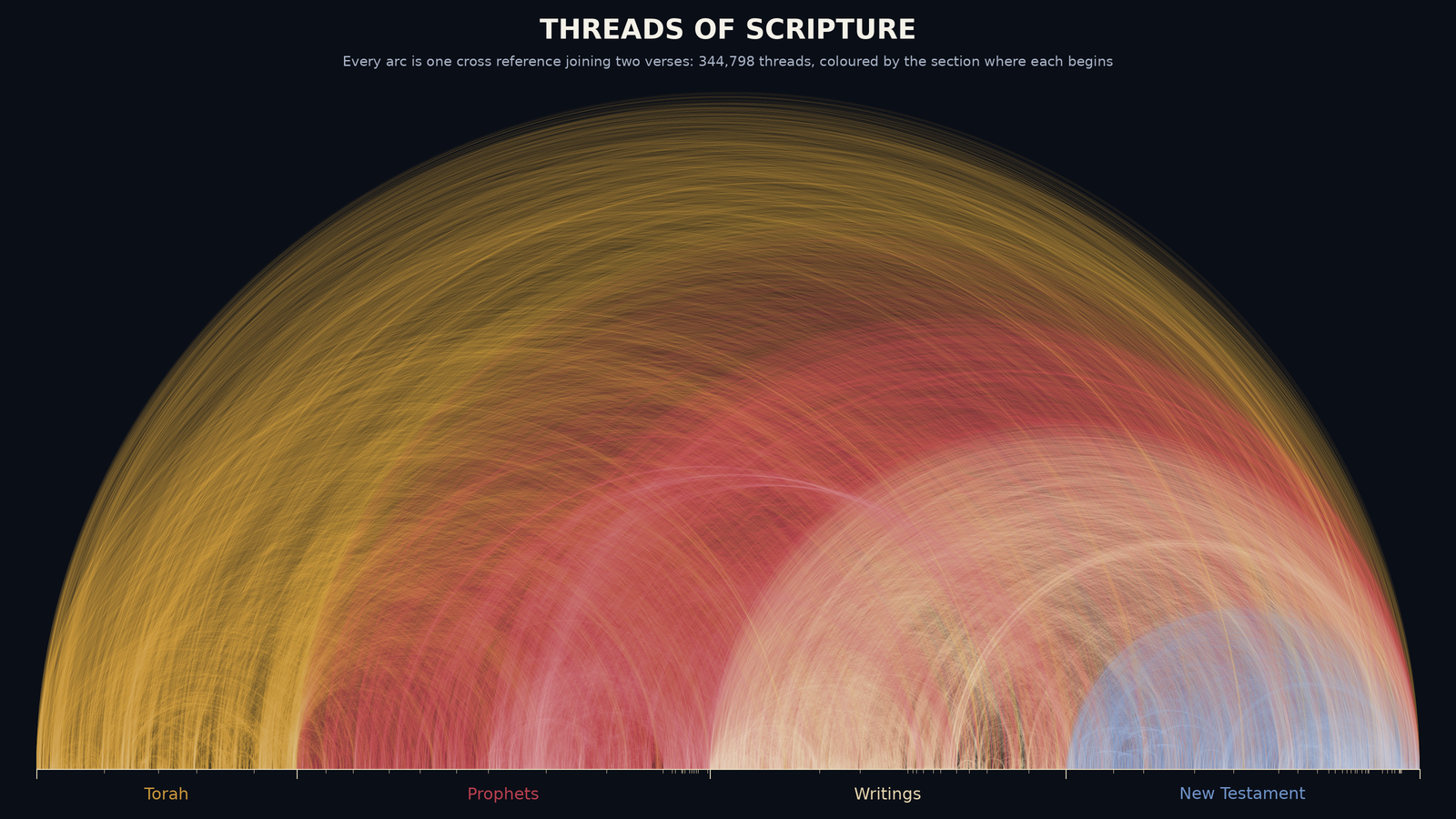
Every verse of the Bible sits on one line, from Genesis on the left to Revelation on the right. Each arc joins two verses that a cross reference links together.
- Torah
- Prophets
- Writings
- New Testament
The sum of thy word is truth; And every one of thy righteous ordinances endureth for ever.Psalm 119:160 (ASV)
How this picture was made
The links
A list of 344,799 cross references from OpenBible.info. A cross reference is a note that one verse is related to another. People suggested these links, and readers voted on them. They are human judgements, not part of the Bible.
How it was drawn
The 31,102 verses sit in Tanakh order: Torah, Prophets, Writings, then the New Testament. Each link is one arc. 344,798 arcs are drawn. One link was left out because 3 John 1:15 is not a verse in the King James numbering. Each arc takes the colour of the section where its left end starts. Where many arcs cross, the light builds up and mixes their colours.
What it shows
- Arcs starting in the Torah: 69,462 (20.1%). Prophets: 124,682 (36.2%). Writings: 66,286 (19.2%). New Testament: 84,368 (24.5%).
- 73,313 arcs join the Hebrew Scriptures and the New Testament. The next picture shows those alone.
What it does not show
It does not say how two verses are related, or whether a link is strong or weak. Every link is drawn the same.
-
 Open it large
6The Bridge
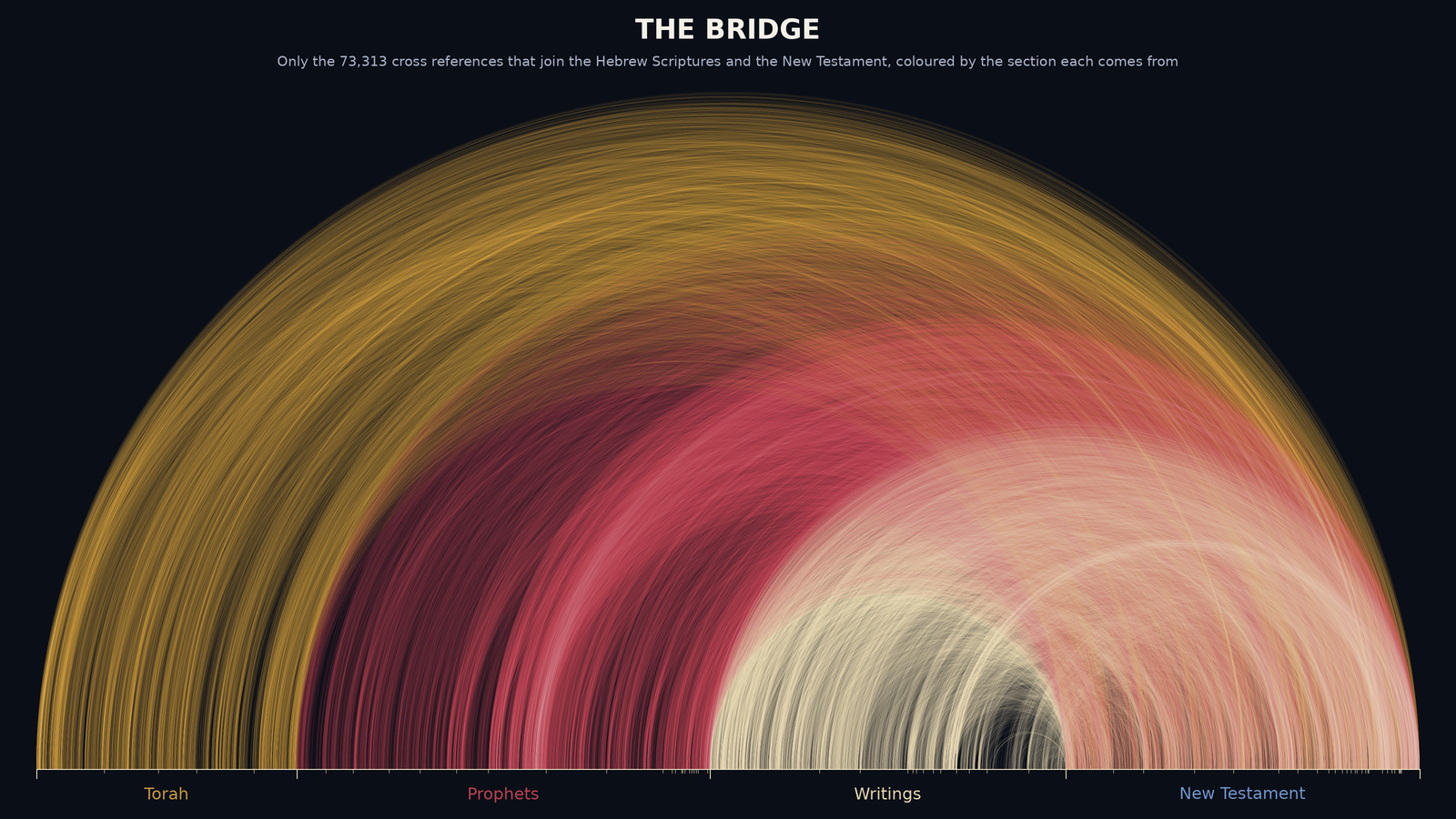
Only the cross references that join the Hebrew Scriptures to the New Testament. Each arc starts in the Torah, the Prophets or the Writings and lands in the New Testament.
- Torah
- Prophets
- Writings
For whatsoever things were written aforetime were written for our learning, that through patience and through comfort of the scriptures we might have hope.Romans 15:4 (ASV)
How this picture was made
The links
The same OpenBible.info list as Threads of Scripture. Of the 344,798 links, 73,313 (21.3%) join the two Testaments. Only those are drawn. Every link inside one Testament is left out.
How it was drawn
The same line of verses and the same way of drawing as Threads of Scripture. Each arc is coloured by the Hebrew section it comes from.
What it shows
- From the Torah: 14,853 (20.3%). From the Prophets: 30,422 (41.5%). From the Writings: 28,038 (38.2%).
- The Hebrew books most linked to the New Testament are Psalms (12,500), Isaiah (9,359) and Genesis (4,483).
- The New Testament books they land in most are Matthew (9,519), Luke (8,370), Acts (7,625) and Revelation (7,277). Hebrews takes 5,061, a lot for its size.
What it does not show
It does not show which links are quotations and which are only echoes or shared ideas. All are drawn alike.
-
 Open it large
7Book Meets Book
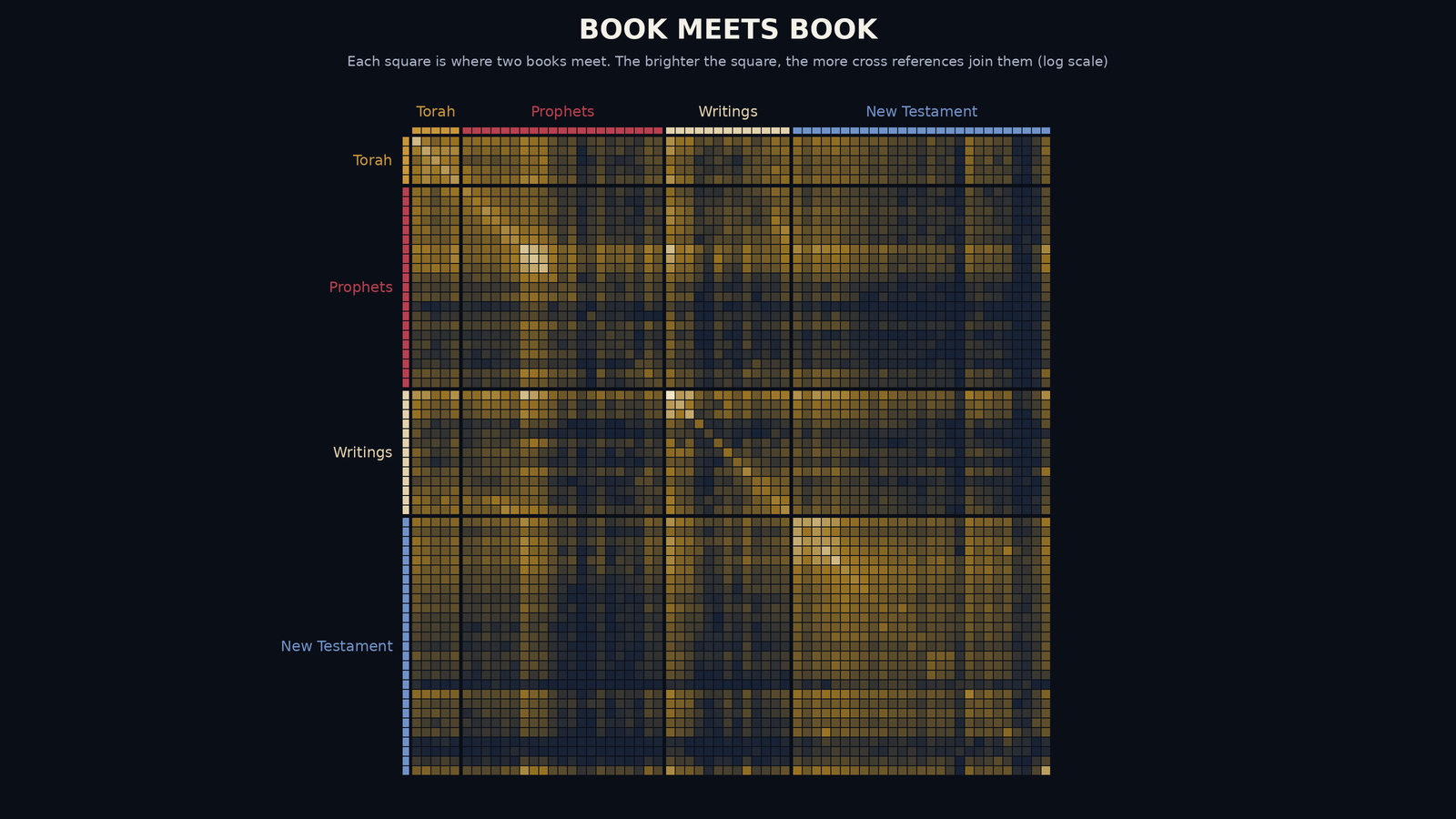
Each book has one row and one column. The square where two books meet is lit by how many cross references join them. The brighter the square, the more links.
- Torah
- Prophets
- Writings
- New Testament
Seek ye out of the book of Jehovah, and read: no one of these shall be missing, none shall want her mate; for my mouth, it hath commanded, and his Spirit, it hath gathered them.Isaiah 34:16 (ASV)
How this picture was made
The links
The same OpenBible.info list as Threads of Scripture: 344,798 links. A link is counted once and shown in both matching squares, so the grid is the same on both sides of the diagonal.
How it was drawn
Rows and columns run in Tanakh order. The diagonal line from top left to bottom right is each book meeting itself: links that stay inside one book. Brightness is on a log scale, where each step brighter means many times more links. This is needed because the busiest square holds 11,648 links and the quietest hold 1. Coloured strips on the edges mark the sections.
What it shows
- 80,126 links stay inside one book. 264,672 join two different books.
- The brightest square is Psalms with itself (11,648). The busiest pair of different books is Isaiah and Psalms (4,547), then Isaiah and Jeremiah (3,466), then Matthew and Luke (3,186).
- Of the 2,145 possible pairs of books, only 109 share no link at all.
What it does not show
Because of the log scale, a square a little brighter can hold many times more links. Read the brightness as "more" or "less", not as an exact amount.
-
 Open it large
8Places of Scripture
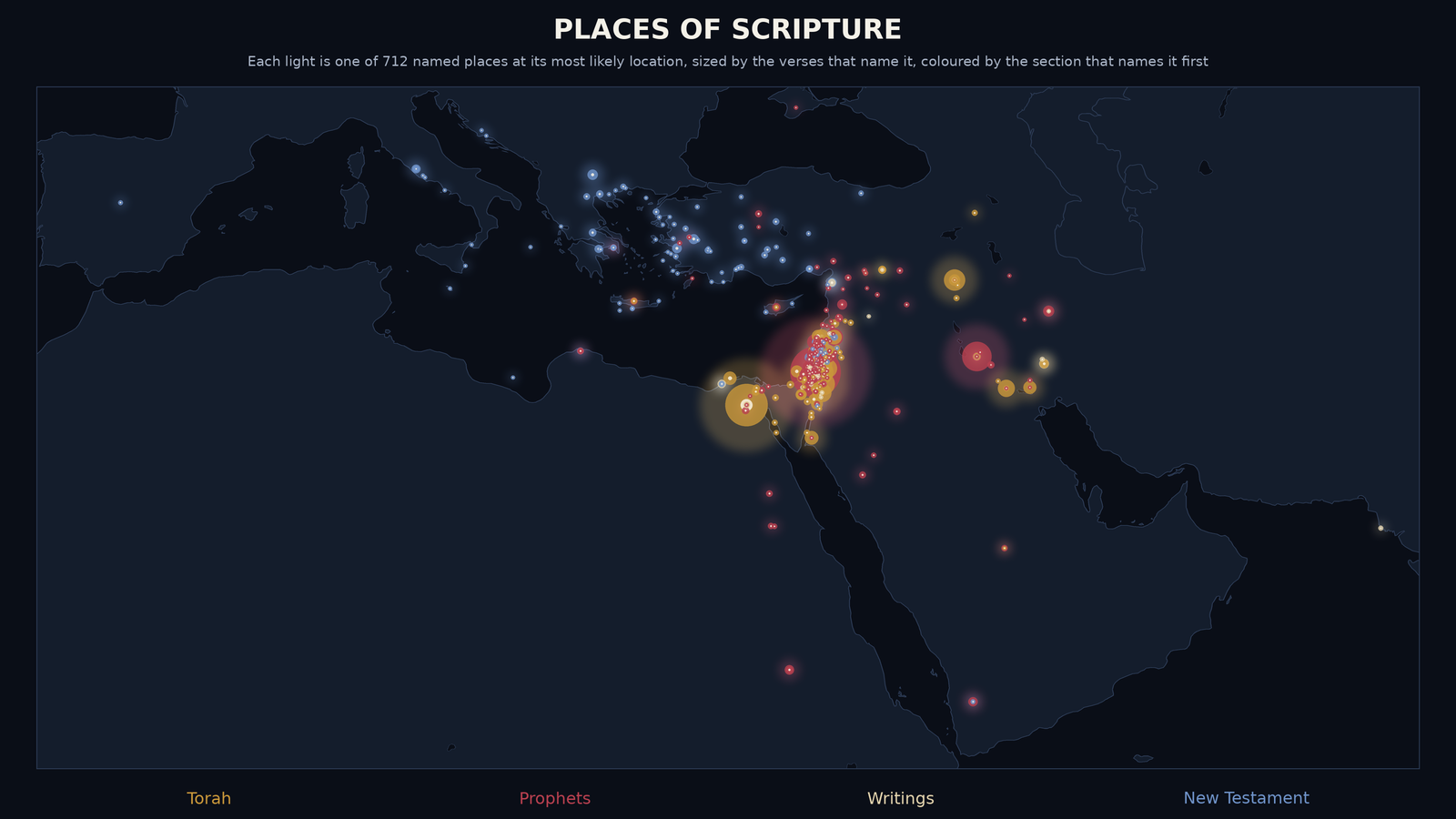
Each light is one place named in the Bible, set at its most likely location. The bigger the light, the more verses name that place. Its colour is the section of the Bible that names it first.
- Torah
- Prophets
- Writings
- New Testament
Arise, walk through the land in the length of it and in the breadth of it; for unto thee will I give it.Genesis 13:17 (ASV)
How this picture was made
The places
OpenBible.info's Bible Geocoding Data lists 1,342 places named in the Bible. For each place it lists every location that scholars have proposed, with a score out of 1,000 for how confident scholarship is. 500 or more means at least 50% confident.
What was kept
- Only the best location for each place, and only if it scores 500 or more: 712 places.
- Left off: 566 places whose best location is less certain, 57 places with no verse in the 66 books, and 7 with no location proposed.
How it was drawn
The land is the coastline only: no borders and no modern names. The area of each light grows with the number of verses that name the place. Colour is the section that names it first, reading in Tanakh order.
What it shows
- The places named in the most verses are Jerusalem (955), Egypt (658), Babylon (296) and the Jordan (202).
- Torah 146 places, Prophets 377, Writings 73, New Testament 116. The blue lights reach west across Asia Minor, Greece and Italy.
What it does not show
Where scholars are unsure, the place is left off rather than guessed. Journeys and borders are not drawn.
-
 Open it large
9People of Scripture
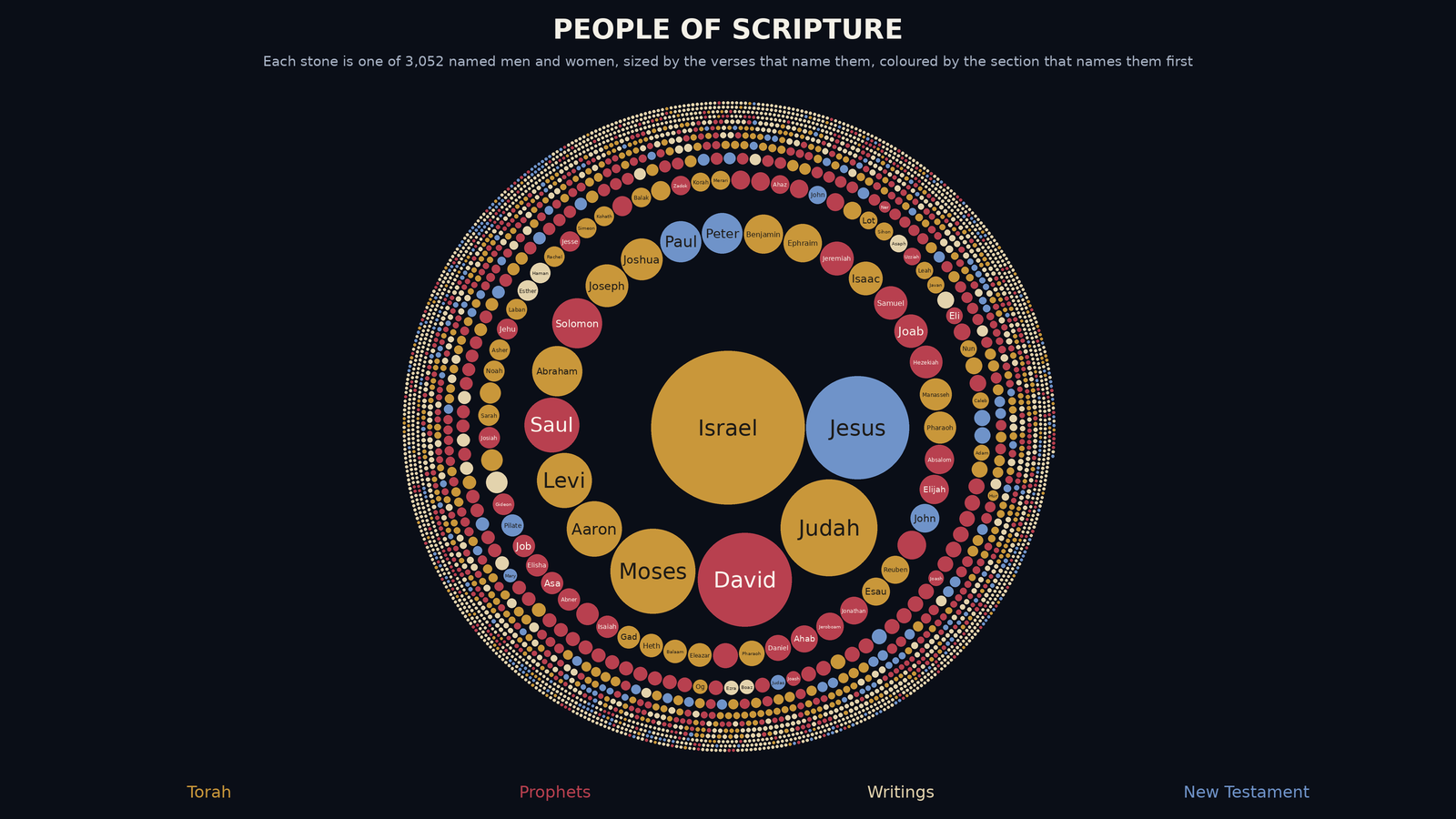
Each stone is one man or woman named in the Bible. The bigger the stone, the more verses name that person. The largest sit at the centre, and thousands of small ones wind outward. Where a name fits inside its stone, it is written there.
- Torah
- Prophets
- Writings
- New Testament
But now thus saith Jehovah that created thee, O Jacob, and he that formed thee, O Israel: Fear not, for I have redeemed thee; I have called thee by thy name, thou art mine.Isaiah 43:1 (ASV)
How this picture was made
The people
STEPBible's list of every person named in the Bible (TIPNR, from Tyndale House, Cambridge). It tells apart people who share a name, so two different men called Zechariah are two stones. 3,052 men and women are drawn: 2,853 men and 199 women. Groups, tribes and places are left out.
What was counted
The verses that name each person, from STEPBible's full lists. 19 references were left out: 18 found only in the Greek Old Testament, and 1 written wrongly in the source.
How it was drawn
The area of each stone is its number of verses, on a true scale. No stone touches another. Colour is the section that first names the person, in Tanakh order. One rule: where STEPBible files another name under a person, and that name's verses all lie in the other Testament, those verses do not set the colour. This touches only one stone. Immanuel (Isaiah 7:14, 8:8) is filed under Jesus, so Jesus is coloured from the first verse that names him as Jesus or Christ (Matthew 1:1).
What it shows
- 1,702 people, more than half, are named in only one verse.
- The largest stones are Israel (2,578 verses), Jesus (1,160), Judah (1,022), David (964) and Moses (785).
- Most of the outer ring is parchment, the Writings. 1,662 people are first named there, mostly in the family lists of 1 Chronicles.
Names on the stones
A name is written on its stone only where it fits inside the circle. 81 stones carry a name. The rest are too small for lettering that can be read.
What it does not show
STEPBible files the people of Israel under the man Israel (Jacob), and does the same for Judah and Levi. So those stones include verses where the name means the whole people descended from them.
-
 Open it large
10The Name as Light
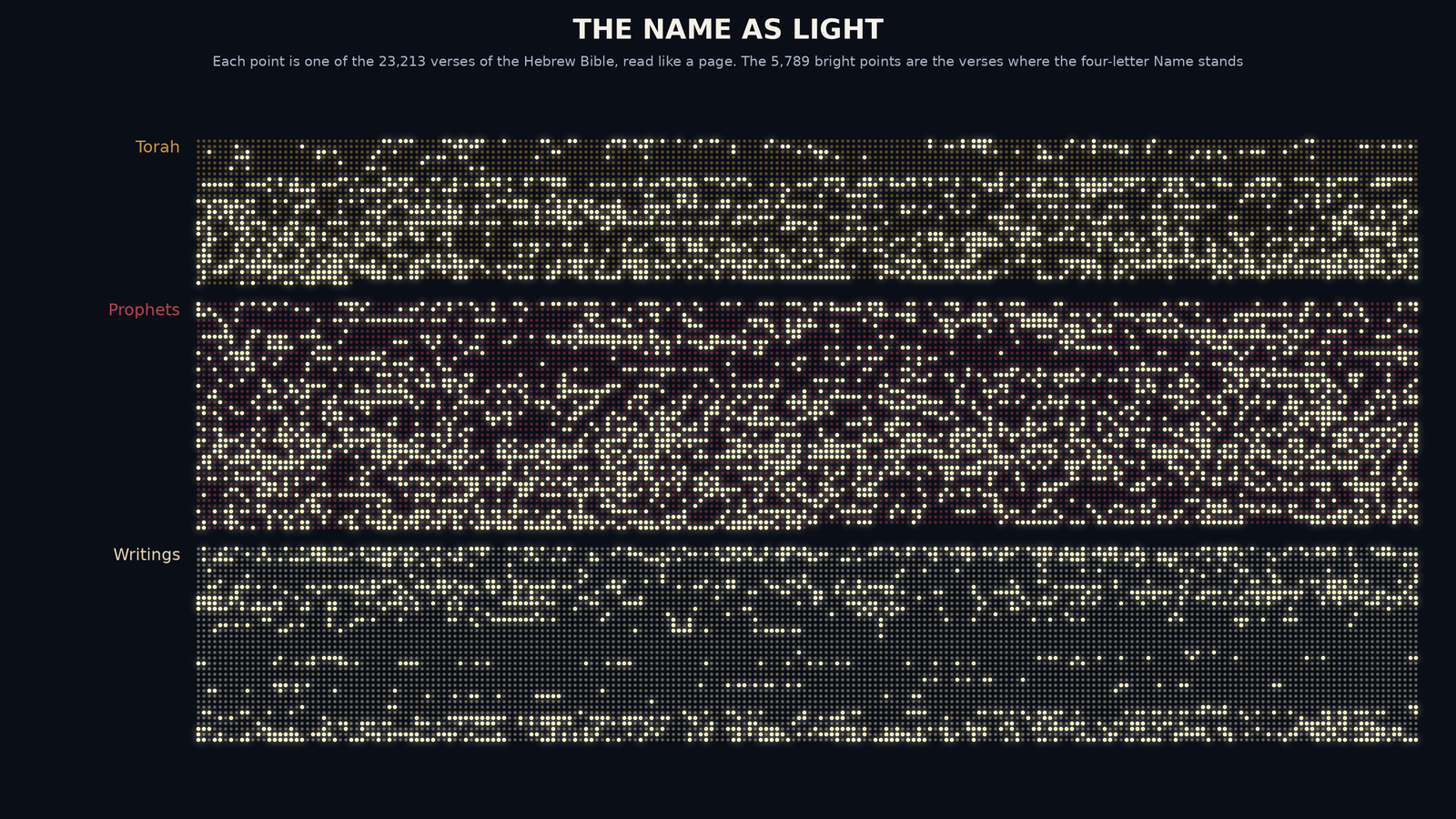
Every verse of the Hebrew Bible is one point, read like a page from left to right. A point shines where God's four-letter Name stands in that verse.
- Torah
- Prophets
- Writings
- the Name stands here
And God said moreover unto Moses, Thus shalt thou say unto the children of Israel, Jehovah, the God of your fathers, the God of Abraham, the God of Isaac, and the God of Jacob, hath sent me unto you: this is my name for ever, and this is my memorial unto all generations.Exodus 3:15 (ASV)
How this picture was made
The text
The Leningrad Codex, from the Open Scriptures Hebrew Bible, where every Hebrew word is tagged with its dictionary entry.
What was counted
Every word tagged as the four-letter Name (Strong's numbers H3068 and H3069). The short form Yah is not counted. It stands 50 times and is reported separately. Only the written text is read, and no Name stands in the margin readings.
How it was drawn
23,213 verses in Tanakh order, each section a block of its own. Dim points carry their section's colour. Bright points are verses where the Name stands.
What it shows
- The Name stands 6,827 times, in 5,789 verses: about one verse in four.
- The Prophets are brightest (31.6% of verses), then the Torah (26.6%), then the Writings (16.0%).
- Jeremiah holds the Name most often (726), then the Psalms (695) and Deuteronomy (550).
- It never stands in three books: Song of Songs, Ecclesiastes and Esther. Look for the dark stretch in the Writings.
What it does not show
It does not show God's other names and titles, such as God, Lord or Most High. Only the four-letter Name is lit.
-
 Open it large
11The Name in the Reading Bibles
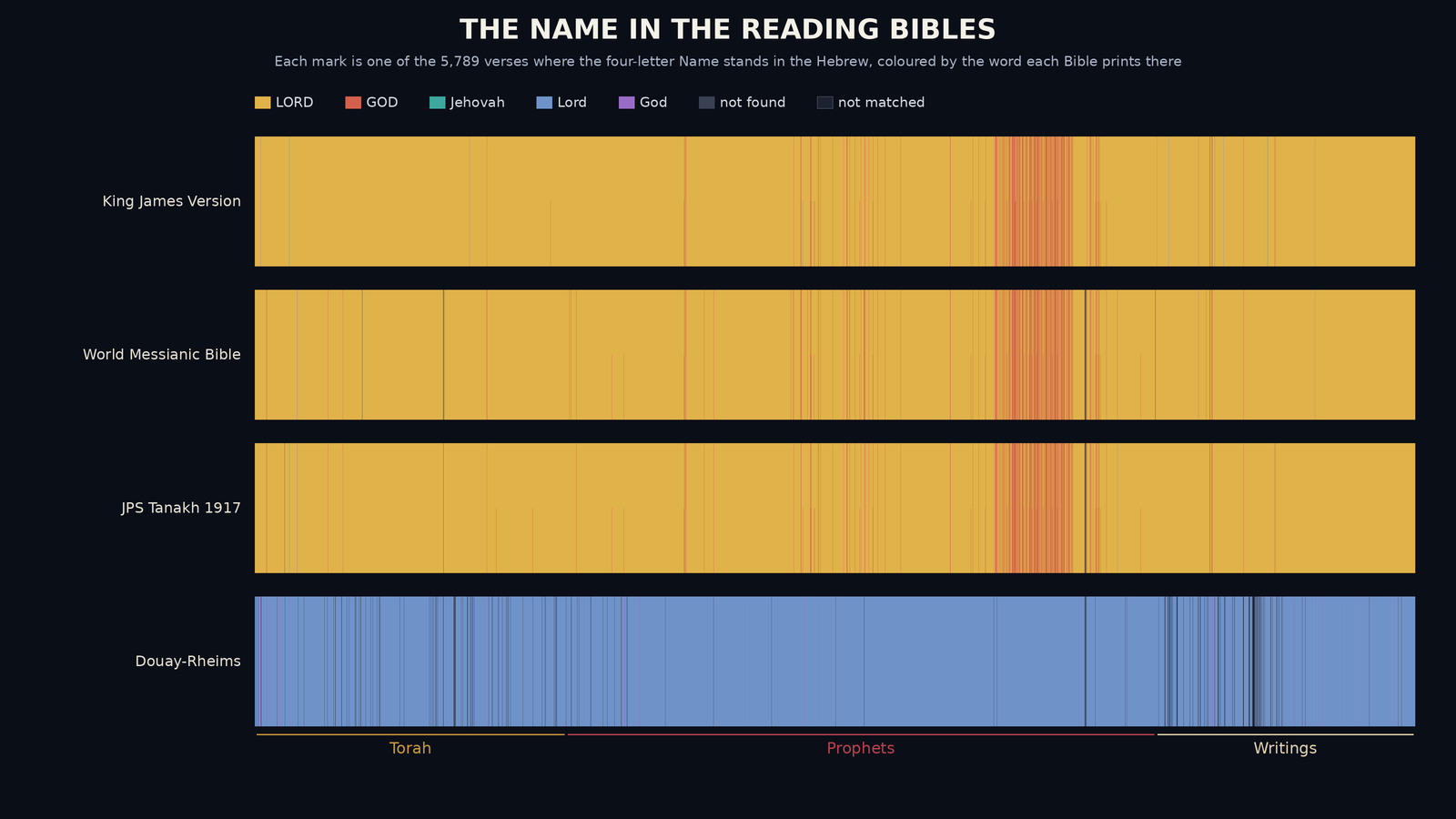
One band for each reading Bible. Each thin mark is one verse where the four-letter Name stands in the Hebrew. Its colour is the word that Bible prints in that verse.
- LORD
- GOD
- Jehovah
- Lord
- God
- not found
- not matched
and I appeared unto Abraham, unto Isaac, and unto Jacob, as God Almighty; but by my name Jehovah I was not known to them.Exodus 6:3 (ASV)
How this picture was made
The verses
The same 5,789 verses that shine in The Name as Light.
The Bibles
The King James Version, the World Messianic Bible, the JPS Tanakh 1917 and the Douay-Rheims. The ASV, which prints Jehovah, is not one of the bands.
How each verse was read
- Hebrew and English Bibles number some verses differently. A published table (from the Open Scriptures Hebrew Bible) turns each Hebrew number into the English one.
- Each Bible's verse is checked against the King James wording. Where the numbers disagree, nearby chapters are searched for the matching verse.
- A verse is marked by the words it holds: LORD or GOD in capitals first, otherwise Lord, otherwise God.
- "Not matched" means the verse is missing from the source file. All three files left out Joel 2:28-32 and Malachi 4, and the Douay-Rheims file lost some Psalm verses.
What it shows
- King James: LORD 5,515, GOD 289, JEHOVAH 4. World Messianic Bible: LORD 5,496, GOD 304. JPS 1917: LORD 5,508, GOD 299.
- The coral GOD marks gather in Ezekiel, where the Hebrew often reads "Lord GOD".
- The Douay-Rheims follows the Latin and prints Lord: 5,512 verses.
What it does not show
It reads whole verses, not single words. A verse that holds both LORD and Lord is marked by its capitals.
-
 Open it large
12Four Words, Start to Finish
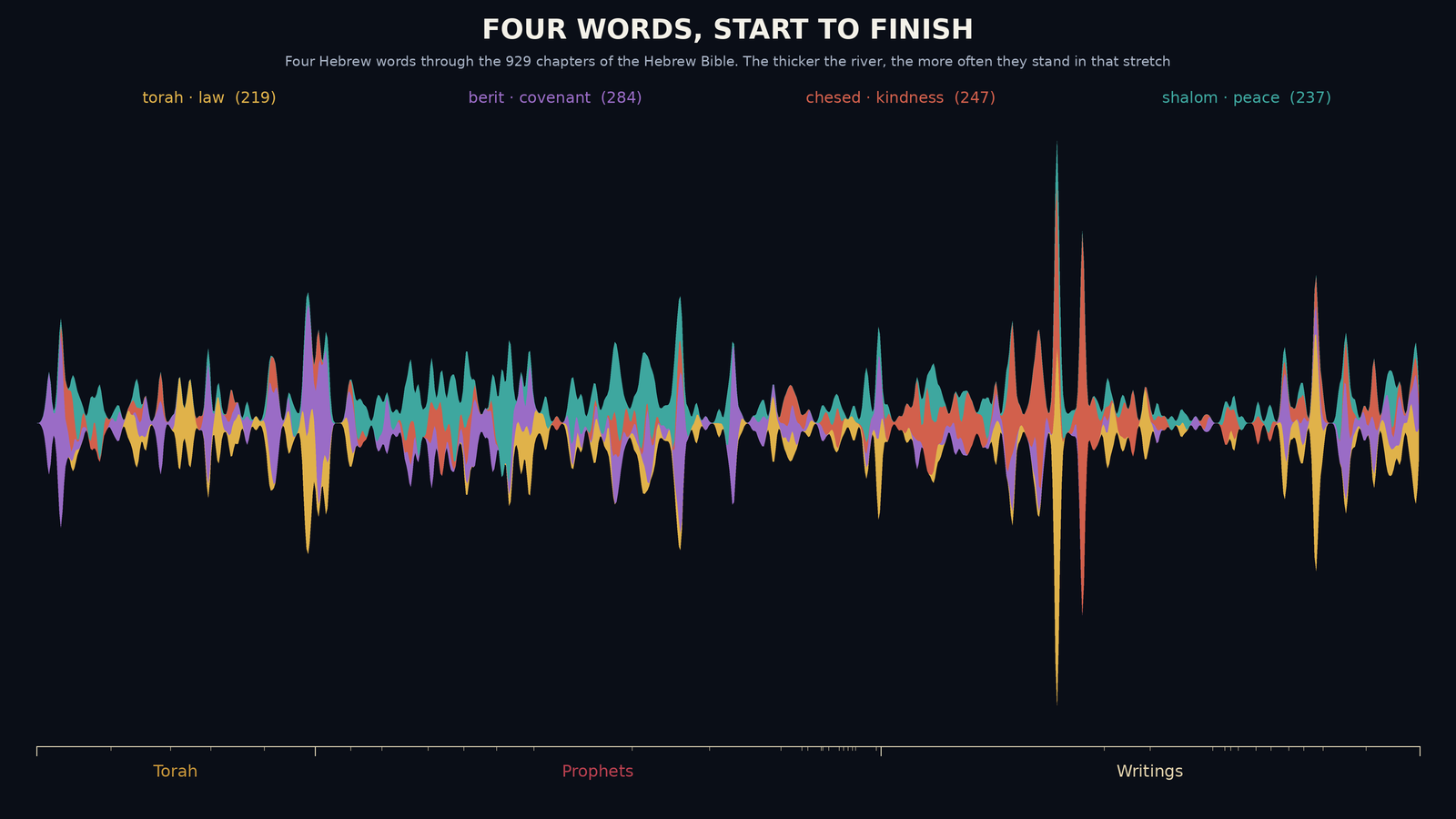
Four Hebrew words flow as one river through every chapter of the Hebrew Bible. The thicker the river, the more often the words stand in that stretch. Each word is its own colour.
- torah: law
- berit: covenant
- chesed: kindness
- shalom: peace
Oh give thanks unto Jehovah; for he is good; For his lovingkindness endureth for ever.Psalm 136:1. The word lovingkindness here is chesed (ASV)
How this picture was made
The text
The Leningrad Codex, from the Open Scriptures Hebrew Bible, with every word tagged with its dictionary entry. Each word's meaning was checked against the Open Scriptures Hebrew dictionary, so no word is named from memory.
What was counted
torah (law, teaching) 219 times. berit (covenant) 284. chesed (kindness, often printed lovingkindness) 247. shalom (peace) 237. All counted in each of the 929 chapters.
How it was drawn
Chapters run left to right in Tanakh order. Thickness is on a true scale: every use adds the same width. Each chapter's count is spread a little over its neighbours so the river flows, but every word's total stays exact. That smoothing lowers the sharpest single-chapter peaks.
What it shows
- Psalm 119 holds torah 25 times. Psalm 136 holds chesed 26 times, once in every verse.
- berit gathers in the Torah, most in Genesis 17 (13 times). shalom runs strongest through the Prophets (157 of 237). chesed belongs mostly to the Writings (173 of 247).
- 518 chapters hold none of the four words.
What it does not show
A word can mean different things in different places. The river counts where the word stands, not what it means there.
-
 Open it large
13Words Found Only Once
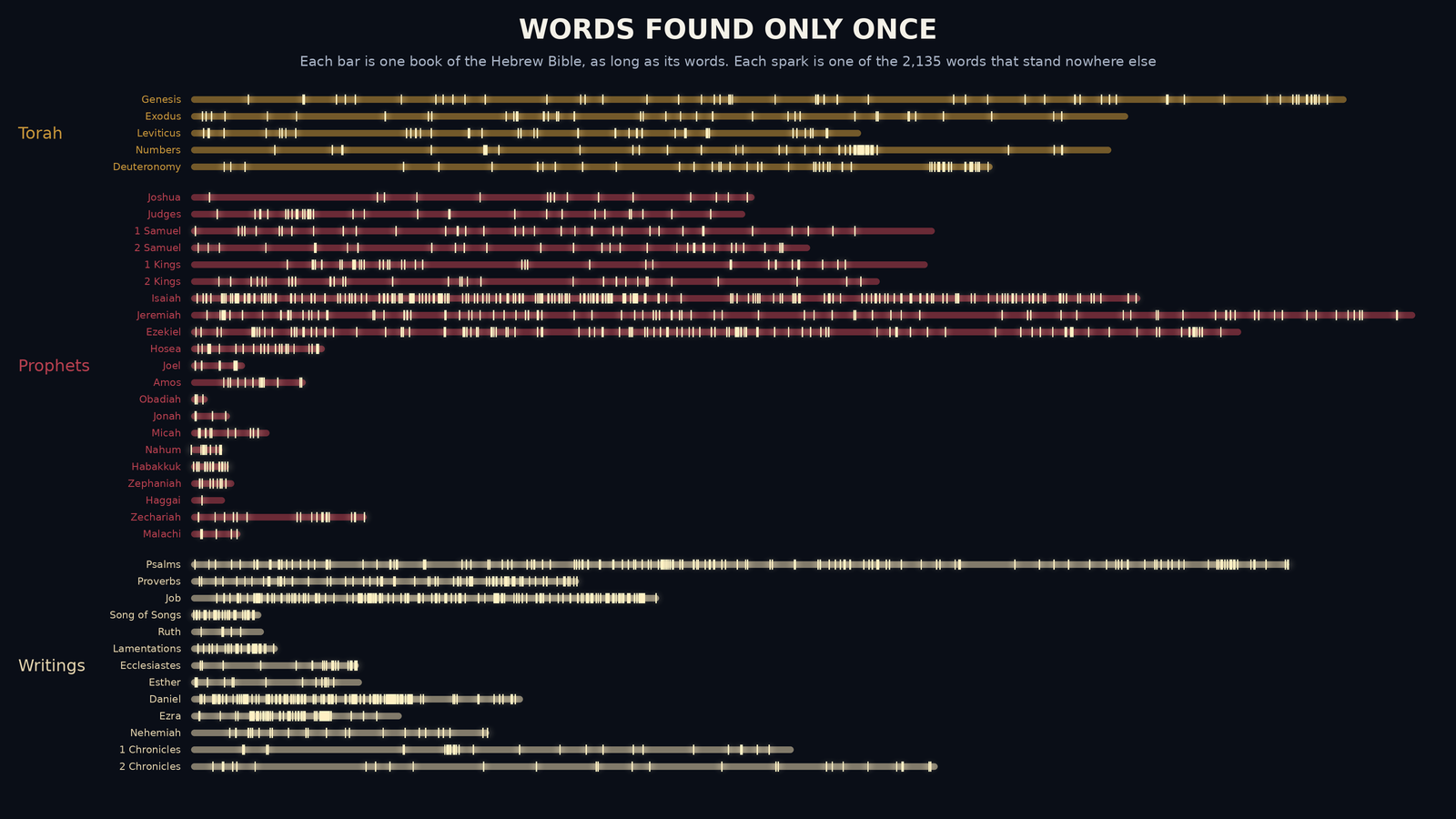
Each bar is one book of the Hebrew Bible, as long as its words. Each spark is a word that stands in that one place and nowhere else in the whole Hebrew Bible.
- Torah
- Prophets
- Writings
- a word found only once
It is the glory of God to conceal a thing; But the glory of kings is to search out a matter.Proverbs 25:2 (ASV)
How this picture was made
The text
The Leningrad Codex, from the Open Scriptures Hebrew Bible, where every word is tagged with its dictionary entry.
What was counted
A dictionary entry that stands in exactly one place in the written text. The small joined parts of a word (such as "and" or "the") are not counted. Names used once are not sparks, since a man named once is not a rare word. They are counted apart: 1,120 names.
How it was drawn
Bars are in Tanakh order and drawn to one scale, so a longer bar is a longer book.
What it shows
- 9,504 dictionary entries are used. 2,135 words stand only once.
- Sparks per 1,000 words: Torah 3.9, Prophets 6.2, Writings 11.4.
- The thickest books are Song of Songs (35.2 per 1,000 words), Daniel (32.8), Nahum (28.7), Habakkuk (25.3), Ezra (23.7) and Job (22.2). Isaiah has the most sparks of any book (271).
- 252 of the sparks are Aramaic words. Aramaic has its own dictionary entries and is a small part of the text, which is one reason Daniel and Ezra shine.
What it does not show
Scholars usually count rare words by their root, and that count is lower. This picture uses the tags in the text, which split some words into separate entries.
-
 Open it large
14The Year of Portions
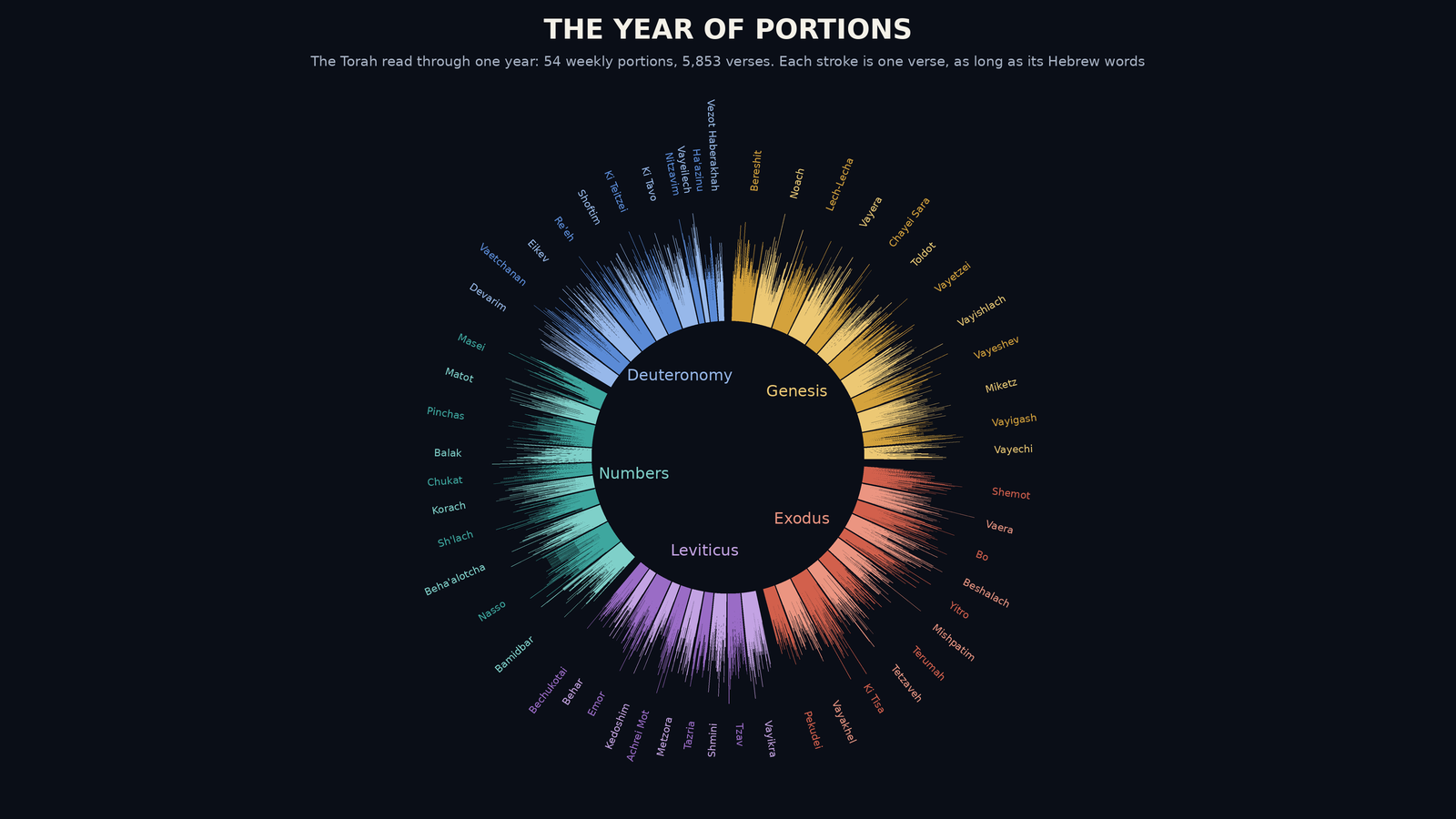
The five books of the Torah go once around a ring, the way they are read through one year in the synagogue. The ring is cut into the 54 weekly portions. Each stroke is one verse, as long as its Hebrew words.
- Genesis
- Exodus
- Leviticus
- Numbers
- Deuteronomy
And they read in the book, in the law of God, distinctly; and they gave the sense, so that they understood the reading.Nehemiah 8:8 (ASV)
How this picture was made
The portions
The 54 weekly Torah portions and their verse ranges, from Hebcal. Each portion runs from the first verse of its first reading to the last verse of its seventh. The names are spelled as Hebcal spells them.
What was counted
The Hebrew words in every verse of the Torah, from the Leningrad Codex: 5,853 verses and 79,982 words.
How it was drawn
The ring runs clockwise from the top. Stroke length is on a true scale: twice the words, twice the length. Each book has its own colour, and neighbouring portions take two shades of it. In this picture the colours mark the five books, not the sections used in the other pictures. One numbering fix: the Hebrew text numbers the Ten Words in Exodus 20 as more verses than the list does, so Exodus 20:24-26 are read with Yitro, where they belong.
What it shows
- The largest portion is Nasso: 176 verses and 2,266 words, including the long, repeated offerings of Numbers 7.
- The portion with the fewest verses is Vayeilech (30). The one with the fewest words is Vezot Haberakhah (512).
What it does not show
It does not show the years when portions are joined together, or the readings from the Prophets read with each portion.
Where the data comes from
Every picture was drawn by a small program that reads open data and writes a report of its counts. Every number on this page comes from those reports.
- Bible texts: King James Version, King James with Apocrypha, American Standard Version, JPS Tanakh 1917, World Messianic Bible and Douay-Rheims, all public domain.
- Hebrew text: Open Scriptures Hebrew Bible, from the Westminster Leningrad Codex (CC BY 4.0). Hebrew dictionary: Open Scriptures Hebrew Lexicon (CC BY 4.0).
- Greek text: Nestle 1904 Greek New Testament (public domain), word tags by biblicalhumanities.org (CC0).
- Cross references: OpenBible.info (CC BY).
- Places: OpenBible.info Bible Geocoding Data (CC BY 4.0). Coastline: Natural Earth (public domain).
- People: STEPBible.org TIPNR, Tyndale House, Cambridge (CC BY 4.0).
- Torah portions: Hebcal (BSD licence).
The full list is on the Sources & credits page.