The Tabernacle

The tent God told Moses to build in the desert, so that he could dwell among his people. This page walks through it from the gate to the ark: what each part was made of, how big it was, what was done there, and the verses that describe it.

Pick a part, then a piece.

Each card gives the English name the American Standard Version (ASV) prints, the Hebrew or Greek word with how to say it, what Exodus, Leviticus and Numbers say about it, its size in cubits and in today’s measures, and the verses. Modern sizes are ranges, because the length of the cubit is not known exactly. The pictures are artist’s renditions: no picture of the tabernacle survives.

Part I

The whole tabernacle

What it was, who built it, its plan and its place in the camp.

After God brought Israel out of Egypt, he told Moses at Mount Sinai to have the people build a tent where he would dwell among them. For the next forty years in the desert, and for centuries after they entered the land, this tent was the centre of Israel’s worship. Exodus gives its plan in great detail, twice: first as God’s instructions to Moses (chapters 25 to 31), then as the record of the work being done (chapters 35 to 40).

This page walks through it the way a visitor would, from the outside in: the camp, the courtyard and its gate, the bronze altar and basin, the tent itself, the Holy Place with its three pieces of gold furniture, and the Most Holy Place with the ark. It ends with the priests, how the tabernacle was carried, and what became of it.

A note on the pictures: no drawing or photograph of the tabernacle survives. Exodus gives many exact sizes and materials but does not describe everything, such as the faces of the cherubim or the patterns on the cloth. Every picture here is an artist’s rendition: what the Bible states is shown as stated, and the rest is the artist’s choice.

What the tabernacle wasHebrew מִשְׁכָּן said meesh-KAHN “dwelling” · Hebrew אֹהֶל said OH-hel “tent” Hebrew מוֹעֵד said moh-ED “meeting” · Greek σκηνή said skay-NAY “tent”

The Bible calls it by two main names. The first, mishkan, means “dwelling place.” It comes from the verb shakan, “to dwell” or “to settle.” The second is ohel mo’ed, the “tent of meeting”: the place where God would meet with Moses and with Israel. The English word “tabernacle” comes from the Latin word for a tent or hut.

God’s purpose is stated plainly: “let them make me a sanctuary, that I may dwell among them.” Moses was to build it exactly to the pattern he was shown on the mountain. When it was finished, a cloud covered the tent and the glory of God filled it so that even Moses could not go in.

The New Testament remembers it. Stephen spoke of “the tabernacle of the testimony in the wilderness.” Hebrews calls it a copy and shadow of heavenly things. John wrote that the Word became flesh and “dwelt among us”: the Greek verb he used, skenoo, comes from skene, the Greek word for tent.
The purpose

  • “And let them make me a sanctuary, that I may dwell among them.” (Exodus 25:8). Open the verse
  • “the pattern of the tabernacle, and the pattern of all the furniture thereof, even so shall ye make it” (Exodus 25:9). Open the verse
  • “at the door of the tent of meeting before Jehovah, where I will meet with you, to speak there unto thee” (Exodus 29:42). Open the verse
  • “And I will dwell among the children of Israel, and will be their God.” (Exodus 29:45). Open the verse

When it was finished

  • “And it came to pass in the first month in the second year, on the first day of the month, that the tabernacle was reared up.” (Exodus 40:17). Open the verse About one year after leaving Egypt.
  • “Then the cloud covered the tent of meeting, and the glory of Jehovah filled the tabernacle.” (Exodus 40:34). Open the verse
  • “Moses was not able to enter into the tent of meeting, because the cloud abode thereon” (Exodus 40:35). Open the verse

In the New Testament

  • “Our fathers had the tabernacle of the testimony in the wilderness” (Acts 7:44). Open the verse
  • “See, saith he, that thou make all things according to the pattern that was showed thee in the mount” (Hebrews 8:5). Open the verse
  • “And the Word became flesh, and dwelt among us” (John 1:14). Open the verse
Who built it, and with whatBezalel, Oholiab, and the gifts of the whole people.

Nothing was taxed or taken by force. Moses asked every person whose heart was willing to bring an offering, and the people brought so much that the craftsmen had to ask Moses to stop them. Much of what they gave was what they had carried out of Egypt.

The list of materials tells how the tabernacle looked: gold, silver and bronze; blue, purple and scarlet yarn; fine linen; goats’ hair; rams’ skins dyed red; the skins of a sea animal (the ASV says sealskins; the Hebrew word is uncertain); acacia wood; olive oil for the lamp; spices for the anointing oil and the incense; and onyx and other precious stones for the high priest’s clothes.

Two men led the work. Bezalel, of the tribe of Judah, was filled with the Spirit of God for skill in metal, stone and wood. Oholiab, of the tribe of Dan, worked with him as an engraver, designer and embroiderer. Many skilled men and women worked under them; the women spun the yarn and goats’ hair (Exodus 35:25–26).

The gifts

  • “of every man whose heart maketh him willing ye shall take my offering” (Exodus 25:2). Open the verse
  • “And this is the offering which ye shall take of them: gold, and silver, and brass,” (Exodus 25:3). Open the verse “and blue, and purple, and scarlet, and fine linen, and goats’ hair,” (Exodus 25:4). Open the verse “and rams’ skins dyed red, and sealskins, and acacia wood,” (Exodus 25:5). Open the verse “oil for the light, spices for the anointing oil, and for the sweet incense,” (Exodus 25:6). Open the verse “onyx stones, and stones to be set, for the ephod, and for the breastplate.” (Exodus 25:7). Open the verse
  • “and they spake unto Moses, saying, The people bring much more than enough for the service of the work which Jehovah commanded to make.” (Exodus 36:5). Open the verse
  • “For the stuff they had was sufficient for all the work to make it, and too much.” (Exodus 36:7). Open the verse

The craftsmen

  • “See, I have called by name Bezalel the son of Uri, the son of Hur, of the tribe of Judah:” (Exodus 31:2). Open the verse
  • “I have filled him with the Spirit of God, in wisdom, and in understanding, and in knowledge, and in all manner of workmanship” (Exodus 31:3). Open the verse
  • “I have appointed with him Oholiab, the son of Ahisamach, of the tribe of Dan” (Exodus 31:6). Open the verse

How much metal

  • Gold: “twenty and nine talents, and seven hundred and thirty shekels” (Exodus 38:24). Open the verse About 1 tonne (1.1 US tons).
  • Silver: 100 talents and 1,775 shekels, from the half-shekel paid by each of 603,550 men (Exodus 38:25–26). About 3 to 3.6 tonnes.
  • Bronze: “seventy talents, and two thousand and four hundred shekels” (Exodus 38:29). Open the verse About 2.1 to 2.6 tonnes.
  • These figures use the talent and shekel sizes explained on the Weights, Measures and Money page.
The layout and the measurementsA rectangle inside a rectangle, facing east.

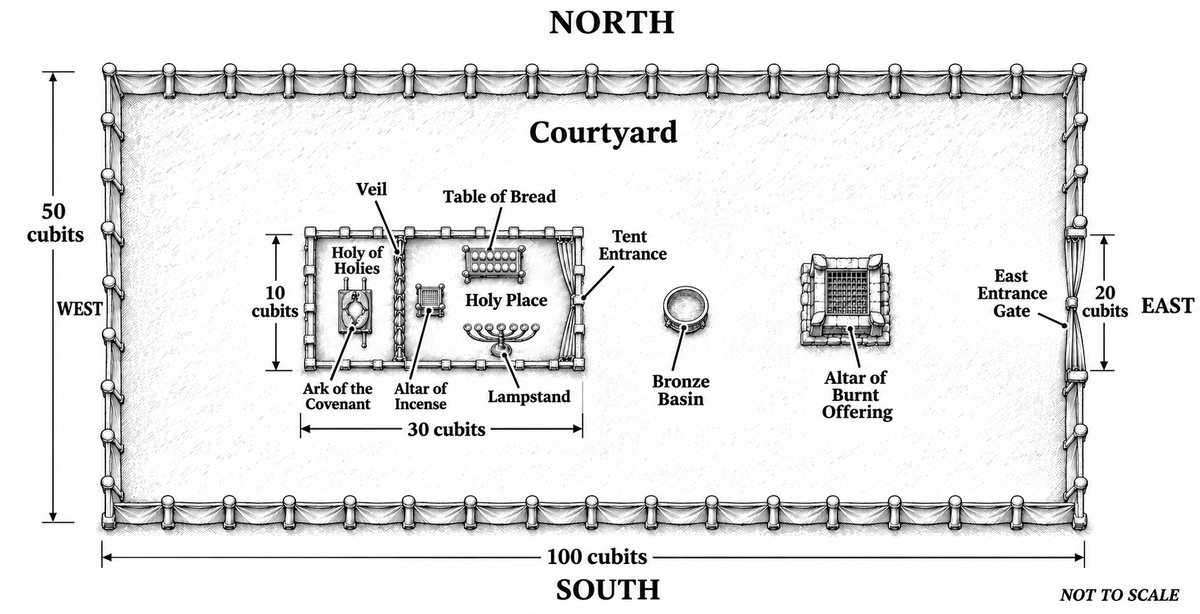
The tabernacle stood inside a courtyard. The courtyard was a long rectangle, twice as long as it was wide, with its one gate in the middle of the east end, facing the sunrise. Inside, a visitor met first the bronze altar, then the bronze basin, then the tent itself at the west end.

The tent was divided by a curtain, the veil, into two rooms. The first, the Holy Place, held three pieces of gold furniture: the table of bread on the north side, the lampstand on the south side, and the gold altar of incense in front of the veil. The second room, behind the veil, was the Most Holy Place. It held only the ark of the covenant.

Exodus does not give the tent’s length and width as single numbers; they are worked out from its boards. Twenty boards, each a cubit and a half wide, stood along each long side, making 30 cubits. The usual reckoning makes the tent 30 cubits long and 10 wide, the Holy Place 20 by 10, and the Most Holy Place a perfect square, 10 by 10.

Layout of the tabernacle and its courtyard, seen from above, with the measurements Exodus gives. Not drawn to scale.Artist’s rendition
Layout of the tabernacle and its courtyard, seen from above, with the measurements Exodus gives. Not drawn to scale.

Sizes from Exodus, with today’s values

  • Courtyard: “The length of the court shall be a hundred cubits, and the breadth fifty every where, and the height five cubits” (Exodus 27:18). Open the verse About 44.5 to 52.5 metres long (146 to 172 feet), 22 to 26 metres wide (73 to 86 feet), and a fence 2.2 to 2.6 metres high (7 to 8.6 feet).
  • Gate: “for the gate of the court shall be a screen of twenty cubits” (Exodus 27:16). Open the verse About 9 to 10.5 metres wide (29 to 34 feet).
  • Tent: 30 cubits by 10, about 13 to 16 metres long (44 to 52 feet) and 4.5 to 5.3 metres wide (15 to 17 feet), worked out from the boards. Exodus 26:16
  • Most Holy Place: 10 cubits each way, about 4.5 to 5.3 metres (15 to 17 feet).
  • Where the furniture stood: “thou shalt set the table without the veil, and the candlestick over against the table on the side of the tabernacle toward the south: and thou shalt put the table on the north side” (Exodus 26:35). Open the verse
  • The cubit is the forearm, about 44.5 to 52.5 centimetres (17½ to 20¾ inches). See Weights, Measures and Money.
The camp around itTwelve tribes on four sides, the Levites in the middle.

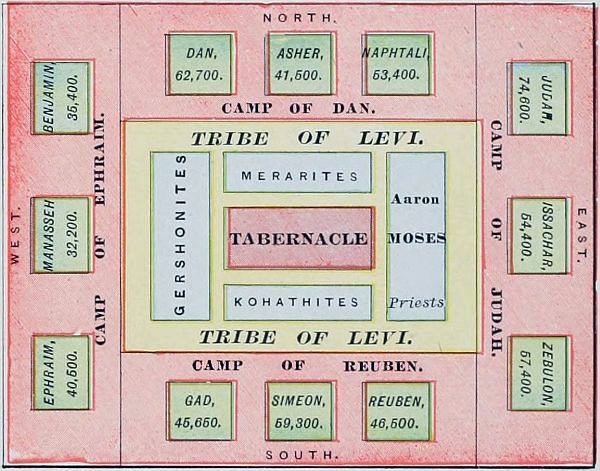
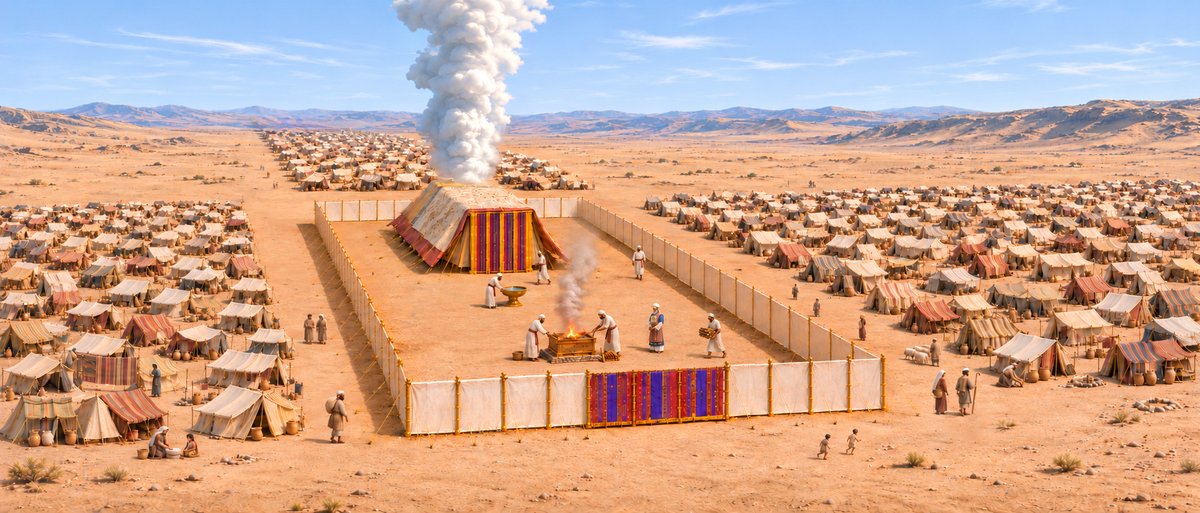
The tabernacle stood in the middle of the camp of Israel. Numbers 2 sets out where every tribe pitched its tents, each under its own banner, facing the tent of meeting from a distance. On the east, the side of the gate, camped Judah with Issachar and Zebulun. On the south, Reuben with Simeon and Gad. On the west, Ephraim with Manasseh and Benjamin. On the north, Dan with Asher and Naphtali.

Between the tribes and the tabernacle camped the Levites, the tribe that served it. Moses, Aaron and Aaron’s sons, the priests, camped on the east in front of the gate. The three Levite families camped on the other three sides: the Gershonites on the west, the Kohathites on the south and the Merarites on the north.

The cloud over the tabernacle told the camp when to move. When the cloud lifted, Israel packed up and followed it; when it settled, they camped, whether for two days or a year. At night the cloud looked like fire.

The tabernacle in the middle of the camp of Israel, with the cloud above the tent.Artist’s rendition
The tabernacle in the middle of the camp of Israel, with the cloud above the tent.
Plan of the camp of Israel with the twelve tribes around the tabernacle
The Camp of Israel, from Hurlbut’s Bible Atlas, 1910 (public domain). The numbers are the men counted in each tribe in Numbers 1–2.

Where the tribes camped

  • “over against the tent of meeting shall they encamp round about” (Numbers 2:2). Open the verse
  • “on the east side toward the sunrising shall be they of the standard of the camp of Judah” (Numbers 2:3). Open the verse
  • “On the south side shall be the standard of the camp of Reuben” (Numbers 2:10). Open the verse
  • “On the west side shall be the standard of the camp of Ephraim” (Numbers 2:18). Open the verse
  • “On the north side shall be the standard of the camp of Dan” (Numbers 2:25). Open the verse

Where the Levites camped

  • “before the tent of meeting toward the sunrising, shall be Moses, and Aaron and his sons” (Numbers 3:38). Open the verse
  • “The families of the Gershonites shall encamp behind the tabernacle westward.” (Numbers 3:23). Open the verse “The families of the sons of Kohath shall encamp on the side of the tabernacle southward.” (Numbers 3:29). Open the verse
  • Merari: “they shall encamp on the side of the tabernacle northward” (Numbers 3:35). Open the verse

The cloud

  • “the cloud covered the tabernacle, even the tent of the testimony: and at even it was upon the tabernacle as it were the appearance of fire, until morning” (Numbers 9:15). Open the verse
  • “And whenever the cloud was taken up from over the Tent, then after that the children of Israel journeyed: and in the place where the cloud abode, there the children of Israel encamped.” (Numbers 9:17). Open the verse
  • “Whether it were two days, or a month, or a year, that the cloud tarried upon the tabernacle” (Numbers 9:22). Open the verse

Back to top

Part II

The courtyard

The fence and gate, the bronze altar, and the bronze basin.

Anyone coming to the tabernacle first saw a high white fence of linen hangings, taller than a man, so that no one outside could see in. There was only one way in: the wide, colourful gate on the east side. Inside the gate, everything was made of bronze.

The courtyard fence and gateHebrew חָצֵר said chah-TSEHR “court” · Hebrew מָסָךְ said mah-SAH-cheh “screen”

The courtyard was fenced with long hangings of fine white linen, held up by sixty pillars: twenty on each long side and ten on each end. Each pillar stood in a bronze base and had silver hooks and silver bands at the top. Cords and bronze tent pegs held it steady.

The gate was a screen of embroidered cloth in blue, purple and scarlet on fine twined linen, twenty cubits wide, hung on four pillars. It was the only opening, and it faced east.

Any Israelite could come into the courtyard to bring an offering. Only the priests went further, into the tent.

What Exodus says

  • “hangings for the court of fine twined linen a hundred cubits long for one side” (Exodus 27:9). Open the verse
  • “the pillars thereof shall be twenty, and their sockets twenty, of brass; the hooks of the pillars and their fillets shall be of silver” (Exodus 27:10). Open the verse
  • “And for the gate of the court shall be a screen of twenty cubits, of blue, and purple, and scarlet, and fine twined linen, the work of the embroiderer; their pillars four, and their sockets four.” (Exodus 27:16). Open the verse
  • “All the pillars of the court round about shall be filleted with silver; their hooks of silver, and their sockets of brass.” (Exodus 27:17). Open the verse
  • “The length of the court shall be a hundred cubits, and the breadth fifty every where, and the height five cubits, of fine twined linen, and their sockets of brass.” (Exodus 27:18). Open the verse

In today’s terms

  • About 44.5 to 52.5 metres by 22 to 26 metres (146 to 172 feet by 73 to 86 feet): a little smaller than half a football field. The fence stood 2.2 to 2.6 metres (7 to 8.6 feet) high and the gate was 9 to 10.5 metres (29 to 34 feet) wide.
The bronze altarHebrew מִזְבֵּחַ said meez-BEH-ahch “altar”

The first thing inside the gate was the altar of burnt offering, the largest object in the courtyard. It was a hollow box of acacia wood covered with bronze, five cubits square and three cubits high, with a horn rising from each corner. A bronze grating of network sat inside it, and it had rings and poles for carrying. Its tools, pots for the ashes, shovels, basins, meat forks and fire pans, were all bronze.

Here animals were offered. Every day, a lamb was offered in the morning and another in the evening. When the priests first began their service, fire came out from before God and burned up the offering on the altar, and the fire was never to go out.

The horns of the altar were smeared with blood when the priests were ordained (Exodus 29:12). In later times a man in danger might run to the altar and take hold of its horns to ask for mercy (1 Kings 1:50).

What Exodus says

  • “And thou shalt make the altar of acacia wood, five cubits long, and five cubits broad; the altar shall be foursquare: and the height thereof shall be three cubits.” (Exodus 27:1). Open the verse
  • “And thou shalt make the horns of it upon the four corners thereof; the horns thereof shall be of one piece with it: and thou shalt overlay it with brass.” (Exodus 27:2). Open the verse
  • “And thou shalt make for it a grating of network of brass; and upon the net shalt thou make four brazen rings in the four corners thereof.” (Exodus 27:4). Open the verse
  • “all the vessels thereof thou shalt make of brass” (Exodus 27:3). Open the verse

The daily offering and the fire

  • “Now this is that which thou shalt offer upon the altar: two lambs a year old day by day continually.” (Exodus 29:38). Open the verse
  • “The one lamb thou shalt offer in the morning; and the other lamb thou shalt offer at even:” (Exodus 29:39). Open the verse
  • “there came forth fire from before Jehovah, and consumed upon the altar the burnt-offering and the fat” (Leviticus 9:24). Open the verse
  • “Fire shall be kept burning upon the altar continually; it shall not go out.” (Leviticus 6:13). Open the verse

In today’s terms

  • About 2.2 to 2.6 metres square (7 to 8.6 feet) and 1.3 to 1.6 metres high (4.4 to 5.2 feet).
The bronze basin (laver)Hebrew כִּיּוֹר said kee-YOHR “basin” (the form in Exodus 30:18)

Between the altar and the door of the tent stood a large bronze basin full of water, on a bronze stand. Before a priest went into the tent, or came to the altar to serve, he had to wash his hands and his feet here. The command is repeated twice, with the warning “that they die not.”

Exodus records where the bronze came from: the basin was made from the bronze mirrors of the women who served at the door of the tent of meeting. In those days mirrors were polished plates of bronze.

Exodus gives no size or shape for the basin. The great bronze “sea” and the ten smaller basins in Solomon’s temple later served the same purpose (1 Kings 7:23–39).

What Exodus says

  • “Thou shalt also make a laver of brass, and the base thereof of brass, whereat to wash. And thou shalt put it between the tent of meeting and the altar, and thou shalt put water therein.” (Exodus 30:18). Open the verse
  • “And Aaron and his sons shall wash their hands and their feet thereat:” (Exodus 30:19). Open the verse
  • “when they go into the tent of meeting, they shall wash with water, that they die not” (Exodus 30:20). Open the verse
  • “And he made the laver of brass, and the base thereof of brass, of the mirrors of the ministering women that ministered at the door of the tent of meeting.” (Exodus 38:8). Open the verse

Back to top

Part III

The tent and the Holy Place

The boards and coverings, the lampstand, the table and the incense altar.

The tent itself was a frame of gold-covered boards, roofed and wrapped with four layers of curtains and skins. Its door, on the east, was another embroidered screen. Inside, there were no windows. The only light in the first room, the Holy Place, came from the seven lamps of the golden lampstand. Here the priests served every day.

The tent: boards, bars and four coveringsGold walls, silver bases, and four roofs.

The walls of the tent were made of upright boards (or frames) of acacia wood, each ten cubits high and a cubit and a half wide, covered with gold. Each board stood on two silver bases, so the floor of the walls rested on a row of solid silver. Long bars of gold-covered wood ran through gold rings along the outside of the boards to hold them together, and one middle bar ran the whole length.

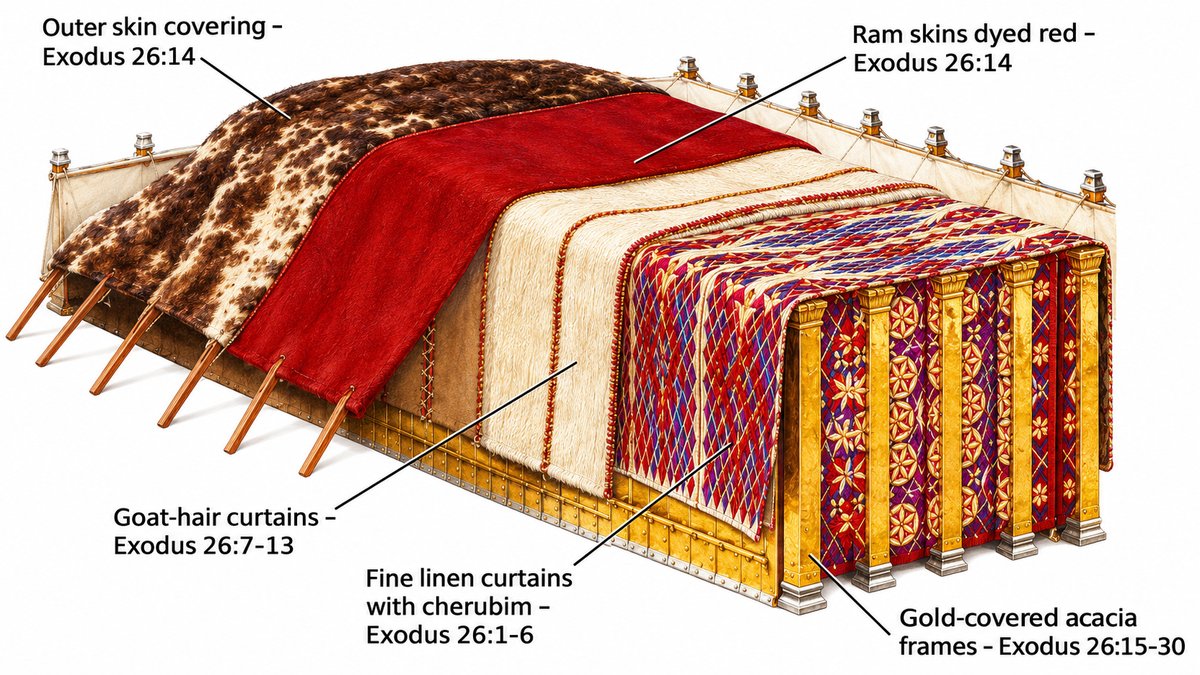
Four layers covered the tent. The innermost, seen from inside, was ten curtains of fine linen in blue, purple and scarlet, with cherubim woven into them. Over that went eleven curtains of goats’ hair, like a Bedouin tent. Over that, a covering of rams’ skins dyed red. On the very top, a covering of the skins of a sea animal (the ASV says sealskins). From outside, the tabernacle looked plain; its beauty was inside.

Each of the hundred silver bases of the tent and the veil weighed a talent, about 30 to 36 kilograms (66 to 79 pounds).

The layers of the tent, cut away to show each one: the gold-covered frames, the linen curtains, the goat-hair curtains, the rams’ skins dyed red, and the outer covering of skins.Artist’s rendition
The layers of the tent, cut away to show each one: the gold-covered frames, the linen curtains, the goat-hair curtains, the rams’ skins dyed red, and the outer covering of skins.

What Exodus says

  • “And thou shalt make the boards for the tabernacle of acacia wood, standing up.” (Exodus 26:15). Open the verse
  • “Ten cubits shall be the length of a board, and a cubit and a half the breadth of each board.” (Exodus 26:16). Open the verse
  • “thou shalt overlay the boards with gold” (Exodus 26:29). Open the verse
  • “And the middle bar in the midst of the boards shall pass through from end to end.” (Exodus 26:28). Open the verse
  • “a hundred sockets for the hundred talents, a talent for a socket” (Exodus 38:27). Open the verse

The four coverings

  • “Moreover thou shalt make the tabernacle with ten curtains; of fine twined linen, and blue, and purple, and scarlet, with cherubim the work of the skilful workman shalt thou make them.” (Exodus 26:1). Open the verse
  • “And thou shalt make curtains of goats’ hair for a tent over the tabernacle: eleven curtains shalt thou make them.” (Exodus 26:7). Open the verse
  • “And thou shalt make a covering for the tent of rams’ skins dyed red, and a covering of sealskins above.” (Exodus 26:14). Open the verse

The door

  • “And thou shalt make a screen for the door of the Tent, of blue, and purple, and scarlet, and fine twined linen, the work of the embroiderer.” (Exodus 26:36). Open the verse
  • “thou shalt make for the screen five pillars of acacia, and overlay them with gold” (Exodus 26:37). Open the verse

In today’s terms

  • Each board: about 4.5 to 5.3 metres high (15 to 17 feet) and 67 to 79 centimetres wide (26 to 31 inches).
The golden lampstandHebrew מְנוֹרָה said meh-noh-RAH “lampstand”

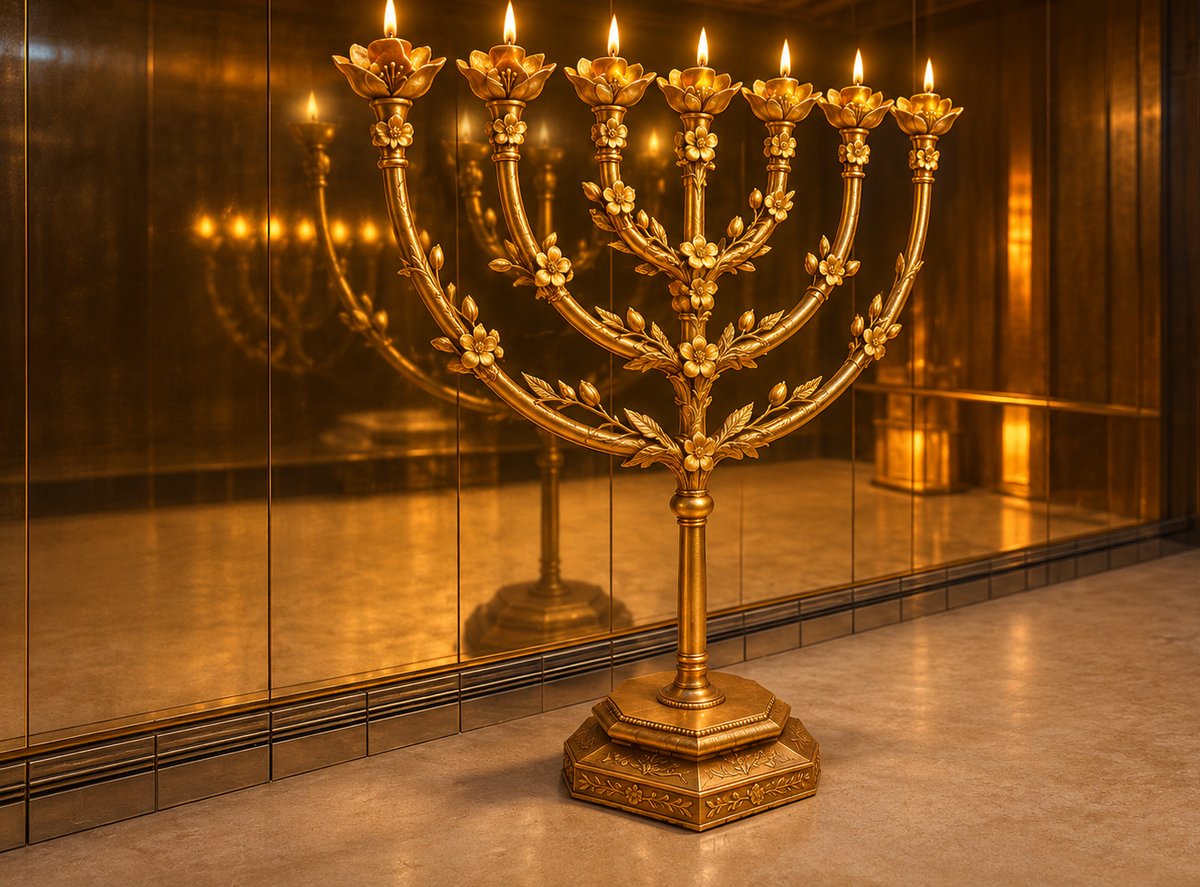
The lampstand stood on the south side of the Holy Place. It was beaten out of a single piece of pure gold weighing a talent, about 30 to 36 kilograms (66 to 79 pounds): a central shaft with three branches curving out on each side, seven lamps in all. Each branch had three cups shaped like almond blossoms, each with a bud and a flower, and the central shaft had four. It looked like a small flowering almond tree made of gold.

The lamps burned pure olive oil, the first and finest oil from olives crushed by beating. The priests tended the lamps every evening and every morning, so that they burned through the night. Its Hebrew name is menorah, the word still used for this shape today.

Exodus gives the lampstand’s weight but not its height. The ASV calls it a “candlestick,” but it held oil lamps, not candles.

The golden lampstand with its seven lamps lit, in the Holy Place.Artist’s rendition
The golden lampstand with its seven lamps lit, in the Holy Place.

What Exodus says

  • “And thou shalt make a candlestick of pure gold: of beaten work shall the candlestick be made, even its base, and its shaft; its cups, its knops, and its flowers, shall be of one piece with it:” (Exodus 25:31). Open the verse
  • “And thou shalt make the lamps thereof, seven: and they shall light the lamps thereof, to give light over against it.” (Exodus 25:37). Open the verse
  • “Of a talent of pure gold shall it be made, with all these vessels.” (Exodus 25:39). Open the verse
  • Almond blossoms: Exodus 25:33 (see Plants of the Bible, Almond tree).

The oil and the daily care

  • “Command the children of Israel, that they bring unto thee pure olive oil beaten for the light, to cause a lamp to burn continually.” (Leviticus 24:2). Open the verse
  • “shall Aaron keep it in order from evening to morning before Jehovah continually” (Leviticus 24:3). Open the verse
  • “And he put the candlestick in the tent of meeting, over against the table, on the side of the tabernacle southward.” (Exodus 40:24). Open the verse
The table of the bread of the PresenceHebrew שֻׁלְחָן said shool-CHAHN “table” · Hebrew לֶחֶם said LEH-chem “bread”

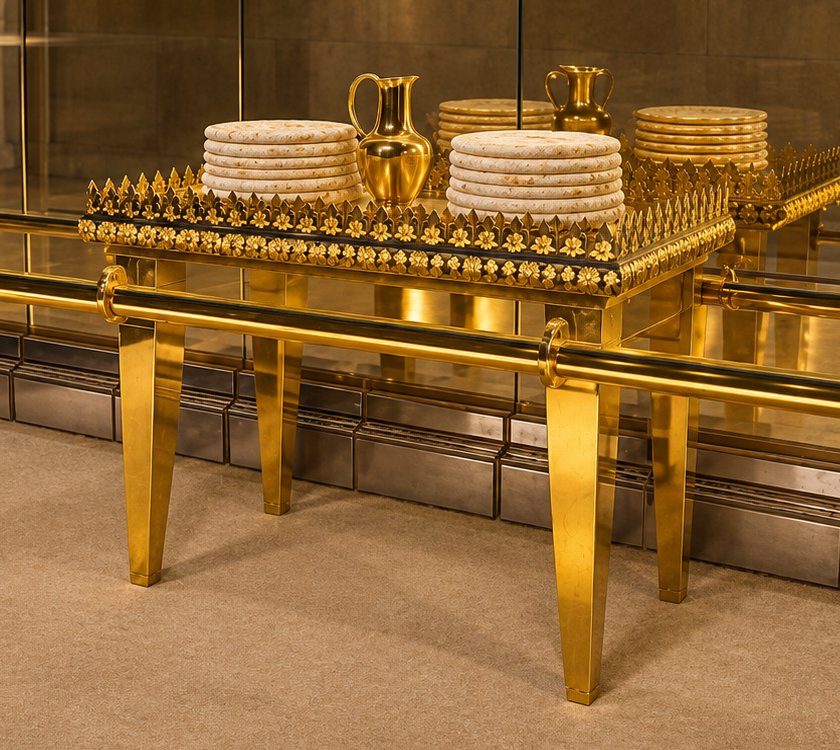
The table stood on the north side of the Holy Place, opposite the lampstand. It was a small table of acacia wood covered with pure gold, two cubits long, one cubit wide and a cubit and a half high, with a gold rim around the top and rings and poles for carrying. Gold plates, dishes, jugs and bowls belonged to it.

On it were set twelve loaves, one for each tribe of Israel, in two rows of six, with pure frankincense beside each row. Each loaf was large, made from two tenths of an ephah of fine flour, about 4.5 to 7 litres of flour. Every Sabbath the priests set out fresh loaves, and the old ones were eaten by the priests in a holy place.

The ASV calls it “showbread.” The Hebrew is “bread of the face” or “bread of the presence,” because it lay before God continually. When David was fleeing from Saul, the priest at Nob gave him this bread, and Jesus later reminded the Pharisees of it.

The table with the twelve loaves in two piles of six.Artist’s rendition
The table with the twelve loaves in two piles of six.

What Exodus says

  • “And thou shalt make a table of acacia wood: two cubits shall be the length thereof, and a cubit the breadth thereof, and a cubit and a half the height thereof.” (Exodus 25:23). Open the verse
  • “And thou shalt overlay it with pure gold, and make thereto a crown of gold round about.” (Exodus 25:24). Open the verse
  • “that the table may be borne with them” (Exodus 25:28). Open the verse
  • “And thou shalt set upon the table showbread before me alway.” (Exodus 25:30). Open the verse

The twelve loaves

  • “And thou shalt take fine flour, and bake twelve cakes thereof: two tenth parts of an ephah shall be in one cake.” (Leviticus 24:5). Open the verse
  • “And thou shalt set them in two rows, six on a row, upon the pure table before Jehovah.” (Leviticus 24:6). Open the verse
  • “thou shalt put pure frankincense upon each row” (Leviticus 24:7). Open the verse
  • “Every sabbath day he shall set it in order before Jehovah continually” (Leviticus 24:8). Open the verse
  • “they shall eat it in a holy place” (Leviticus 24:9). Open the verse

David and the bread

  • “there was no bread there but the showbread, that was taken from before Jehovah” (1 Samuel 21:6). Open the verse
  • “how he entered into the house of God, and ate the showbread, which it was not lawful for him to eat” (Matthew 12:4). Open the verse

In today’s terms

  • About 89 to 105 centimetres long (35 to 41 inches), 44.5 to 52.5 centimetres wide (17½ to 20¾ inches) and 67 to 79 centimetres high (26 to 31 inches).
The golden altar of incenseHebrew קְטֹרֶת said keh-TOH-ret “incense”

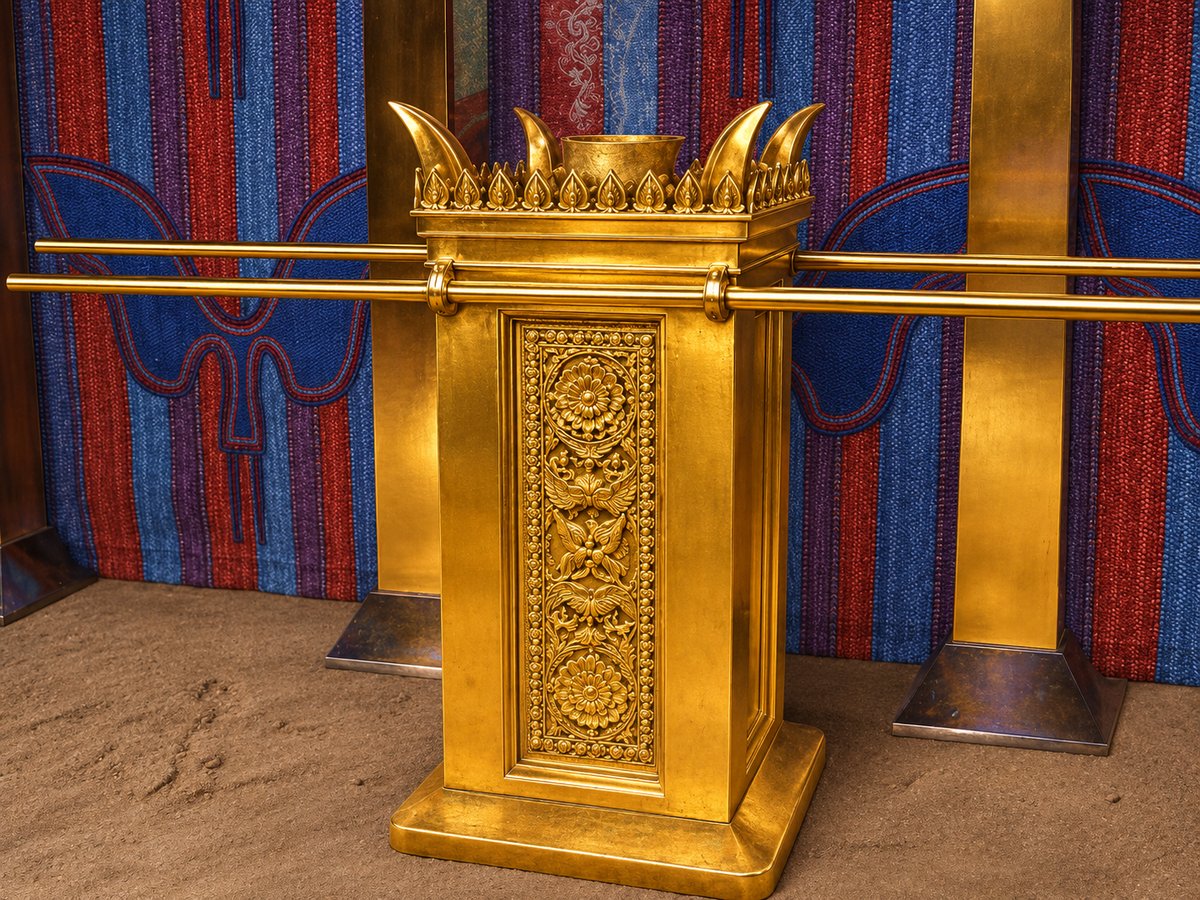
The small gold altar stood in the Holy Place right in front of the veil, facing the ark on the other side. It was made of acacia wood covered with pure gold: one cubit square and two cubits high, taller than it was wide, with a horn at each corner, a gold rim, and rings and poles for carrying.

Every morning when he tended the lamps, and every evening when he lit them, the priest burned sweet incense on it. The incense had its own recipe: equal weights of stacte, onycha, galbanum and pure frankincense, seasoned with salt and ground fine. No one was allowed to make it for personal use (Exodus 30:37–38). Only incense was burned here, never animal offerings.

Once a year, on the Day of Atonement, blood was put on its horns. Two of Aaron’s sons, Nadab and Abihu, died for offering incense with fire God had not commanded, and King Uzziah was struck with a skin disease beside this altar when he tried to burn incense himself.

The gold altar of incense in front of the veil.Artist’s rendition
The gold altar of incense in front of the veil.

What Exodus says

  • “And thou shalt make an altar to burn incense upon: of acacia wood shalt thou make it.” (Exodus 30:1). Open the verse
  • “A cubit shall be the length thereof, and a cubit the breadth thereof; foursquare shall it be; and two cubits shall be the height thereof: the horns thereof shall be of one piece with it.” (Exodus 30:2). Open the verse
  • “And thou shalt overlay it with pure gold, the top thereof, and the sides thereof round about, and the horns thereof; and thou shalt make unto it a crown of gold round about.” (Exodus 30:3). Open the verse
  • “thou shalt put it before the veil that is by the ark of the testimony” (Exodus 30:6). Open the verse

The incense

  • “And Aaron shall burn thereon incense of sweet spices: every morning, when he dresseth the lamps, he shall burn it.” (Exodus 30:7). Open the verse
  • “And when Aaron lighteth the lamps at even, he shall burn it, a perpetual incense before Jehovah throughout your generations.” (Exodus 30:8). Open the verse
  • “And Jehovah said unto Moses, Take unto thee sweet spices, stacte, and onycha, and galbanum; sweet spices with pure frankincense: of each shall there be a like weight;” (Exodus 30:34). Open the verse
  • “and thou shalt make of it incense, a perfume after the art of the perfumer, seasoned with salt, pure and holy:” (Exodus 30:35). Open the verse
  • “Aaron shall make atonement upon the horns of it once in the year” (Exodus 30:10). Open the verse

Warnings

  • “offered strange fire before Jehovah, which he had not commanded them” (Leviticus 10:1). Open the verse
  • “the leprosy brake forth in his forehead before the priests in the house of Jehovah, beside the altar of incense” (2 Chronicles 26:19). Open the verse

In today’s terms

  • About 44.5 to 52.5 centimetres square (17½ to 20¾ inches) and 89 to 105 centimetres high (35 to 41 inches).

Back to top

Part IV

The Most Holy Place

The veil, the ark and mercy seat, and the Day of Atonement.

Behind the veil was the Most Holy Place, also called the Holy of Holies. It was a dark, square room with nothing in it but the ark of the covenant. Only the high priest entered, and only on one day of the year.

The veilHebrew פָּרֹכֶת said pah-ROH-chet “veil”

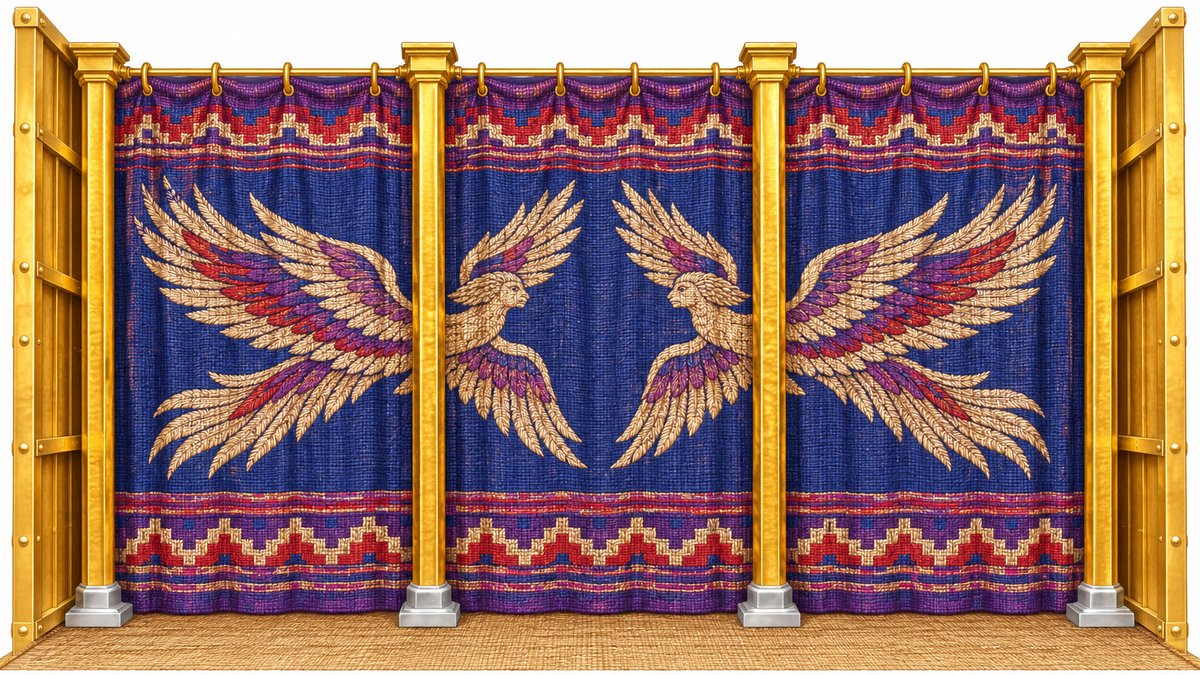
The veil was a heavy curtain of blue, purple and scarlet yarn and fine twined linen, with cherubim worked into it by skilled weavers. It hung on four gold-covered acacia pillars that stood on silver bases, and it divided the Holy Place from the Most Holy Place.

When Israel broke camp, the priests took down the veil and covered the ark with it, so that the ark was never seen, even while being carried.

Solomon’s temple, and the temple of Jesus’ day, also had a veil before the Most Holy Place. Matthew records that at the moment Jesus died, the veil of the temple was torn in two from top to bottom. Hebrews calls the inner room the place “after the second veil,” the first being the screen at the door of the tent.

The veil of blue, purple and scarlet, with cherubim worked into it, hung on four gold-covered pillars standing on silver bases. Exodus gives the colours and the cherubim; the faces and patterns are the artist’s choice.Artist’s rendition
The veil of blue, purple and scarlet, with cherubim worked into it, hung on four gold-covered pillars standing on silver bases. Exodus gives the colours and the cherubim; the faces and patterns are the artist’s choice.

What Exodus says

  • “And thou shalt make a veil of blue, and purple, and scarlet, and fine twined linen: with cherubim the work of the skilful workman shall it be made:” (Exodus 26:31). Open the verse
  • “and thou shalt hang it upon four pillars of acacia overlaid with gold; their hooks shall be of gold, upon four sockets of silver.” (Exodus 26:32). Open the verse
  • “the veil shall separate unto you between the holy place and the most holy” (Exodus 26:33). Open the verse

Covering the ark

  • “when the camp setteth forward, Aaron shall go in, and his sons, and they shall take down the veil of the screen, and cover the ark of the testimony with it,” (Numbers 4:5). Open the verse

In the New Testament

  • “the veil of the temple was rent in two from the top to the bottom” (Matthew 27:51). Open the verse
  • “And after the second veil, the tabernacle which is called the Holy of holies;” (Hebrews 9:3). Open the verse
The ark of the covenant and the mercy seatHebrew אֲרוֹן said ah-ROHN “chest” · Hebrew כַּפֹּרֶת said kah-POH-ret “mercy seat” · Hebrew כְּרוּב said keh-ROOV “cherub”

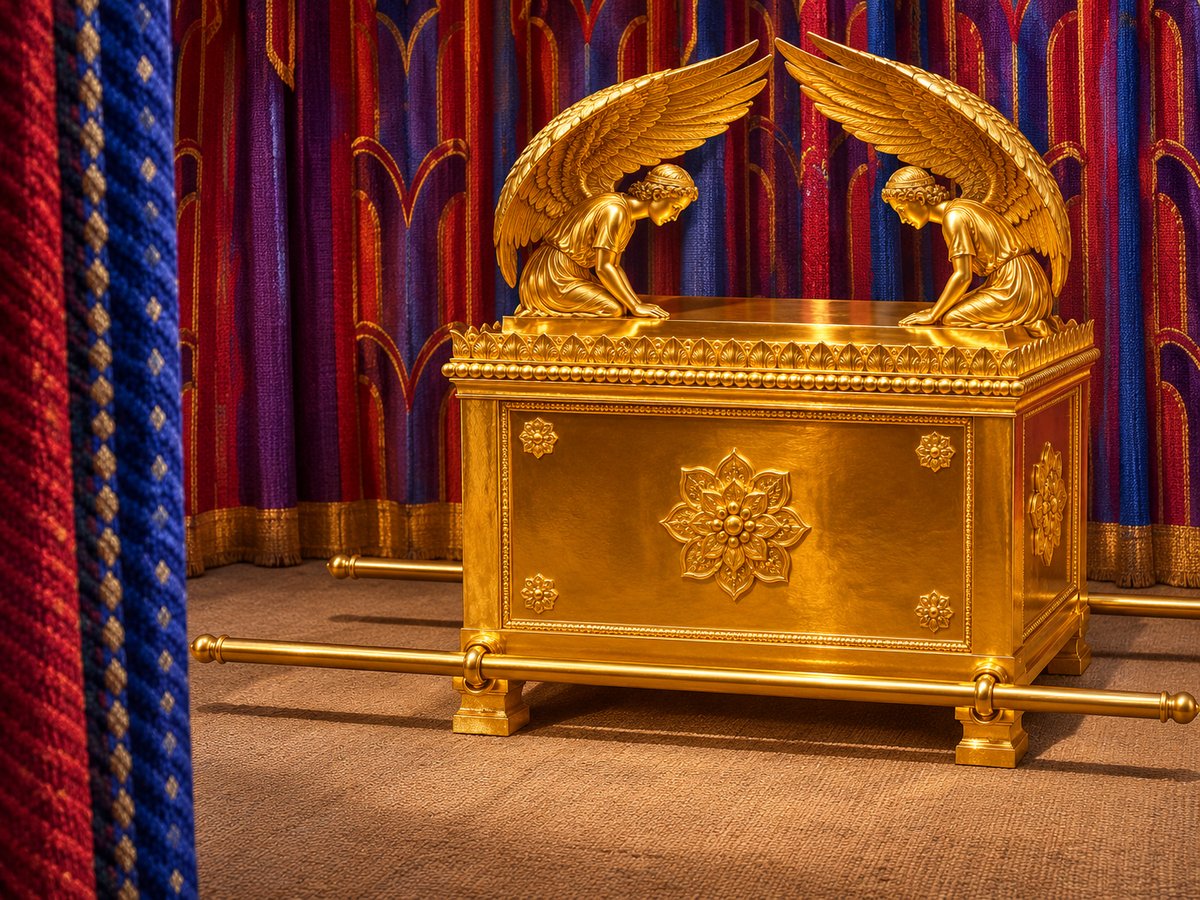
The ark was a chest of acacia wood covered with pure gold inside and out, two and a half cubits long and a cubit and a half wide and high. Gold rings were fixed to its four feet, and gold-covered poles ran through them. The poles were never to be taken out.

Its lid, the mercy seat, was a slab of pure gold. At each end of it stood a cherub, beaten from the same gold, facing each other and looking down toward the lid, with their wings spread up and over it. God said he would meet Moses and speak to him from above the mercy seat, between the two cherubim.

Inside the ark Moses put “the testimony”: the two stone tablets of the Ten Commandments. Hebrews says a gold jar of manna and Aaron’s staff that budded were also there; by the time of Solomon, 1 Kings says, only the two tablets remained. Exodus does not describe what the cherubim looked like beyond their wings and faces; the picture shows one artist’s idea.

The ark of the covenant with the two cherubim on its lid, in front of the veil.Artist’s rendition
The ark of the covenant with the two cherubim on its lid, in front of the veil.

What Exodus says

  • “And they shall make an ark of acacia wood: two cubits and a half shall be the length thereof, and a cubit and a half the breadth thereof, and a cubit and a half the height thereof.” (Exodus 25:10). Open the verse
  • “And thou shalt make a mercy-seat of pure gold: two cubits and a half shall be the length thereof, and a cubit and a half the breadth thereof.” (Exodus 25:17). Open the verse
  • “And thou shalt make two cherubim of gold; of beaten work shalt thou make them, at the two ends of the mercy-seat.” (Exodus 25:18). Open the verse
  • “And the cherubim shall spread out their wings on high, covering the mercy-seat with their wings, with their faces one to another; toward the mercy-seat shall the faces of the cherubim be.” (Exodus 25:20). Open the verse
  • “And thou shalt put the mercy-seat above upon the ark; and in the ark thou shalt put the testimony that I shall give thee.” (Exodus 25:21). Open the verse
  • “there I will meet with thee, and I will commune with thee from above the mercy-seat, from between the two cherubim” (Exodus 25:22). Open the verse

What was inside

  • “And thou shalt put into the ark the testimony which I shall give thee.” (Exodus 25:16). Open the verse
  • “wherein was a golden pot holding the manna, and Aaron’s rod that budded, and the tables of the covenant” (Hebrews 9:4). Open the verse
  • “There was nothing in the ark save the two tables of stone which Moses put there at Horeb” (1 Kings 8:9). Open the verse

In today’s terms

  • About 1.1 to 1.3 metres long (44 to 52 inches) and 67 to 79 centimetres wide and high (26 to 31 inches): about the size of a large chest.
The Day of AtonementOnce a year, behind the veil.

On one day a year, the tenth day of the seventh month, the high priest went behind the veil. He did not wear his gold and coloured garments that day, but plain white linen. He brought a fire pan of coals from the altar and two handfuls of incense, so that a cloud of incense filled the room and covered the mercy seat.

He went in with the blood of a bull, offered for his own sins and his family’s, and sprinkled it on and in front of the mercy seat. Then he killed a goat for the sins of the people and did the same with its blood. A second goat was sent away alive into the desert (Leviticus 16:20–22). The whole nation fasted and did no work.

The Hebrew name of the day is Yom Kippur, and it is still kept by Jewish people today. Hebrews 9 describes this day and compares it with the death of Jesus.

Leviticus 16

  • “that he come not at all times into the holy place within the veil, before the mercy-seat which is upon the ark; that he die not” (Leviticus 16:2). Open the verse
  • “He shall put on the holy linen coat” (Leviticus 16:4). Open the verse
  • “And he shall take a censer full of coals of fire from off the altar before Jehovah, and his hands full of sweet incense beaten small, and bring it within the veil:” (Leviticus 16:12). Open the verse
  • “that the cloud of the incense may cover the mercy-seat” (Leviticus 16:13). Open the verse
  • “and he shall take of the blood of the bullock, and sprinkle it with his finger upon the mercy-seat on the east; and before the mercy-seat shall he sprinkle of the blood with his finger seven times.” (Leviticus 16:14). Open the verse
  • “Then shall he kill the goat of the sin-offering, that is for the people, and bring his blood within the veil” (Leviticus 16:15). Open the verse
  • “in the seventh month, on the tenth day of the month, ye shall afflict your souls, and shall do no manner of work” (Leviticus 16:29). Open the verse
  • “for on this day shall atonement be made for you, to cleanse you; from all your sins shall ye be clean before Jehovah.” (Leviticus 16:30). Open the verse

In the New Testament

  • “but into the second the high priest alone, once in the year, not without blood, which he offereth for himself, and for the errors of the people:” (Hebrews 9:7). Open the verse
  • “nor yet through the blood of goats and calves, but through his own blood, entered in once for all into the holy place, having obtained eternal redemption.” (Hebrews 9:12). Open the verse

Back to top

Part V

Priests, travel and later history

The priests’ clothes, carrying the tabernacle, and what became of it.

A building needs people to run it. The tabernacle had the priests, Aaron and his sons, who served at the altars and in the tent, and the rest of the tribe of Levi, who guarded it, took it down, carried it and set it up again. This last part also follows the tabernacle through Israel’s history after the desert.

The priests and their clothesHebrew כֹּהֵן said koh-HEN “priest” · Hebrew אֵפוֹד said eh-FOHD · Hebrew חֹשֶׁן said CHOH-shen “breastpiece”

Only Aaron and his descendants could be priests. The ordinary priests wore a long coat of fine linen, a sash, a linen cap, and linen undergarments. No shoes are listed among their clothes.

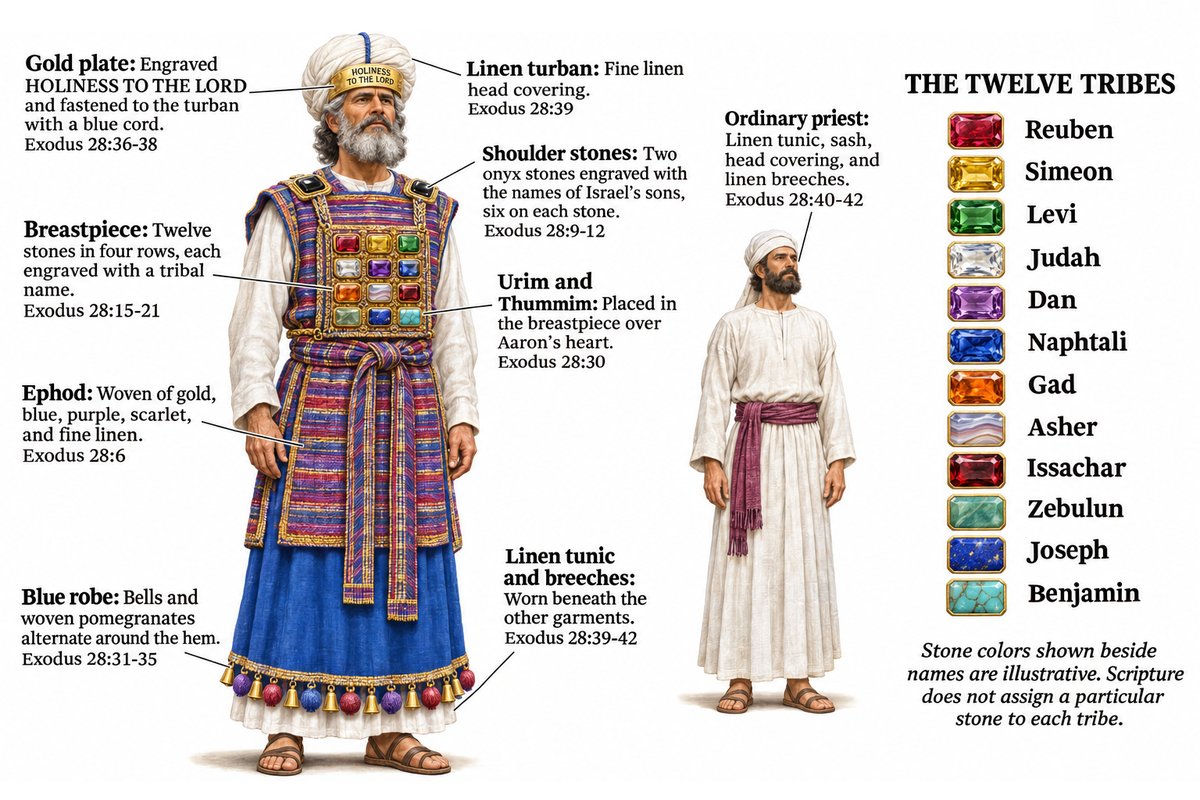
The high priest wore eight garments, made “for glory and for beauty.” Over the linen coat went a robe all of blue, with pomegranates of coloured yarn and golden bells around its hem, so that he could be heard as he moved in the Holy Place. Over that went the ephod, a kind of apron of gold thread and coloured yarn, with two onyx stones on the shoulders engraved with the names of the twelve tribes, six on each. On his chest hung the breastpiece, a square pocket set with twelve precious stones in four rows, each engraved with the name of a tribe. Inside it were the Urim and Thummim, used to ask God for decisions. On the front of his turban was a plate of pure gold engraved “Holy to YHWH” (the ASV prints “Holy to Jehovah”).

So the high priest carried the names of the twelve tribes on his shoulders and over his heart every time he went in before God.

The high priest in his eight garments (left) and an ordinary priest in linen (right), with the twelve tribes beside the stones of the breastpiece. The tribes are shown in order of birth, as Jewish tradition places them; Scripture does not state which stone stood for which tribe, and the colours are illustrative.Artist’s rendition
The high priest in his eight garments (left) and an ordinary priest in linen (right), with the twelve tribes beside the stones of the breastpiece. The tribes are shown in order of birth, as Jewish tradition places them; Scripture does not state which stone stood for which tribe, and the colours are illustrative.

The garments

  • “And thou shalt make holy garments for Aaron thy brother, for glory and for beauty.” (Exodus 28:2). Open the verse
  • “And these are the garments which they shall make: a breastplate, and an ephod, and a robe, and a coat of checker work, a mitre, and a girdle: and they shall make holy garments for Aaron thy brother, and his sons, that he may minister unto me in the priest’s office.” (Exodus 28:4). Open the verse
  • “And they shall make the ephod of gold, of blue, and purple, scarlet, and fine twined linen, the work of the skilful workman.” (Exodus 28:6). Open the verse
  • “Aaron shall bear their names before Jehovah upon his two shoulders for a memorial” (Exodus 28:12). Open the verse
  • “they shall be for the twelve tribes” (Exodus 28:21). Open the verse
  • “Aaron shall bear the names of the children of Israel in the breastplate of judgment upon his heart” (Exodus 28:29). Open the verse
  • “thou shalt put in the breastplate of judgment the Urim and the Thummim” (Exodus 28:30). Open the verse
  • “And thou shalt make the robe of the ephod all of blue.” (Exodus 28:31). Open the verse
  • “a golden bell and a pomegranate, a golden bell and a pomegranate, upon the skirts of the robe round about.” (Exodus 28:34). Open the verse
  • “the sound thereof shall be heard when he goeth in unto the holy place before Jehovah, and when he cometh out, that he die not” (Exodus 28:35). Open the verse
  • “And thou shalt make a plate of pure gold, and grave upon it, like the engravings of a signet, Holy to Jehovah.” (Exodus 28:36). Open the verse

The twelve stones of the breastpiece

  • “And thou shalt set in it settings of stones, four rows of stones: a row of sardius, topaz, and carbuncle shall be the first row;” (Exodus 28:17). Open the verse
  • “and the second row an emerald, a sapphire, and a diamond;” (Exodus 28:18). Open the verse
  • “and the third row a jacinth, an agate, and an amethyst;” (Exodus 28:19). Open the verse
  • “and the fourth row a beryl, and an onyx, and a jasper: they shall be inclosed in gold in their settings.” (Exodus 28:20). Open the verse
  • The English names come from the old Greek and Latin translations. Scholars are not sure which modern stone each Hebrew word means, so each line below gives the ASV name, the tribe, then what the stone is usually thought to be.

Each stone

  • Sardius — Reuben (row 1): a deep red stone, usually taken to be carnelian, a red quartz. The Hebrew name, odem, comes from the word for red.
  • Topaz — Simeon (row 1): a yellow-green stone, usually taken to be peridot (chrysolite), not the modern topaz.
  • Carbuncle — Levi (row 1): a stone that “flashes” (Hebrew bareqet, from the word for lightning). Some think it was emerald or green beryl; others a red garnet.
  • Emerald — Judah (row 2): Hebrew nofekh. Often taken to be turquoise, which was mined in Sinai; others suggest a red garnet.
  • Sapphire — Dan (row 2): most scholars think this was lapis lazuli, a deep blue stone with gold flecks, not the modern sapphire.
  • Diamond — Naphtali (row 2): Hebrew yahalom. Probably not a diamond, which could not be engraved with the tools of that time; suggestions include onyx, jasper and white quartz.
  • Jacinth — Gad (row 3): Hebrew leshem. Uncertain: amber, an orange zircon, or opal have all been suggested.
  • Agate — Asher (row 3): a banded quartz in layers of white, grey, brown or red.
  • Amethyst — Issachar (row 3): a purple quartz.
  • Beryl — Zebulun (row 4): Hebrew tarshish, perhaps because it was traded from Tarshish. Possibly a yellow or golden stone such as chrysolite or yellow jasper.
  • Onyx — Joseph (row 4): Hebrew shoham, a banded stone in black and white layers. The two shoulder stones of the ephod were also onyx.
  • Jasper — Benjamin (row 4): an opaque quartz, most often red, green or yellow.
  • Each stone was set in gold and engraved like a seal with the name of one of the twelve sons of Israel. Exodus does not say which name went on which stone. The tribe beside each stone follows the order of the sons’ births (Genesis 29–30 and 35), the order Jewish tradition gives, for example the commentator Rashi on Exodus 28:21. Exodus itself uses the order of birth for the two shoulder stones: “according to their birth” (Exodus 28:10). Open the verse

The other priests

  • “And for Aaron’s sons thou shalt make coats, and thou shalt make for them girdles, and head-tires shalt thou make for them, for glory and for beauty.” (Exodus 28:40). Open the verse
  • “thou shalt make them linen breeches” (Exodus 28:42). Open the verse
Taking it down and carrying itThe work of the three Levite families.

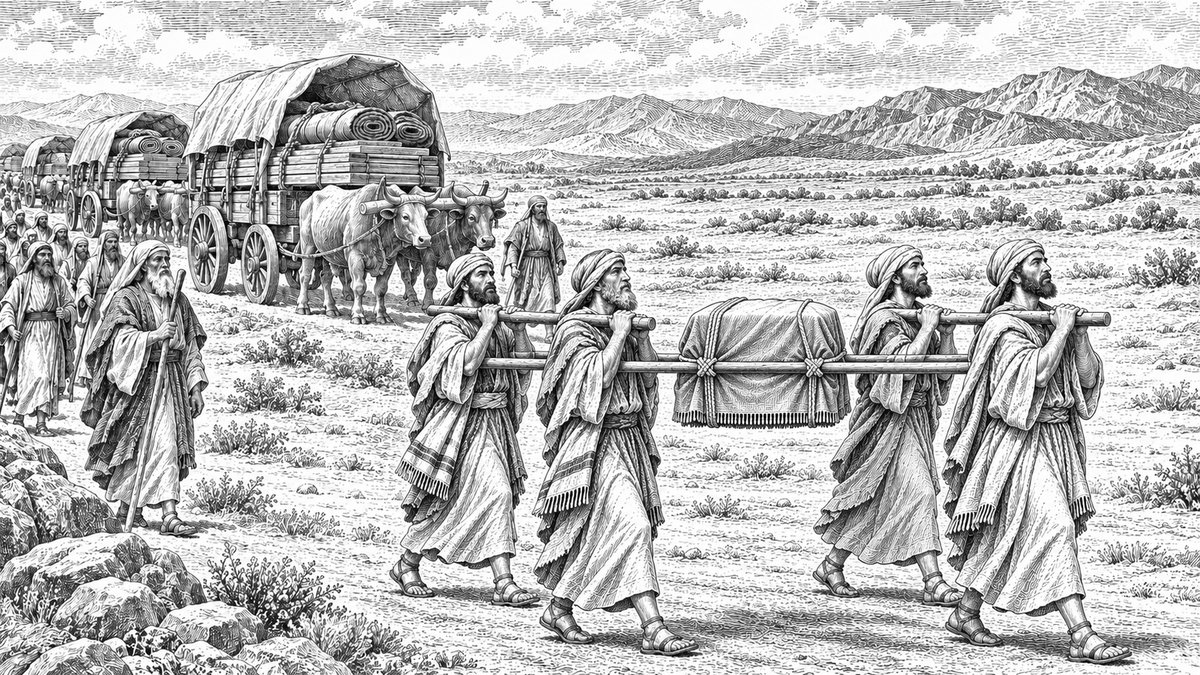
When the cloud lifted, the whole tabernacle was packed and carried. First Aaron and his sons went in, took down the veil, and wrapped each holy object in cloth and skins so that no one else saw it. Then the Levites carried it, each family with its own load.

The Kohathites carried the holy furniture: the ark, the table, the lampstand and the two altars. They carried them on their shoulders by the poles and were not allowed to touch the holy things themselves. The Gershonites carried all the curtains, coverings, hangings and screens. The Merarites carried the heavy parts: the boards, bars, pillars and bases, pegs and cords.

The leaders of the tribes gave six covered wagons and twelve oxen for the work. Moses gave two wagons to the Gershonites and four to the Merarites, who had the heaviest loads. The Kohathites got none, because the holy things were carried on the shoulder.

Levites carrying the covered ark on poles on their shoulders, with the wagons and oxen behind them carrying the boards and curtains.Artist’s rendition
Levites carrying the covered ark on poles on their shoulders, with the wagons and oxen behind them carrying the boards and curtains.

The Levites

  • “when the tabernacle setteth forward, the Levites shall take it down; and when the tabernacle is to be pitched, the Levites shall set it up” (Numbers 1:51). Open the verse
  • “the sons of Kohath shall come to bear it: but they shall not touch the sanctuary, lest they die” (Numbers 4:15). Open the verse
  • “they shall bear the curtains of the tabernacle, and the tent of meeting, its covering” (Numbers 4:25). Open the verse
  • “the boards of the tabernacle, and the bars thereof, and the pillars thereof, and the sockets thereof” (Numbers 4:31). Open the verse

The wagons

  • “Two wagons and four oxen he gave unto the sons of Gershon, according to their service:” (Numbers 7:7). Open the verse
  • “four wagons and eight oxen he gave unto the sons of Merari” (Numbers 7:8). Open the verse
  • “But unto the sons of Kohath he gave none, because the service of the sanctuary belonged unto them; they bare it upon their shoulders.” (Numbers 7:9). Open the verse
What happened to it laterShiloh, Nob, Gibeon, and Solomon’s temple.

After Israel crossed the Jordan, their first camp was at Gilgal. Once much of the land was taken, the whole people gathered at Shiloh, in the hill country of Ephraim, and set up the tent of meeting there, where it stood for many years. In Samuel’s childhood it was at Shiloh, and by then it had doors and is called a temple.

In a battle against the Philistines, the Israelites carried the ark out of Shiloh to the front, and it was captured. It was in Philistine country seven months, then sent back, and stayed twenty years at Kiriath-jearim. Later David brought it up to Jerusalem and set it in a tent he had pitched for it. Meanwhile the tabernacle itself, with the bronze altar, stood at the high place at Gibeon. In David’s time the priests at Nob still kept the bread of the Presence.

When Solomon finished the temple in Jerusalem, about 480 years after the exodus (1 Kings 6:1), the priests and Levites brought up the ark, the tent of meeting and all its holy vessels, and placed the ark in the Most Holy Place of the temple under the wings of two great cherubim. After that the Bible does not mention the tabernacle as a place of worship again.

Shiloh

  • “And the whole congregation of the children of Israel assembled themselves together at Shiloh, and set up the tent of meeting there: and the land was subdued before them.” (Joshua 18:1). Open the verse
  • “Eli the priest was sitting upon his seat by the door-post of the temple of Jehovah” (1 Samuel 1:9). Open the verse
  • “So that he forsook the tabernacle of Shiloh, The tent which he placed among men;” (Psalms 78:60). Open the verse

The ark captured and returned

  • “And the ark of God was taken; and the two sons of Eli, Hophni and Phinehas, were slain.” (1 Samuel 4:11). Open the verse
  • “And the ark of Jehovah was in the country of the Philistines seven months.” (1 Samuel 6:1). Open the verse
  • “from the day that the ark abode in Kiriath-jearim, that the time was long; for it was twenty years” (1 Samuel 7:2). Open the verse
  • “set it in its place, in the midst of the tent that David had pitched for it” (2 Samuel 6:17). Open the verse

Gibeon and the temple

  • “For the tabernacle of Jehovah, which Moses made in the wilderness, and the altar of burnt-offering, were at that time in the high place at Gibeon.” (1 Chronicles 21:29). Open the verse
  • “there was the tent of meeting of God, which Moses the servant of Jehovah had made in the wilderness” (2 Chronicles 1:3). Open the verse
  • “And they brought up the ark of Jehovah, and the tent of meeting, and all the holy vessels that were in the Tent; even these did the priests and the Levites bring up.” (1 Kings 8:4). Open the verse
  • “And the priests brought in the ark of the covenant of Jehovah unto its place, into the oracle of the house, to the most holy place, even under the wings of the cherubim.” (1 Kings 8:6). Open the verse

Back to top

↑Top