The Hebrew Bible (Old Testament)
Beginnings
Genesis 1 to 11

1God creates the world
In the beginning God creates the heavens and the earth. Over six days he makes light, the sky, land and sea, plants, the sun, moon and stars, fish, birds and animals. Then God makes man “in his own image”, “male and female”. God sees everything he has made, “and, behold, it was very good”. On the seventh day he rests, and “God blessed the seventh day, and hallowed it” (Genesis 2:3).
Genesis 1:1In the beginning God created the heavens and the earth.
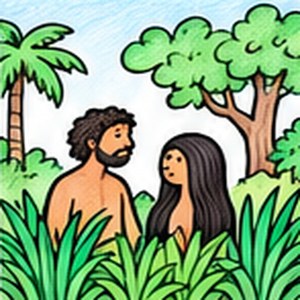
2The garden of Eden
“Jehovah God formed man of the dust of the ground, and breathed into his nostrils the breath of life; and man became a living soul”. God plants a garden in Eden and puts the man there to work it and keep it. He tells him not to eat from “the tree of the knowledge of good and evil”, for on the day he eats of it he will die. Then God makes the woman from one of the man's ribs and brings her to him.
Genesis 2:8And Jehovah God planted a garden eastward, in Eden; and there he put the man whom he had formed.
3The forbidden fruit
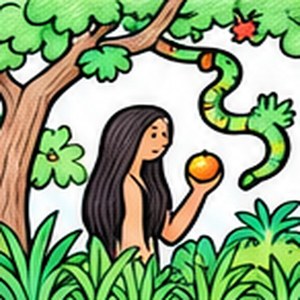
The serpent tells the woman, “Ye shall not surely die”. She eats fruit from the tree of the knowledge of good and evil and gives some to her husband, and he eats. Their eyes are opened, and they hide from God among the trees. God tells them of pain and hard work, and that man will return to the ground: “for dust thou art, and unto dust shalt thou return”. He tells the serpent that the woman's seed “shall bruise thy head”. Then he sends them out of the garden.
Genesis 3:6And when the woman saw that the tree was good for food, and that it was a delight to the eyes, and that the tree was to be desired to make one wise, she took of the fruit thereof, and did eat; and she gave also unto her husband with her, and he did eat.
4Cain and Abel
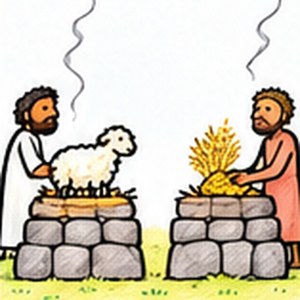
Adam and Eve have two sons, Cain and Abel. Both bring offerings, and God accepts Abel's but not Cain's. Cain is very angry. God warns him, “sin coucheth at the door”, but Cain kills his brother. When God asks where Abel is, Cain answers, “am I my brother’s keeper?” God sends Cain away to wander, and appoints a sign for him so that no one will kill him.
Genesis 4:4And Abel, he also brought of the firstlings of his flock and of the fat thereof. And Jehovah had respect unto Abel and to his offering:
5The flood
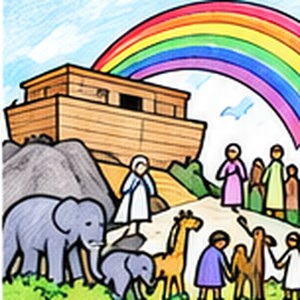
The earth is filled with violence, and God decides to send a flood. “But Noah found favor in the eyes of Jehovah” (Genesis 6:8). Noah builds an ark as God tells him, and he, his family and the animals with them are saved. Afterward God makes a covenant never again to destroy the earth by a flood, and sets his bow in the cloud as the sign.
Genesis 9:13I do set my bow in the cloud, and it shall be for a token of a covenant between me and the earth.
6The tower of Babel
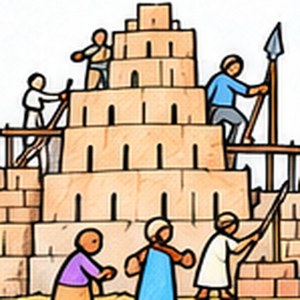
The whole earth has one language. People build a city and “a tower, whose top may reach unto heaven”, saying, “let us make us a name”. God confuses their language so they cannot understand one another, and he scatters them across the earth. The city is called Babel.
Genesis 11:9Therefore was the name of it called Babel; because Jehovah did there confound the language of all the earth: and from thence did Jehovah scatter them abroad upon the face of all the earth.
Abraham's family
Genesis 12 to 24
7Abram leaves home
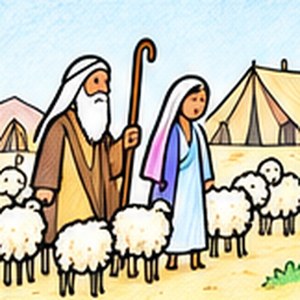
God tells Abram to leave his country and his father's house for a land he will show him. He promises, “I will make of thee a great nation”, and says that in him “shall all the families of the earth be blessed”. Abram goes, with his wife Sarai and his nephew Lot. In Canaan God appears to him and says, “Unto thy seed will I give this land”.
Genesis 12:1Now Jehovah said unto Abram, Get thee out of thy country, and from thy kindred, and from thy father’s house, unto the land that I will show thee:
8The promise under the stars
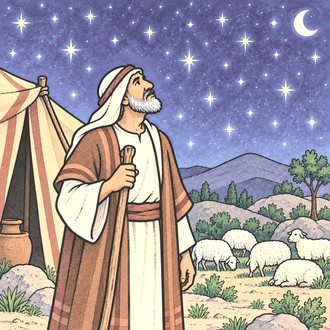
God brings Abram outside and tells him to count the stars, if he can: “So shall thy seed be”. “And he believed in Jehovah; and he reckoned it to him for righteousness”. That day God makes a covenant with Abram to give the land to his descendants.
Genesis 15:5And he brought him forth abroad, and said, Look now toward heaven, and number the stars, if thou be able to number them: and he said unto him, So shall thy seed be.
9Isaac is born
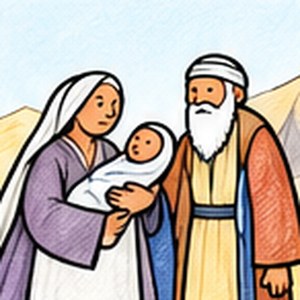
God renames Abram and Sarai as Abraham and Sarah. He makes his covenant with Abraham and gives circumcision as its sign. God promises them a son, and Sarah laughs, for she is old. God answers, “Is anything too hard for Jehovah?” (Genesis 18:14). Jehovah destroys Sodom and Gomorrah; Lot escapes, but his wife looks back and becomes a pillar of salt. When Abraham is a hundred years old, Sarah gives birth to Isaac.
Genesis 21:2And Sarah conceived, and bare Abraham a son in his old age, at the set time of which God had spoken to him.
10Hagar and Ishmael
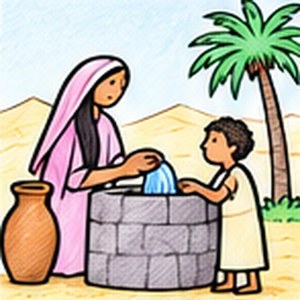
Abraham already has a son, Ishmael, by Hagar, Sarah's Egyptian servant. Years before, when Hagar ran away from Sarah, the angel of Jehovah found her by a spring, and she called him “Thou art a God that seeth” (Genesis 16:13). After Isaac is born, Hagar and the boy are sent away into the desert. When their water runs out, God hears the boy, shows Hagar a well, and promises, “I will make him a great nation”.
Genesis 21:19And God opened her eyes, and she saw a well of water; and she went, and filled the bottle with water, and gave the lad drink.
11Abraham's test
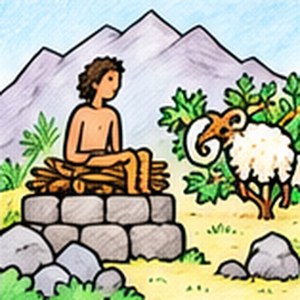
God tells Abraham to offer his son Isaac as a burnt-offering on a mountain. On the way Isaac asks where the lamb is, and Abraham answers, “God will provide himself the lamb”. As Abraham takes the knife, the angel of Jehovah calls to him from heaven and stops him. Abraham offers a ram caught in a thicket instead, and names the place Jehovah-jireh. God repeats his promise: “in thy seed shall all the nations of the earth be blessed”.
Genesis 22:13And Abraham lifted up his eyes, and looked, and, behold, behind him a ram caught in the thicket by his horns: and Abraham went and took the ram, and offered him up for a burnt-offering in the stead of his son.
12A wife for Isaac
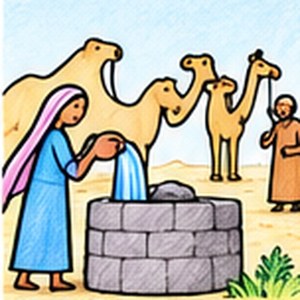
Abraham sends his servant back to his family's land to find a wife for Isaac. At a well the servant prays for a sign, and Rebekah offers water to him and to his camels. Her family asks her if she will go, and she says, “I will go”. Isaac takes Rebekah as his wife, “and he loved her”.
Genesis 24:19And when she had done giving him drink, she said, I will draw for thy camels also, until they have done drinking.
Jacob and Joseph
Genesis 25 to 50, and Exodus 1
13Esau sells his birthright
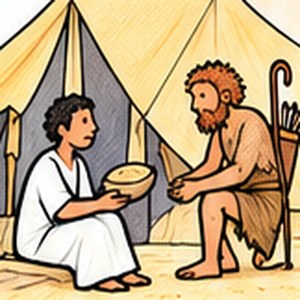
Rebekah has twins. Before they are born, God tells her, “the elder shall serve the younger”. Esau becomes a hunter, and Jacob stays among the tents. One day Esau comes in from the field faint with hunger and sells his rights as the firstborn to Jacob for bread and a stew of lentils. “so Esau despised his birthright”.
Genesis 25:34And Jacob gave Esau bread and pottage of lentils; and he did eat and drink, and rose up, and went his way: so Esau despised his birthright.
14Jacob's dream
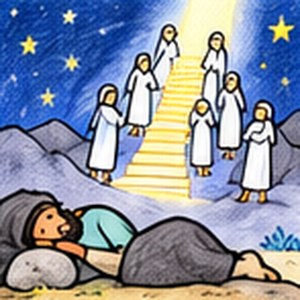
With his mother's help, Jacob tricks his father Isaac, who is old and cannot see, into blessing him instead of Esau. Then he runs from his brother's anger. On the way he dreams of a ladder reaching to heaven, “and, behold, the angels of God ascending and descending on it”. God gives him the promise made to Abraham, and Jacob names the place Beth-el. He goes on to his uncle Laban, works for him twenty years, and marries Laban's daughters Leah and Rachel. His family grows to eleven sons and a daughter.
Genesis 28:12And he dreamed; and, behold, a ladder set up on the earth, and the top of it reached to heaven; and, behold, the angels of God ascending and descending on it.
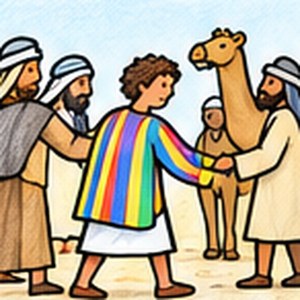
15Joseph is sold
Before Joseph's story begins, Jacob wrestles all night on his way home and is given a new name: “Thy name shall be called no more Jacob, but Israel” (Genesis 32:28). Of his twelve sons he loves Joseph most, and gives him “a coat of many colors”. Joseph dreams that his brothers' sheaves, and even the sun, moon and stars, bow down to him, and his brothers hate him for it. They throw him into a pit and sell him to traders going to Egypt for twenty pieces of silver. Then they bring his coat, dipped in blood, to their father, who mourns for him as dead.
Genesis 37:28And there passed by Midianites, merchantmen; and they drew and lifted up Joseph out of the pit, and sold Joseph to the Ishmaelites for twenty pieces of silver. And they brought Joseph into Egypt.
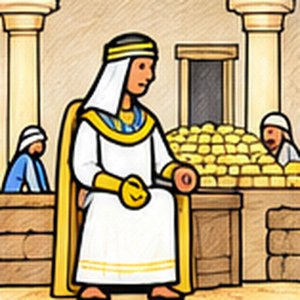
16Joseph rules in Egypt
In Egypt Joseph is sold to Potiphar, an officer of Pharaoh, and “Jehovah was with Joseph” (Genesis 39:2). Potiphar's wife falsely accuses him, and he is put in prison. There he explains the dreams of Pharaoh's butler and baker. Later he explains Pharaoh's dreams of seven years of plenty and seven years of famine, and Pharaoh puts him in charge of all the land of Egypt.
Genesis 41:41And Pharaoh said unto Joseph, See, I have set thee over all the land of Egypt.
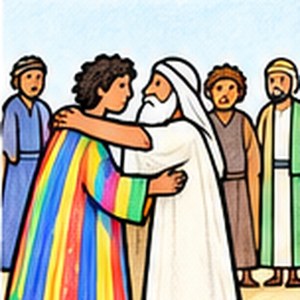
17Joseph and his family
The famine drives Joseph's brothers to Egypt to buy grain. They do not know him, and he tests them. Then he tells them, “I am Joseph” (Genesis 45:3), and forgives them. His father comes down to Egypt with the whole family, and Joseph meets him with tears. After Jacob dies, Joseph tells his brothers, “ye meant evil against me; but God meant it for good” (Genesis 50:20).
Genesis 46:29And Joseph made ready his chariot, and went up to meet Israel his father, to Goshen; and he presented himself unto him, and fell on his neck, and wept on his neck a good while.
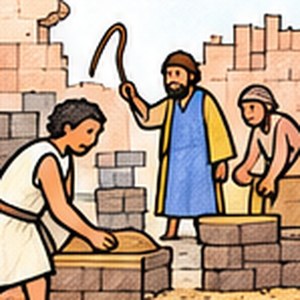
18Slaves in Egypt
Israel's family grows into a great people in Egypt. Then “there arose a new king over Egypt, who knew not Joseph”. He fears them and makes them slaves, with hard labor in mortar and brick. He orders the Hebrew midwives to kill the baby boys, but the midwives fear God and do not obey.
Exodus 1:14and they made their lives bitter with hard service, in mortar and in brick, and in all manner of service in the field, all their service, wherein they made them serve with rigor.
Out of Egypt
Exodus 2 to 17

19Moses in the reeds
Pharaoh orders every Hebrew baby boy thrown into the river. One mother hides her son in “an ark of bulrushes” among the reeds by the river, and his sister watches from far off. Pharaoh's daughter finds him and feels pity for him. The sister offers to find a Hebrew nurse and brings the baby's own mother. When he is grown, Pharaoh's daughter names him Moses, “Because I drew him out of the water”.
Exodus 2:3And when she could not longer hide him, she took for him an ark of bulrushes, and daubed it with slime and with pitch; and she put the child therein, and laid it in the flags by the river’s brink.
20The burning bush
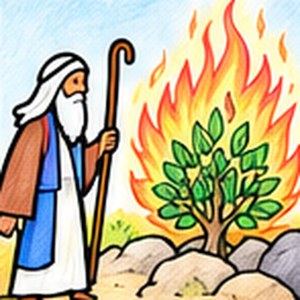
When Moses is grown, he kills an Egyptian who is beating a Hebrew, and flees to Midian, where he becomes a shepherd. God speaks to him from a bush that burns but is not burnt up: “the place whereon thou standest is holy ground”. God says he has seen the suffering of his people, and sends Moses to bring them out of Egypt. When Moses asks his name, God answers, “I am that I am”. Then he gives his name, YHWH, which the American Standard Version prints as Jehovah.
Exodus 3:15And God said moreover unto Moses, Thus shalt thou say unto the children of Israel, Jehovah, the God of your fathers, the God of Abraham, the God of Isaac, and the God of Jacob, hath sent me unto you: this is my name for ever, and this is my memorial unto all generations.
21The plagues
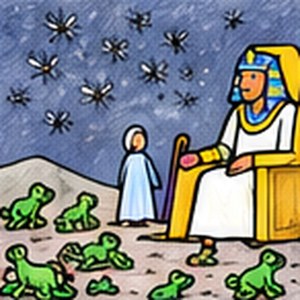
Moses and his brother Aaron tell Pharaoh, “Let my people go” (Exodus 5:1). Pharaoh refuses, and his heart is hardened. God sends plagues on Egypt one after another: blood, frogs, lice, flies, disease on the cattle, boils, hail, locusts and darkness.
Exodus 8:6And Aaron stretched out his hand over the waters of Egypt; and the frogs came up, and covered the land of Egypt.
22The Passover
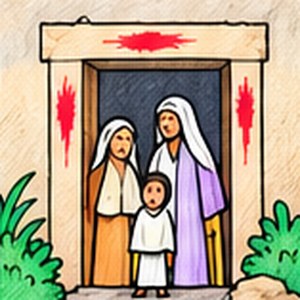
In the last plague the firstborn of Egypt die. Each family of Israel kills a lamb “without blemish”, marks the doorposts with its blood, and eats it with unleavened bread, dressed and ready to leave. Death passes over the houses marked with the blood. God tells them to keep this day as a feast “throughout your generations”. That night Pharaoh lets them go.
Exodus 12:13And the blood shall be to you for a token upon the houses where ye are: and when I see the blood, I will pass over you, and there shall no plague be upon you to destroy you, when I smite the land of Egypt.
23Through the sea
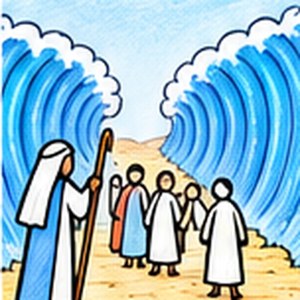
God leads Israel by a pillar of cloud by day and a pillar of fire by night. Pharaoh changes his mind and chases them with his army. Moses stretches out his hand over the sea, and God drives the sea back with a strong east wind. Israel walks through on dry ground, and the water returns over the Egyptians. Then Moses and Israel sing, “I will sing unto Jehovah, for he hath triumphed gloriously” (Exodus 15:1).
Exodus 14:22And the children of Israel went into the midst of the sea upon the dry ground: and the waters were a wall unto them on their right hand, and on their left.
24Food and water in the desert
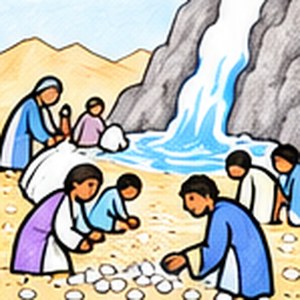
In the desert the people complain of hunger and thirst. God sends quails in the evening and manna, bread from heaven, each morning. On the sixth day they gather twice as much, so that they can rest on the sabbath. At Horeb, Moses strikes a rock, and water comes out for the people to drink.
Exodus 16:15And when the children of Israel saw it, they said one to another, What is it? for they knew not what it was. And Moses said unto them, It is the bread which Jehovah hath given you to eat.
Sinai and the wilderness
Exodus 19 to Deuteronomy 34
25The law at Sinai
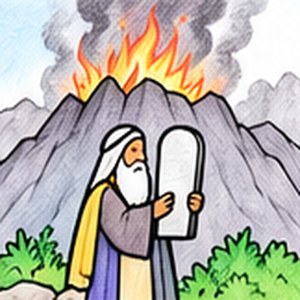
At Mount Sinai God speaks the Ten Words (Commandments) from the fire on the mountain. The people answer, “All that Jehovah hath spoken will we do, and be obedient” (Exodus 24:7). God makes his covenant with Israel, and Moses stays on the mountain forty days and forty nights. God gives him the law, the Torah, and two tablets of stone.
Exodus 31:18And he gave unto Moses, when he had made an end of communing with him upon mount Sinai, the two tables of the testimony, tables of stone, written with the finger of God.
26The golden calf
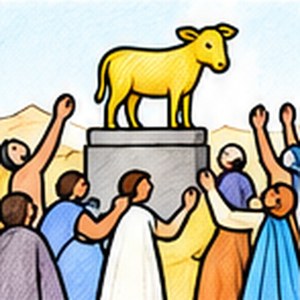
While Moses is on the mountain, the people ask Aaron to make them gods. Aaron makes a golden calf, and they say, “These are thy gods, O Israel”. Moses breaks the tablets. He pleads with God for the people, and God does not destroy them. Later God gives the tablets again and proclaims his name to Moses: “Jehovah, Jehovah, a God merciful and gracious” (Exodus 34:6).
Exodus 32:4And he received it at their hand, and fashioned it with a graving tool, and made it a molten calf: and they said, These are thy gods, O Israel, which brought thee up out of the land of Egypt.
27The tabernacle
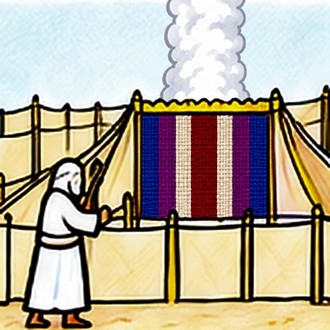
God tells Israel to build a tent where he will dwell among them, the tabernacle. In it is the ark of the covenant, with the mercy-seat, its gold lid, on top. Aaron and his sons serve as priests. When it is finished, the cloud covers it and the glory of Jehovah fills it. The book of Leviticus gives the laws for the offerings, the priests and the day of atonement, and says, “Ye shall be holy; for I Jehovah your God am holy” (Leviticus 19:2).
Exodus 40:34Then the cloud covered the tent of meeting, and the glory of Jehovah filled the tabernacle.
Also in this part of the story:
Leviticus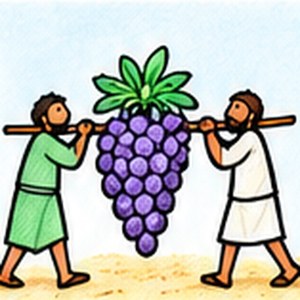
28The spies
Twelve men spy out the land of Canaan and bring back a huge cluster of grapes. Ten of them say the people there are too strong. Two of them, Joshua and Caleb, say, “Jehovah is with us: fear them not” (Numbers 14:9). The people refuse to go in, so they must wander forty years in the desert. Of the grown men of that generation, only Joshua and Caleb will enter the land.
Numbers 13:23And they came unto the valley of Eshcol, and cut down from thence a branch with one cluster of grapes, and they bare it upon a staff between two; they brought also of the pomegranates, and of the figs.
29The bronze serpent
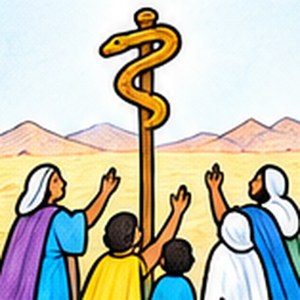
The people speak against God and Moses, and poisonous snakes bite them. They come to Moses and say, “We have sinned”, and Moses prays for them. God tells him to make a serpent and set it on a pole. Moses makes it of brass, and whoever is bitten and looks at it lives.
Numbers 21:9And Moses made a serpent of brass, and set it upon the standard: and it came to pass, that if a serpent had bitten any man, when he looked unto the serpent of brass, he lived.
30Moses sees the land
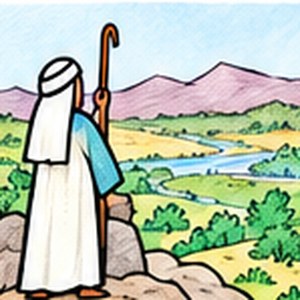
Moses may not enter the land, because at Meribah he struck the rock instead of speaking to it as God told him. Before he dies, he repeats the Torah to the new generation; this is the book of Deuteronomy. In it he says, “Hear, O Israel: Jehovah our God is one Jehovah” (Deuteronomy 6:4). God shows him the promised land from Mount Nebo. Moses dies there, and Joshua leads Israel after him.
Deuteronomy 34:4And Jehovah said unto him, This is the land which I sware unto Abraham, unto Isaac, and unto Jacob, saying, I will give it unto thy seed: I have caused thee to see it with thine eyes, but thou shalt not go over thither.
Into the land
Joshua, Judges, Ruth and 1 Samuel 1
31Crossing the Jordan
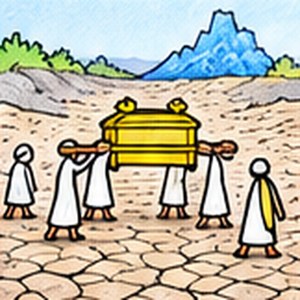
Joshua leads Israel after Moses. When the priests carrying the ark of the covenant step into the Jordan, the water stops upstream, and the people cross on dry ground. They take twelve stones from the river, one for each tribe, so their children will ask what the stones mean and remember what God did.
Joshua 3:17And the priests that bare the ark of the covenant of Jehovah stood firm on dry ground in the midst of the Jordan; and all Israel passed over on dry ground, until all the nation were passed clean over the Jordan.
32Jericho
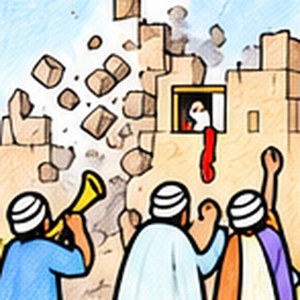
Before the battle, Rahab of Jericho hides two of Israel's spies. They tell her to tie “this line of scarlet thread” (Joshua 2:18) in her window. Israel marches around Jericho once a day for six days, and seven times on the seventh. The priests blow the trumpets, the people shout, and the wall falls down. Rahab and her family are spared.
Joshua 6:20So the people shouted, and the priests blew the trumpets: and it came to pass, when the people heard the sound of the trumpet, that the people shouted with a great shout, and the wall fell down flat, so that the people went up into the city, every man straight before him, and they took the city.
33Gideon
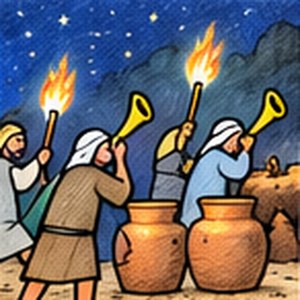
In the land, Israel turns away from God again and again, and enemies rule them. God raises up leaders called judges. The angel of Jehovah comes to Gideon and says, “Jehovah is with thee, thou mighty man of valor” (Judges 6:12). Gideon asks for a sign with a fleece of wool. God cuts his army to three hundred men, “lest Israel vaunt themselves against me”, and they defeat the Midianites with trumpets and torches hidden in pitchers.
Judges 7:20And the three companies blew the trumpets, and brake the pitchers, and held the torches in their left hands, and the trumpets in their right hands wherewith to blow; and they cried, The sword of Jehovah and of Gideon.
34Samson
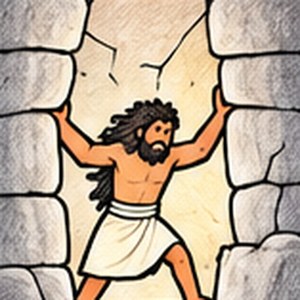
Samson is a judge with great strength. Before he was born, an angel said he would be a Nazirite to God, and “no razor shall come upon his head” (Judges 13:5). Delilah keeps asking the secret of his strength until he tells her, and the Philistines cut his hair and capture him. They put out his eyes. Blind and in chains, he prays, “remember me, I pray thee, and strengthen me”. He pushes down the pillars of their temple and dies with them.
Judges 16:30And Samson said, Let me die with the Philistines. And he bowed himself with all his might; and the house fell upon the lords, and upon all the people that were therein. So the dead that he slew at his death were more than they that he slew in his life.
35Ruth
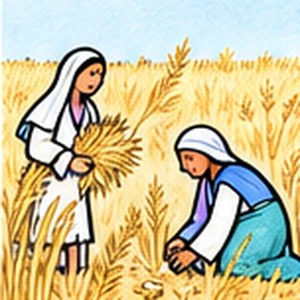
Naomi, a widow, goes home to Bethlehem from Moab. Her daughter-in-law Ruth, a woman of Moab, will not leave her: “thy people shall be my people, and thy God my God” (Ruth 1:16). Ruth gathers grain in the field of Boaz, a relative of Naomi's husband. As near kinsman, Boaz buys back the family's land and takes Ruth as his wife. Their great-grandson is David.
Ruth 2:3And she went, and came and gleaned in the field after the reapers: and her hap was to light on the portion of the field belonging unto Boaz, who was of the family of Elimelech.
36Samuel is given to God
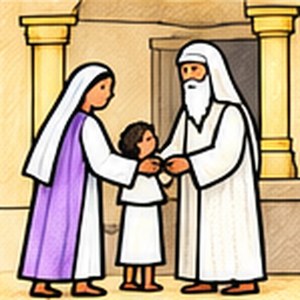
Hannah has no children and prays for a son, promising to give him to God. When Samuel is born, she brings him to serve with Eli the priest. One night God calls the boy by name, and Samuel answers, “Speak; for thy servant heareth” (1 Samuel 3:10). He grows up to be a prophet and judge over Israel.
1 Samuel 1:28therefore also I have granted him to Jehovah; as long as he liveth he is granted to Jehovah. And he worshipped Jehovah there.
The kings
1 Samuel 9 to 1 Kings 12
37Saul, the first king
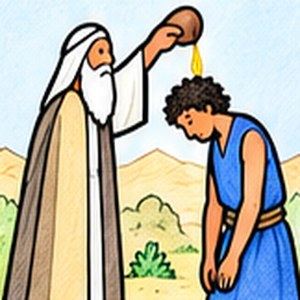
The people ask Samuel for a king like all the nations. God tells Samuel, “they have not rejected thee, but they have rejected me” (1 Samuel 8:7), but he gives them a king. Samuel anoints Saul with oil. Later Saul disobeys God, and Samuel tells him, “to obey is better than sacrifice” (1 Samuel 15:22). God rejects Saul as king.
1 Samuel 10:1Then Samuel took the vial of oil, and poured it upon his head, and kissed him, and said, Is it not that Jehovah hath anointed thee to be prince over his inheritance?
38David is anointed
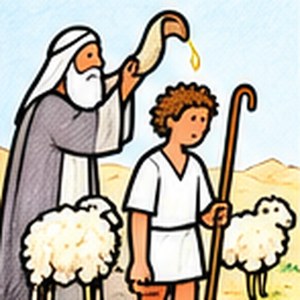
God sends Samuel to Bethlehem to anoint one of the sons of Jesse. Samuel thinks the oldest son must be the one, but God tells him, “man looketh on the outward appearance, but Jehovah looketh on the heart”. Samuel passes over seven sons and anoints the youngest, David, who keeps the sheep. From that day the Spirit of Jehovah comes upon David.
1 Samuel 16:13Then Samuel took the horn of oil, and anointed him in the midst of his brethren: and the Spirit of Jehovah came mightily upon David from that day forward. So Samuel rose up, and went to Ramah.
39David and Goliath
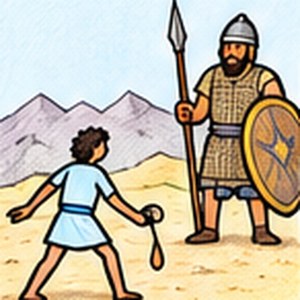
Goliath, a Philistine giant, dares Israel's army to send a man to fight him. David goes out with a sling and five smooth stones, saying, “the battle is Jehovah’s”, and strikes him down. After this King Saul grows jealous and tries to kill David. Saul's son Jonathan loves David as his own soul and helps him escape.
1 Samuel 17:49And David put his hand in his bag, and took thence a stone, and slang it, and smote the Philistine in his forehead; and the stone sank into his forehead, and he fell upon his face to the earth.
40King David
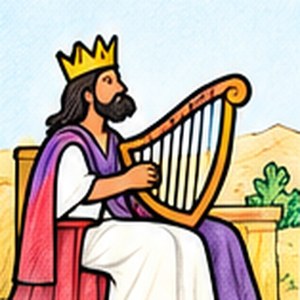
After Saul dies, David becomes king of all Israel and makes Jerusalem his city. God promises him, “thy throne shall be established for ever” (2 Samuel 7:16). Later David takes Bathsheba, the wife of Uriah, and has Uriah killed in battle. The prophet Nathan tells him, “Thou art the man” (2 Samuel 12:7), and David says, “I have sinned against Jehovah” (2 Samuel 12:13). Many of the Psalms carry David's name.
2 Samuel 5:3So all the elders of Israel came to the king to Hebron; and king David made a covenant with them in Hebron before Jehovah: and they anointed David king over Israel.
Also in this part of the story:
Psalms1 Chronicles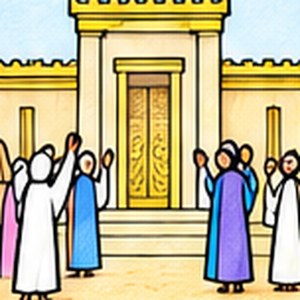
41Solomon builds the temple
David's son Solomon asks God for wisdom. When two women both claim one baby, he finds the true mother. He builds the temple in Jerusalem, and the cloud of Jehovah's glory fills it. But when he is old, “his wives turned away his heart after other gods” (1 Kings 11:4). Proverbs and the Song of Songs carry his name.
1 Kings 8:10And it came to pass, when the priests were come out of the holy place, that the cloud filled the house of Jehovah,
Also in this part of the story:
JobProverbsEcclesiastesSong of Songs2 Chronicles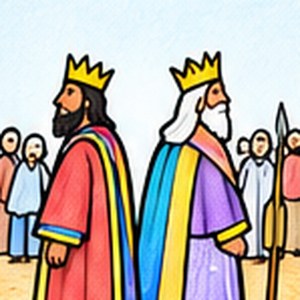
42The kingdom splits
After Solomon, his son Rehoboam answers the people harshly. Ten tribes break away and make Jeroboam king of the northern kingdom of Israel. Judah keeps David's family as its kings in Jerusalem. Jeroboam sets up two golden calves, at Beth-el and at Dan, and tells the people, “behold thy gods, O Israel”.
1 Kings 12:16And when all Israel saw that the king hearkened not unto them, the people answered the king, saying, What portion have we in David? neither have we inheritance in the son of Jesse: to your tents, O Israel: now see to thine own house, David. So Israel departed unto their tents.
The prophets
1 Kings 18 to 2 Kings 17, Jonah, Amos and Jeremiah
43Fire on Mount Carmel
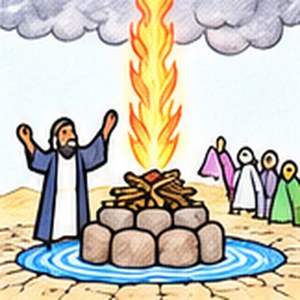
King Ahab and Queen Jezebel lead Israel to worship Baal. The prophet Elijah gathers the people on Mount Carmel and asks, “How long go ye limping between the two sides?” Fire falls from heaven on Elijah's altar, and the people fall on their faces and say, “Jehovah, he is God; Jehovah, he is God”.
1 Kings 18:38Then the fire of Jehovah fell, and consumed the burnt-offering, and the wood, and the stones, and the dust, and licked up the water that was in the trench.
44Elijah taken up
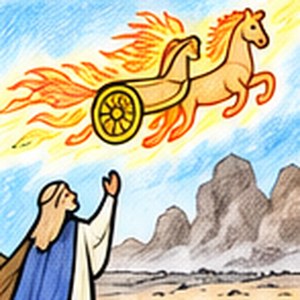
Elijah's helper Elisha will not leave him. Elisha asks for “a double portion of thy spirit”. A chariot of fire appears, and Elijah goes up by a whirlwind into heaven. Elisha picks up Elijah's mantle and carries on his work.
2 Kings 2:11And it came to pass, as they still went on, and talked, that, behold, there appeared a chariot of fire, and horses of fire, which parted them both asunder; and Elijah went up by a whirlwind into heaven.
45Jonah
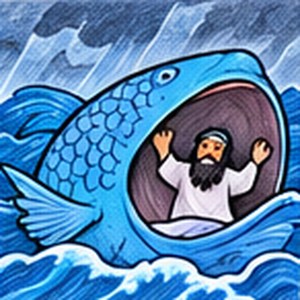
God sends the prophet Jonah to warn Nineveh, “that great city” (Jonah 1:2), but Jonah runs the other way by ship. In a storm the sailors throw him into the sea, and a great fish swallows him. From inside the fish he prays, and the fish spits him out on land. When he preaches, Nineveh turns from its evil, and God spares the city. Jonah is angry, and God asks him whether he should not have pity on Nineveh.
Jonah 1:17And Jehovah prepared a great fish to swallow up Jonah; and Jonah was in the belly of the fish three days and three nights.
Also in this part of the story:
Nahum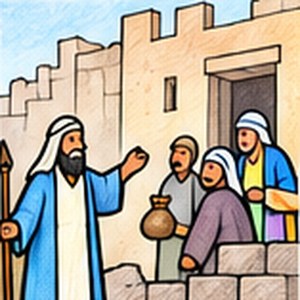
46Amos
Prophets warn Israel and Judah that God will judge them for worshiping idols and mistreating the poor. Amos, a herdsman of Tekoa, preaches in the northern kingdom. He brings God's word to Israel: “Seek ye me, and ye shall live” (Amos 5:4).
Amos 5:24But let justice roll down as waters, and righteousness as a mighty stream.
47Israel taken captive
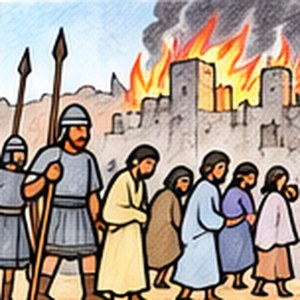
The northern kingdom does not turn back. The Assyrians capture Samaria and carry the people away. 2 Kings gives the reason: “the children of Israel had sinned against Jehovah their God” (2 Kings 17:7). In Judah, the prophet Isaiah warns and comforts the people, and in the days of King Hezekiah, Jerusalem is saved from the Assyrian army.
2 Kings 17:6In the ninth year of Hoshea the king of Assyria took Samaria, and carried Israel away unto Assyria, and placed them in Halah, and on the Habor, the river of Gozan, and in the cities of the Medes.
Also in this part of the story:
Isaiah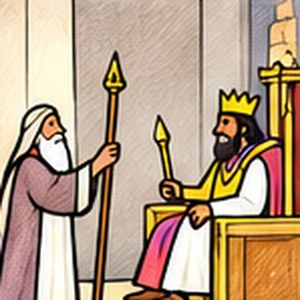
48Jeremiah warns the king
Babylon rises and surrounds Jerusalem. The prophet Jeremiah tells King Zedekiah to surrender so the city will not be burned. The princes let Jeremiah down into a pit of mire to die, but Ebed-melech the Ethiopian pulls him out. The king does not listen. Jeremiah also gives God's promise: “I will make a new covenant with the house of Israel, and with the house of Judah” (Jeremiah 31:31).
Jeremiah 38:17Then said Jeremiah unto Zedekiah, Thus saith Jehovah, the God of hosts, the God of Israel: If thou wilt go forth unto the king of Babylon’s princes, then thy soul shall live, and this city shall not be burned with fire; and thou shalt live, and thy house.
Exile and return
2 Kings 25 to Nehemiah
49Jerusalem falls
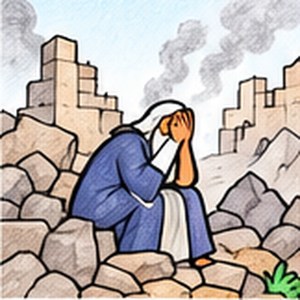
The Babylonians break into Jerusalem, burn the temple, and carry the people away to Babylon. King Zedekiah's sons are killed before him, and his eyes are put out. Jeremiah had said the land would serve the king of Babylon “seventy years” (Jeremiah 25:11). The book of Lamentations mourns the ruined city.
2 Kings 25:9And he burnt the house of Jehovah, and the king’s house; and all the houses of Jerusalem, even every great house, burnt he with fire.
Also in this part of the story:
LamentationsHabakkukZephaniahObadiah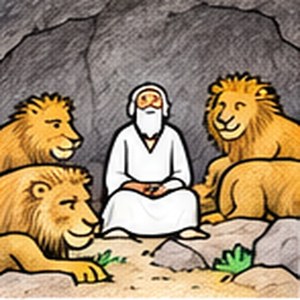
50Daniel and his friends in Babylon
In Babylon, Daniel and his friends Shadrach, Meshach and Abednego stay faithful to God. The three friends will not bow to the king's golden image and are thrown into a burning fiery furnace. They come out unharmed, and the king sees a fourth man walking with them in the fire. Years later Daniel keeps praying when it is against the law. He is thrown to the lions and is not harmed.
Daniel 6:22My God hath sent his angel, and hath shut the lions’ mouths, and they have not hurt me; forasmuch as before him innocency was found in me; and also before thee, O king, have I done no hurt.
51The valley of dry bones
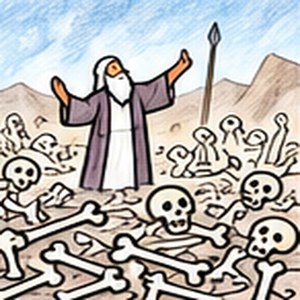
The prophet Ezekiel, also a captive in Babylon, sees a valley full of dry bones. When he speaks God's word, the bones come together, breath enters them, and they live. God says, “these bones are the whole house of Israel”, and promises to bring them home.
Ezekiel 37:10So I prophesied as he commanded me, and the breath came into them, and they lived, and stood up upon their feet, an exceeding great army.
52Return and rebuilding
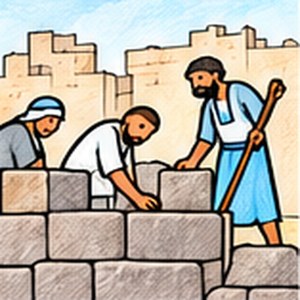
Persia conquers Babylon, and King Cyrus lets the Jews go home to build the house of Jehovah. They lay the foundation of a new temple with shouts of praise, while old men who saw the first temple weep. The prophets Haggai and Zechariah urge them to finish it. Later comes Ezra the scribe, who “had set his heart to seek the law of Jehovah, and to do it, and to teach” (Ezra 7:10).
Ezra 3:11And they sang one to another in praising and giving thanks unto Jehovah, saying, For he is good, for his lovingkindness endureth for ever toward Israel. And all the people shouted with a great shout, when they praised Jehovah, because the foundation of the house of Jehovah was laid.
53Queen Esther
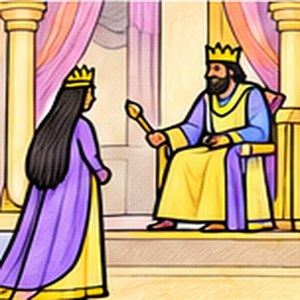
In Persia, a Jewish woman named Esther becomes queen. The king's official Haman plots to destroy all the Jews. Her cousin Mordecai tells her, “who knoweth whether thou art not come to the kingdom for such a time as this?” (Esther 4:14). Esther risks her life to go before the king uninvited, and her people are saved. The Jews keep the feast of Purim to remember it.
Esther 5:2And it was so, when the king saw Esther the queen standing in the court, that she obtained favor in his sight; and the king held out to Esther the golden sceptre that was in his hand. So Esther drew near, and touched the top of the sceptre.
54Nehemiah rebuilds the wall
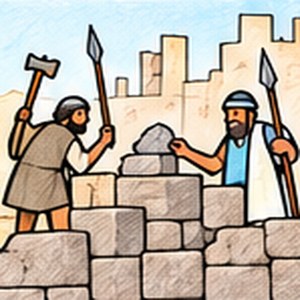
Nehemiah, cupbearer to the king of Persia, comes to Jerusalem and leads the people in rebuilding its walls. They work with a tool in one hand and a weapon in the other. When the wall is done, Ezra reads the book of the law to the people, and they weep. Nehemiah tells them, “the joy of Jehovah is your strength” (Nehemiah 8:10).
Nehemiah 4:17They that builded the wall and they that bare burdens laded themselves; every one with one of his hands wrought in the work, and with the other held his weapon;
Also in this part of the story:
Malachi