The Letters, One by One

The New Testament letters were sent one at a time, to real people in real places, before they were gathered into one book. This page shows each letter on its own.

Pick a part, then a letter.

Twenty-one letters, and the seven short letters inside Revelation. Each card gives who the letter says sent it, who it was sent to, what the book of Acts says about that place, the people it names, what it says about being read or passed on, and how it ends. Every quotation is the American Standard Version’s own words.

Part I

Paul’s letters to churches

Nine letters, from Rome to Thessalonica.

Before they were bound together in the New Testament, these were real letters. Each one was written at a particular time, to particular people, about things that were happening to them. A messenger carried it, often for hundreds of miles, and it was read aloud to the church when it arrived.

Reading a letter as a letter helps. Ask who wrote it, who it went to, what was going on in that place, and what the writer wanted them to do. The cards in this part give those facts for each of Paul’s nine letters to churches, from the letter itself and from the book of Acts, which tells how many of these churches began.

RomansPaul to the believers in Rome, a city he had not yet visited.

Romans is Paul’s longest letter: 16 chapters, 432 verses in the ASV. He wrote it to the believers in Rome, the capital of the empire, a church he had not started and had never visited. He wanted to visit them on his way to Spain.

It sets out the gospel step by step. Chapters 1 to 3: all people, Jews and Gentiles alike, have sinned. Chapters 3 to 5: a person is made right with God by faith, as Abraham was. Chapters 6 to 8: life in the Spirit, ending with the promise that nothing “shall be able to separate us from the love of God.” Chapters 9 to 11: what this means for Israel. Chapters 12 to 16: how to live, including obeying rulers and loving one another, and a long list of greetings.

The letter was written down by a man named Tertius. Paul commends to the Romans a woman named Phoebe, a servant of the church at Cenchreae, the port of Corinth. Paul wrote it before he went to Jerusalem; he reached Rome years later as a prisoner.

Passages people know it for include Romans 3:23 (“all have sinned”), 5:8, 6:23, 8:28, 8:38 and 39, 10:9, and 12:1 and 2.
Who the letter says sent it

  • “Paul, a servant of Jesus Christ, called to be an apostle” (Romans 1:1). Open the verse
  • Written down by another man: “I Tertius, who write the epistle, salute you in the Lord.” (Romans 16:22). Open the verse

Who it was sent to

  • “to all that are in Rome, beloved of God, called to be saints” (Romans 1:7). Open the verse

The place

  • Rome, the capital of the empire. When he wrote, Paul had not been there: “oftentimes I purposed to come unto you (and was hindered hitherto)” (Romans 1:13). Open the verse
  • He hoped to go on to Spain: “whensoever I go unto Spain” (Romans 15:24). Open the verse
  • He reached Rome as a prisoner: “And when we entered into Rome” (Acts 28:16). Open the verse

People it names

Phoebe, Prisca, Aquila, Epaenetus, Mary, Andronicus, Junias, Ampliatus, Urbanus, Stachys, Apelles, Aristobulus, Herodion, Narcissus, Tryphaena, Tryphosa, Persis, Rufus, Asyncritus, Phlegon, Hermes, Patrobas, Hermas, Philologus, Julia, Nereus, Olympas, Timothy, Lucius, Jason, Sosipater, Tertius, Gaius, Erastus, Quartus.

Who carried it

  • Paul commends the woman who is coming to them: “I commend unto you Phoebe our sister, who is a servant of the church that is at Cenchreae” (Romans 16:1). Open the verse Cenchreae was the port of Corinth.

Greetings from Corinth

  • “Gaius my host, and of the whole church, saluteth you. Erastus the treasurer of the city saluteth you” (Romans 16:23). Open the verse

How it ends

  • “to the only wise God, through Jesus Christ, to whom be the glory for ever. Amen.” (Romans 16:27). Open the verse
1 CorinthiansPaul and Sosthenes to the church at Corinth.

1 Corinthians has 16 chapters, 437 verses. Paul started the church in Corinth, a busy port city in Greece, and stayed there a year and a half (Acts 18). He wrote this letter later from Ephesus, after he heard of problems in the church from members of Chloe’s household and received a letter from them with questions.

It deals with one problem after another: the church split into groups following different leaders; a man living with his father’s wife; believers suing each other in court; questions about marriage; whether to eat meat offered to idols; how to behave at the Lord’s Supper; and how to use spiritual gifts in meetings.

It also holds two of the best-known chapters in the Bible. Chapter 13 is about love: “Love suffereth long, and is kind.” Chapter 15 is about the resurrection: Paul writes that Christ rose from the dead, and was seen by Peter, the twelve, over five hundred people at once, James, and last of all Paul.

Who the letter says sent it

  • “Paul, called to be an apostle of Jesus Christ through the will of God, and Sosthenes our brother” (1 Corinthians 1:1). Open the verse
  • “The salutation of me Paul with mine own hand.” (1 Corinthians 16:21). Open the verse

Who it was sent to

  • “unto the church of God which is at Corinth” (1 Corinthians 1:2). Open the verse

The place

  • Paul founded the church there: “he departed from Athens, and came to Corinth” (Acts 18:1). Open the verse “And he dwelt there a year and six months” (Acts 18:11). Open the verse
  • He wrote from Ephesus: “But I will tarry at Ephesus until Pentecost” (1 Corinthians 16:8). Open the verse
  • It answers news he had heard: “by them that are of the household of Chloe” (1 Corinthians 1:11). Open the verse
  • It names an earlier letter: “I wrote unto you in my epistle” (1 Corinthians 5:9). Open the verse

People it names

Sosthenes, Chloe, Apollos, Cephas, Crispus, Gaius, Stephanas, Timothy, Fortunatus, Achaicus, Aquila, Prisca.

How it ends

  • “My love be with you all in Christ Jesus. Amen.” (1 Corinthians 16:24). Open the verse
2 CorinthiansPaul and Timothy to Corinth and all Achaia.

2 Corinthians has 13 chapters, 257 verses, written by Paul and Timothy to the church at Corinth and all believers in the province of Achaia (southern Greece).

It is Paul’s most personal letter. Between 1 and 2 Corinthians things had gone badly. Paul had made a painful visit, and then written a severe letter “with many tears.” Titus brought word that the church had taken it to heart, and Paul writes with relief.

He defends his work against men he calls “the very chiefest apostles,” and lists what he has suffered: beaten, stoned, shipwrecked, in prison, hungry, cold. He speaks of his “thorn in the flesh” and of God’s answer: “My grace is sufficient for thee.” Chapters 8 and 9 ask the Corinthians to give generously to a collection for the poor believers in Jerusalem.

Who the letter says sent it

  • “Paul, an apostle of Christ Jesus through the will of God, and Timothy our brother” (2 Corinthians 1:1). Open the verse

Who it was sent to

  • “unto the church of God which is at Corinth, with all the saints that are in the whole of Achaia” (2 Corinthians 1:1). Open the verse

The place

  • It speaks of a hard letter sent before: “For out of much affliction and anguish of heart I wrote unto you with many tears” (2 Corinthians 2:4). Open the verse “For though I made you sorry with my epistle, I do not regret it” (2 Corinthians 7:8). Open the verse

People it names

Timothy, Silvanus, Titus, Aretas.

How it ends

  • “The grace of the Lord Jesus Christ, and the love of God, and the communion of the Holy Spirit, be with you all.” (2 Corinthians 13:14). Open the verse
GalatiansPaul to several churches in one region.

Galatians has 6 chapters, 149 verses. It went to several churches in Galatia, a region in what is now central Turkey. It is the only letter of Paul with no word of thanks at the start; he goes straight to the problem.

After Paul left, other teachers had come and told the Gentile believers that they must be circumcised and keep the Law of Moses to belong to God’s people. Paul writes to oppose this. He tells how he received the gospel, how he met Peter and James in Jerusalem, and how he once confronted Peter face to face in Antioch.

He argues from Abraham, who believed God before the Law was given. He ends with the fruit of the Spirit: “love, joy, peace, longsuffering, kindness, goodness, faithfulness, meekness, self-control.” Near the end he takes the pen himself: “See with how large letters I write unto you with mine own hand.”

Who the letter says sent it

  • “Paul, an apostle (not from men, neither through man” (Galatians 1:1). Open the verse
  • “and all the brethren that are with me” (Galatians 1:2). Open the verse
  • “See with how large letters I write unto you with mine own hand.” (Galatians 6:11). Open the verse

Who it was sent to

  • “unto the churches of Galatia” (Galatians 1:2). Open the verse More than one church: one letter to be passed around a region.

The place

  • Galatia was a region of Asia Minor (modern Turkey). Acts: “And they went through the region of Phrygia and Galatia” (Acts 16:6). Open the verse
  • “because of an infirmity of the flesh I preached the gospel unto you the first time” (Galatians 4:13). Open the verse

People it names

Cephas, James, John, Barnabas, Titus, Peter.

How it ends

  • “The grace of our Lord Jesus Christ be with your spirit, brethren. Amen.” (Galatians 6:18). Open the verse
EphesiansPaul to the saints at Ephesus.

Ephesians has 6 chapters, 155 verses. Paul writes it as a prisoner. Ephesus was a large city on the coast of Asia (western Turkey), where Paul worked for about three years (Acts 19 and 20). The ASV’s margin notes that some very old copies do not have the words “at Ephesus” in the first verse.

The first half praises God for what he has done: choosing, adopting and forgiving believers, and making Jews and Gentiles one new people, with the wall between them broken down. Chapter 2 holds the verse “by grace have ye been saved through faith.”

The second half turns to daily life: unity in the church, honest speech, anger, husbands and wives, children and parents, servants and masters. It ends with the “whole armor of God”: truth, righteousness, the gospel of peace, faith, salvation, and the word of God. Tychicus carried it.

Who the letter says sent it

  • “Paul, an apostle of Christ Jesus through the will of God” (Ephesians 1:1). Open the verse
  • He writes as a prisoner: “I Paul, the prisoner of Christ Jesus” (Ephesians 3:1). Open the verse

Who it was sent to

  • “to the saints that are at Ephesus, and the faithful in Christ Jesus” (Ephesians 1:1). Open the verse
  • The ASV’s margin: “Some very ancient authorities omit at Ephesus.”

The place

  • Ephesus, a great city of the province of Asia. Paul stayed there longer than anywhere else: “And this continued for the space of two years” (Acts 19:10). Open the verse “by the space of three years I ceased not to admonish every one night and day with tears” (Acts 20:31). Open the verse

People it names

Tychicus.

Who carried it

  • “Tychicus, the beloved brother and faithful minister in the Lord, shall make known to you all things” (Ephesians 6:21). Open the verse

How it ends

  • “Grace be with all them that love our Lord Jesus Christ with a love incorruptible.” (Ephesians 6:24). Open the verse
PhilippiansPaul and Timothy to the church at Philippi.

Philippians has 4 chapters, 104 verses, from Paul and Timothy. Philippi was a Roman colony in Macedonia (northern Greece). Paul started the church there with Lydia, a seller of purple cloth, and a jailer who was baptized the night of an earthquake (Acts 16).

Paul writes from prison. The church had sent him a gift by Epaphroditus, who fell so ill on the trip that he nearly died. Philippians is partly a thank-you letter.

Its key word is joy, even in chains. It holds the hymn about Christ, who humbled himself and became obedient to death on a cross (chapter 2), Paul’s words “to live is Christ, and to die is gain,” and “I can do all things in him that strengtheneth me.” He asks two women, Euodia and Syntyche, to settle their quarrel.

Who the letter says sent it

  • “Paul and Timothy, servants of Christ Jesus” (Philippians 1:1). Open the verse

Who it was sent to

  • “to all the saints in Christ Jesus that are at Philippi, with the bishops and deacons” (Philippians 1:1). Open the verse

The place

  • “Philippi, which is a city of Macedonia, the first of the district, a Roman colony” (Acts 16:12). Open the verse The first believer there: “a certain woman named Lydia, a seller of purple” (Acts 16:14). Open the verse
  • He writes from prison: “so that my bonds became manifest in Christ throughout the whole praetorian guard” (Philippians 1:13). Open the verse

People it names

Timothy, Epaphroditus, Euodia, Syntyche, Clement.

A thank-you letter

  • They had sent him a gift: “having received from Epaphroditus the things that came from you” (Philippians 4:18). Open the verse
  • Greetings from Rome: “All the saints salute you, especially they that are of Caesar’s household.” (Philippians 4:22). Open the verse

How it ends

  • “The grace of the Lord Jesus Christ be with your spirit.” (Philippians 4:23). Open the verse
ColossiansPaul and Timothy to a church Paul had never seen.

Colossians has 4 chapters, 95 verses, from Paul and Timothy. Colossae was a small town near Laodicea and Hierapolis. Paul had never been there. The believers there had learned the gospel from Epaphras, who was from Colossae.

Paul writes from prison against teaching that was leading the believers astray: rules about food and holy days, worship of angels, and claims to secret knowledge. In answer he describes Christ as the image of the invisible God, the one in whom all things hold together. Like Ephesians, it has rules for households.

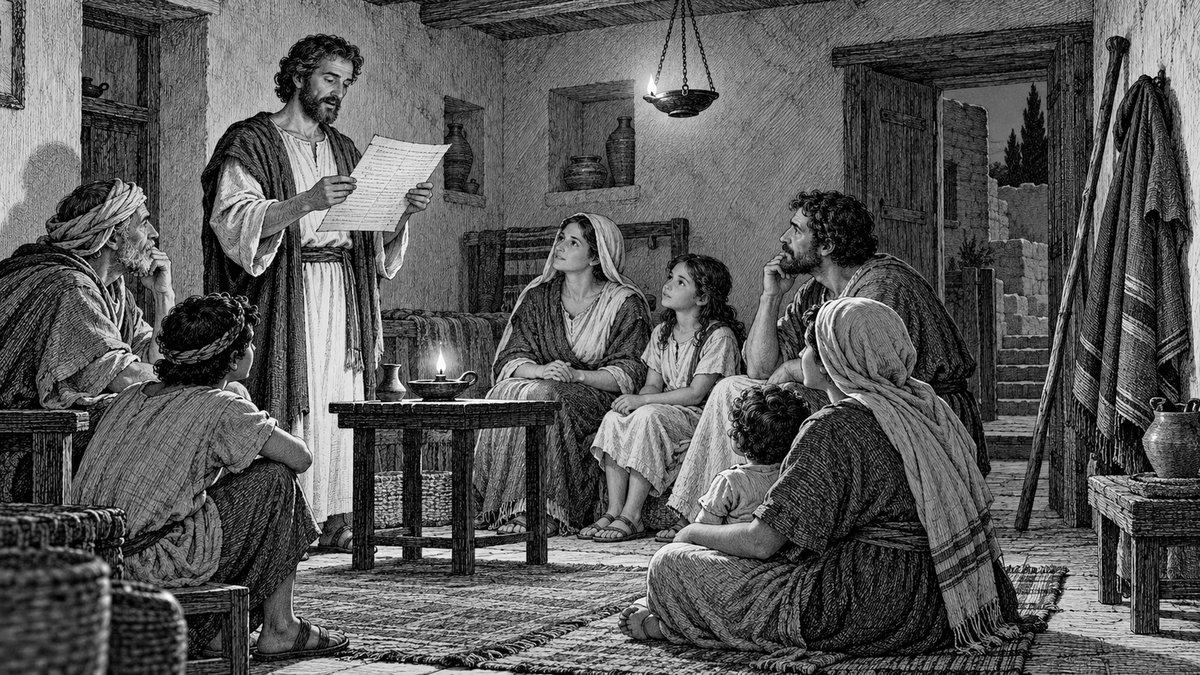
Tychicus carried it, with Onesimus. At the end Paul tells them to send the letter on to Laodicea and to read the letter coming from there.

Drawing: a letter read aloud to a church meeting in a house
Drawing: a letter read aloud to a church meeting in a house. An ink drawing made for Open Scroll, not a picture from the time.

Who the letter says sent it

  • “Paul, an apostle of Christ Jesus through the will of God, and Timothy our brother” (Colossians 1:1). Open the verse
  • “The salutation of me Paul with mine own hand.” (Colossians 4:18). Open the verse

Who it was sent to

  • “to the saints and faithful brethren in Christ that are at Colossae” (Colossians 1:2). Open the verse

The place

  • Colossae is not named in Acts. It was near Laodicea and Hierapolis: “for them in Laodicea, and for them in Hierapolis” (Colossians 4:13). Open the verse
  • “for as many as have not seen my face in the flesh” (Colossians 2:1). Open the verse

People it names

Timothy, Epaphras, Tychicus, Onesimus, Aristarchus, Mark, Barnabas, Justus, Luke, Demas, Nymphas, Archippus.

About reading it and passing it on

  • “And when this epistle hath been read among you, cause that it be read also in the church of the Laodiceans; and that ye also read the epistle from Laodicea.” (Colossians 4:16). Open the verse Letters were read aloud and swapped between churches.

Who carried it

  • “All my affairs shall Tychicus make known unto you” (Colossians 4:7). Open the verse With him went Onesimus, the slave of Philemon: “together with Onesimus, the faithful and beloved brother, who is one of you” (Colossians 4:9). Open the verse

How it ends

  • “The salutation of me Paul with mine own hand. Remember my bonds. Grace be with you.” (Colossians 4:18). Open the verse
1 ThessaloniansPaul, Silvanus and Timothy to Thessalonica.

1 Thessalonians has 5 chapters, 89 verses, from Paul, Silvanus (Silas) and Timothy. Thessalonica was the main city of Macedonia. Paul preached there for three sabbaths before trouble forced him to leave by night (Acts 17).

Worried about the young church, he sent Timothy back to check on them. Timothy returned with good news, and Paul wrote this letter full of thanks.

Some of the believers had died, and the others were grieving and asking what would happen to them. Paul answers in chapter 4: the dead in Christ will rise first, and then the living will be caught up together with them. He ends by charging them to have the letter read to all the brothers.

Who the letter says sent it

  • “Paul, and Silvanus, and Timothy” (1 Thessalonians 1:1). Open the verse

Who it was sent to

  • “unto the church of the Thessalonians” (1 Thessalonians 1:1). Open the verse

The place

  • “they came to Thessalonica, where was a synagogue of the Jews” (Acts 17:1). Open the verse “and for three sabbath days reasoned with them from the scriptures” (Acts 17:2). Open the verse

People it names

Silvanus, Timothy.

About reading it and passing it on

  • “I adjure you by the Lord that this epistle be read unto all the brethren.” (1 Thessalonians 5:27). Open the verse

How it ends

  • “The grace of our Lord Jesus Christ be with you.” (1 Thessalonians 5:28). Open the verse
2 ThessaloniansThe same three writers, to the same church.

2 Thessalonians is short: 3 chapters, 47 verses, from the same three men to the same church.

Someone had told the Thessalonians that the day of the Lord had already come, perhaps by a letter falsely claiming to be from Paul. He writes that certain things must happen first. Some of them had stopped working and were living off the others; Paul tells them, “If any will not work, neither let him eat.”

He signs it in his own hand and says this is the mark in every letter, so they can tell a real letter from him.

Who the letter says sent it

  • “Paul, and Silvanus, and Timothy” (2 Thessalonians 1:1). Open the verse
  • “The salutation of me Paul with mine own hand, which is the token in every epistle: so I write.” (2 Thessalonians 3:17). Open the verse His own handwriting as the sign the letter was really his.

Who it was sent to

  • “unto the church of the Thessalonians” (2 Thessalonians 1:1). Open the verse

The place

  • Thessalonica, a city of Macedonia (see 1 Thessalonians).

People it names

Silvanus, Timothy.

How it ends

  • “The grace of our Lord Jesus Christ be with you all.” (2 Thessalonians 3:18). Open the verse

Back to top

Part II

Paul’s letters to people

Timothy, Titus and Philemon.

Four of Paul’s letters go to individual people: two to Timothy, one to Titus and one to Philemon. Timothy and Titus were younger men who travelled and worked with Paul, and whom he left in charge of churches. Philemon was a believer in whose house a church met.

These letters give practical advice about leading a church, and they show Paul’s friendships. 2 Timothy is very likely the last letter he wrote.

1 TimothyPaul to his co-worker Timothy, left at Ephesus.

1 Timothy has 6 chapters, 113 verses. Timothy was from Lystra, the son of a Jewish mother and a Greek father, and became Paul’s closest helper (Acts 16). Paul calls him “my true child in faith.”

Paul had left Timothy at Ephesus to stop certain men teaching a different doctrine. The letter tells him how to lead the church: how to pray, what qualities to look for in overseers and deacons, how to care for widows, how to treat older and younger men and women, and how to deal with false teachers.

Well-known lines: “Let no man despise thy youth”; “give heed to reading”; and “the love of money is a root of all kinds of evil.”

Who the letter says sent it

  • “Paul, an apostle of Christ Jesus according to the commandment of God our Saviour” (1 Timothy 1:1). Open the verse

Who it was sent to

  • “unto Timothy, my true child in faith” (1 Timothy 1:2). Open the verse

The place

  • “As I exhorted thee to tarry at Ephesus, when I was going into Macedonia” (1 Timothy 1:3). Open the verse
  • Timothy in Acts: “a certain disciple was there, named Timothy, the son of a Jewess that believed; but his father was a Greek” (Acts 16:1). Open the verse

People it names

Timothy, Hymenaeus, Alexander.

About reading it and passing it on

  • “Till I come, give heed to reading, to exhortation, to teaching.” (1 Timothy 4:13). Open the verse

How it ends

  • “which some professing have erred concerning the faith. Grace be with you.” (1 Timothy 6:21). Open the verse
2 TimothyPaul’s last letter, from prison.

2 Timothy has 4 chapters, 83 verses. Paul is in prison again, and he expects to die soon: “the time of my departure is come. I have fought the good fight, I have finished the course, I have kept the faith.”

He urges Timothy to be strong, to not be ashamed of him or of the gospel, and to keep teaching what he learned. He reminds him of the faith of his grandmother Lois and his mother Eunice, and that from a child he had known the sacred writings. Chapter 3 says “Every scripture inspired of God is also profitable for teaching.”

It ends with personal news and requests. Many have left him. Only Luke is with him. He asks Timothy to come before winter, to bring Mark, and to bring the cloak he left at Troas, and the books and parchments.

Who the letter says sent it

  • “Paul, an apostle of Christ Jesus through the will of God” (2 Timothy 1:1). Open the verse
  • “nor of me his prisoner” (2 Timothy 1:8). Open the verse

Who it was sent to

The place

  • Timothy’s family: “which dwelt first in thy grandmother Lois, and thy mother Eunice” (2 Timothy 1:5). Open the verse

People it names

Lois, Eunice, Phygelus, Hermogenes, Onesiphorus, Hymenaeus, Philetus, Jannes, Jambres, Demas, Crescens, Titus, Luke, Mark, Tychicus, Carpus, Alexander, Prisca, Aquila, Erastus, Trophimus, Eubulus, Pudens, Linus, Claudia.

Last requests

  • “Give diligence to come before winter.” (2 Timothy 4:21). Open the verse
  • “bring when thou comest, and the books, especially the parchments” (2 Timothy 4:13). Open the verse

How it ends

  • “The Lord be with thy spirit. Grace be with you.” (2 Timothy 4:22). Open the verse
TitusPaul to Titus on Crete.

Titus has 3 chapters, 46 verses. Titus was a Gentile believer who worked with Paul; he is named in 2 Corinthians and Galatians, but not in Acts. Paul had left him on the island of Crete to organise the churches there.

The letter tells Titus to appoint elders in every town and lists what kind of men they should be. It gives instructions for older men and women, younger men, and servants, and tells believers to obey rulers and be ready for every good work. It says plainly that God saved us not by works we did but by his mercy.

Who the letter says sent it

  • “Paul, a servant of God, and an apostle of Jesus Christ” (Titus 1:1). Open the verse

Who it was sent to

  • “to Titus, my true child after a common faith” (Titus 1:4). Open the verse

The place

  • “For this cause left I thee in Crete, that thou shouldest set in order the things that were wanting, and appoint elders in every city” (Titus 1:5). Open the verse
  • Crete in Acts: “we sailed under the lee of Crete” (Acts 27:7). Open the verse Titus is not named in Acts.

People it names

Titus, Artemas, Tychicus, Zenas, Apollos.

How it ends

  • “All that are with me salute thee. Salute them that love us in faith. Grace be with you all.” (Titus 3:15). Open the verse
PhilemonA short letter about a slave named Onesimus.

Philemon is Paul’s shortest letter: one chapter, 25 verses. It is a personal appeal written from prison to Philemon, a believer whose house was used as a meeting place for a church.

Onesimus, Philemon’s slave, had left him and come to Paul. Through Paul he became a believer. Now Paul sends him back with this letter. He asks Philemon to receive Onesimus “no longer as a servant, but more than a servant, a brother beloved.” If Onesimus owed anything, Paul writes in his own hand, “I will repay it.” The name Onesimus means “useful,” and Paul plays on it: once useless to you, now useful.

Who the letter says sent it

  • “Paul, a prisoner of Christ Jesus, and Timothy our brother” (Philemon 1). Open the verse
  • “I Paul write it with mine own hand, I will repay it” (Philemon 19). Open the verse

Who it was sent to

  • “to Philemon our beloved and fellow-worker” (Philemon 1). Open the verse “and to Apphia our sister, and to Archippus our fellow-soldier, and to the church in thy house” (Philemon 2). Open the verse

The place

  • The church met in Philemon’s house. Colossians calls Onesimus “one of you” (Colossians 4:9). Open the verse and sends a message “to Archippus” (Colossians 4:17). Open the verse

People it names

Timothy, Philemon, Apphia, Archippus, Onesimus, Epaphras, Mark, Aristarchus, Demas, Luke.

What it asks

  • “I beseech thee for my child, whom I have begotten in my bonds, Onesimus” (Philemon 10). Open the verse
  • “But withal prepare me also a lodging” (Philemon 22). Open the verse

How it ends

  • “The grace of our Lord Jesus Christ be with your spirit. Amen.” (Philemon 25). Open the verse

Back to top

Part III

The other letters

Hebrews, James, Peter, John and Jude.

The remaining letters are often called the general letters, because most of them are not addressed to one church or person. They are named after their writers, not their readers: James, Peter, John and Jude. Hebrews is the exception; it is named for its readers, and its writer is not named at all.

HebrewsNo sender is named.

Hebrews has 13 chapters, 303 verses. The letter never names its writer. It ends like a letter, with greetings and news that Timothy has been released, but it begins like a sermon, and the writer calls it a “word of exhortation.”

It is written to believers who were tempted to give up under pressure. It compares Christ with the angels, with Moses, and with the high priests of Israel, and the new covenant with the old, quoting the Old Testament again and again.

Chapter 11 lists people who lived by faith: Abel, Enoch, Noah, Abraham, Sarah, Moses, Rahab and many more. Chapter 12 begins “let us run with patience the race that is set before us.”

Who the letter says sent it

  • The letter does not name its writer. It begins without a greeting: “God, having of old time spoken unto the fathers in the prophets” (Hebrews 1:1). Open the verse

Who it was sent to

  • No place or church is named.

The place

  • “They of Italy salute you.” (Hebrews 13:24). Open the verse
  • “for I have written unto you in few words” (Hebrews 13:22). Open the verse

People it names

Timothy.

News at the end

  • “Know ye that our brother Timothy hath been set at liberty” (Hebrews 13:23). Open the verse

How it ends

JamesTo the twelve tribes in the Dispersion.

James has 5 chapters, 108 verses. It is written by James, “a servant of God and of the Lord Jesus Christ,” to “the twelve tribes which are of the Dispersion”: Jewish believers living outside the land of Israel. In Acts, James leads the church in Jerusalem.

It is full of short, practical teaching. It covers trials and temptation, rich and poor, controlling the tongue, quarrels, and prayer. Its best-known teaching is that faith without works is dead: “show me thy faith apart from thy works, and I by my works will show thee my faith.” It is also the letter that says “be ye doers of the word, and not hearers only.”

Who the letter says sent it

  • “James, a servant of God and of the Lord Jesus Christ” (James 1:1). Open the verse
  • In Acts, James leads the church in Jerusalem: “Paul went in with us unto James; and all the elders were present” (Acts 21:18). Open the verse

Who it was sent to

  • “to the twelve tribes which are of the Dispersion, greeting” (James 1:1). Open the verse

The place

  • The Dispersion: Jews living outside the land of Israel.

People it names

Abraham, Isaac, Rahab, Job, Elijah.

How it ends

  • “let him know, that he who converteth a sinner from the error of his way shall save a soul from death, and shall cover a multitude of sins.” (James 5:20). Open the verse It ends without a farewell.
1 PeterTo believers scattered across five regions.

1 Peter has 5 chapters, 105 verses, written by Peter through Silvanus to believers scattered through five regions of Asia Minor. It sends greetings from “she that is in Babylon” and from Mark, whom Peter calls his son.

Its main subject is suffering for doing right. Peter tells his readers they are strangers and exiles in this world, a chosen people, a royal priesthood. He tells them to live well among outsiders, to submit to rulers, servants to masters, and wives and husbands to treat each other well, and not to be surprised by the “fiery trial.” He reminds them that Christ also suffered.

Who the letter says sent it

  • “Peter, an apostle of Jesus Christ” (1 Peter 1:1). Open the verse
  • “By Silvanus, our faithful brother, as I account him, I have written unto you briefly” (1 Peter 5:12). Open the verse

Who it was sent to

  • “to the elect who are sojourners of the Dispersion in Pontus, Galatia, Cappadocia, Asia, and Bithynia” (1 Peter 1:1). Open the verse Five regions of Asia Minor (modern Turkey).

The place

  • “She that is in Babylon, elect together with you, saluteth you; and so doth Mark my son.” (1 Peter 5:13). Open the verse

People it names

Silvanus, Mark, Sarah, Abraham, Noah.

How it ends

  • “Salute one another with a kiss of love. Peace be unto you all that are in Christ.” (1 Peter 5:14). Open the verse
2 PeterPeter’s second letter.

2 Peter has 3 chapters, 61 verses. It says it is Peter’s second letter to the same readers, written when he knew his death was near.

It warns against false teachers who deny the Lord and live immorally, and against scoffers who mock the promise that the Lord will return. Peter answers that with the Lord one day is as a thousand years, and that he is patient, not wishing that any should perish. It is the only New Testament letter that names Paul’s letters, and calls them hard to understand in places.

Who the letter says sent it

  • “Simon Peter, a servant and apostle of Jesus Christ” (2 Peter 1:1). Open the verse
  • “This is now, beloved, the second epistle that I write unto you” (2 Peter 3:1). Open the verse

Who it was sent to

  • “to them that have obtained a like precious faith with us” (2 Peter 1:1). Open the verse

The place

  • No place is named.

People it names

Noah, Lot, Balaam, Paul.

It names Paul’s letters

  • “even as our beloved brother Paul also, according to the wisdom given to him, wrote unto you” (2 Peter 3:15). Open the verse “as also in all his epistles” (2 Peter 3:16). Open the verse

How it ends

  • “But grow in the grace and knowledge of our Lord and Saviour Jesus Christ. To him be the glory both now and for ever. Amen.” (2 Peter 3:18). Open the verse
1 JohnNo sender is named; it speaks to “my little children.”

1 John has 5 chapters, 105 verses. It does not name its writer or its readers. The writer speaks as one who saw, heard and touched the Word of life, and calls his readers “my little children.”

It gives tests for knowing that you know God: walking in the light, keeping his commandments, and loving one another. It warns against those who deny that Yeshua (Jesus) came in the flesh. It contains the words “God is love” and “If we confess our sins, he is faithful and righteous to forgive us our sins.” It ends: “My little children, guard yourselves from idols.”

Who the letter says sent it

  • The writer does not give his name. He speaks as an eyewitness: “that which we have seen with our eyes, that which we beheld, and our hands handled” (1 John 1:1). Open the verse

Who it was sent to

  • “My little children, these things write I unto you that ye may not sin.” (1 John 2:1). Open the verse

The place

  • No place is named.

People it names

Cain.

How it ends

  • “My little children, guard yourselves from idols.” (1 John 5:21). Open the verse
2 JohnThe elder to the elect lady.

2 John is the shortest book of the Bible in the ASV, with 13 verses. It is from “the elder” to “the elect lady and her children.” Some readers take the lady to be a woman; others take her to be a church. The letter does not say.

The elder rejoices that some of her children are walking in the truth, reminds them to love one another, and warns them not to welcome deceivers who deny that Yeshua came in the flesh. He ends by saying he has much more to write but would rather come and speak face to face.

Who the letter says sent it

Who it was sent to

The place

  • No place is named.

About reading it and passing it on

  • “Having many things to write unto you, I would not write them with paper and ink: but I hope to come unto you, and to speak face to face” (2 John 12). Open the verse

How it ends

  • “The children of thine elect sister salute thee.” (2 John 13). Open the verse
3 JohnThe elder to Gaius.

3 John has 14 verses in the ASV. It is from “the elder” to a man named Gaius, whom he loves and praises for welcoming travelling teachers.

It names two other men. Diotrephes, who “loveth to have the preeminence,” refuses to receive the elder or the travelling brothers and throws out those who do. Demetrius is well spoken of by everyone. Like 2 John, it ends with the hope of speaking face to face.

Who the letter says sent it

Who it was sent to

  • “unto Gaius the beloved, whom I love in truth” (3 John 1). Open the verse

The place

  • No place is named. It speaks of another letter: “I wrote somewhat unto the church: but Diotrephes, who loveth to have the preeminence among them, receiveth us not” (3 John 9). Open the verse

People it names

Gaius, Diotrephes, Demetrius.

About reading it and passing it on

  • “I had many things to write unto thee, but I am unwilling to write them to thee with ink and pen” (3 John 13). Open the verse

How it ends

  • “but I hope shortly to see thee, and we shall speak face to face. Peace be unto thee. The friends salute thee. Salute the friends by name.” (3 John 14). Open the verse
JudeJude, brother of James.

Jude has one chapter, 25 verses. Its writer calls himself “a servant of Jesus Christ, and brother of James.” He says he meant to write about salvation, but felt he had to urge his readers to “contend earnestly for the faith.”

It warns against ungodly men who had slipped into the church. Jude compares them to the Israelites who died in the desert, the angels who left their place, Sodom and Gomorrah, Cain, Balaam and Korah. He quotes a prophecy of Enoch, words also found in the book of 1 Enoch, which is on the Ancient Reference Books shelf in Open Scroll. It ends with a blessing: “Now unto him that is able to guard you from stumbling.”

Who the letter says sent it

  • “Jude, a servant of Jesus Christ, and brother of James” (Jude 1). Open the verse

Who it was sent to

  • “to them that are called, beloved in God the Father” (Jude 1). Open the verse

The place

  • No place is named.

People it names

James, Michael, Moses, Cain, Balaam, Korah, Enoch, Adam.

It quotes Enoch

  • “And to these also Enoch, the seventh from Adam, prophesied, saying, Behold, the Lord came with ten thousands of his holy ones” (Jude 14). Open the verse
  • The same words stand in 1 Enoch 1:9 in R. H. Charles’s translation: “And behold! He cometh with ten thousands of His holy ones To execute judgement upon all.” 1 Enoch is on the Ancient Reference Books shelf. Open 1 Enoch 1:9

How it ends

  • “to the only God our Saviour, through Jesus Christ our Lord, be glory, majesty, dominion and power, before all time, and now, and for evermore. Amen.” (Jude 25). Open the verse

Back to top

Part IV

Letters inside Revelation

The book of Revelation opens with seven short letters. Yeshua, in John’s vision, tells him to write to the angel of each of seven churches in the Roman province of Asia, in what is now western Turkey.

Each letter follows the same pattern: a description of Christ, praise for what the church does well, a warning about what is wrong, a call to repent, and a promise “to him that overcometh.” Each ends: “He that hath an ear, let him hear what the Spirit saith to the churches.”

Seven short letters in RevelationTo seven churches in the province of Asia.

Ephesus is praised for hard work and for testing false apostles, but has left its first love. Smyrna is poor and about to suffer, and is told to be faithful unto death. Pergamum lives “where Satan’s throne is,” and holds fast, but some follow false teaching. Thyatira is praised for love and service, but tolerates a false prophetess.

Sardis has a name for being alive but is dead. Philadelphia has little power but has kept God’s word, and receives no rebuke at all. Laodicea is rich and proud but “lukewarm, and neither hot nor cold,” and is told: “Behold, I stand at the door and knock.”

How they are sent

  • “John to the seven churches that are in Asia” (Revelation 1:4). Open the verse
  • “What thou seest, write in a book and send it to the seven churches” (Revelation 1:11). Open the verse

The seven

  • Ephesus: “To the angel of the church in Ephesus write: These things saith he that holdeth the seven stars in his right hand, he that walketh in the midst of the seven golden candlesticks:” (Revelation 2:1). Open the verse
  • Smyrna: “And to the angel of the church in Smyrna write: These things saith the first and the last, who was dead, and lived again:” (Revelation 2:8). Open the verse
  • Pergamum: “And to the angel of the church in Pergamum write: These things saith he that hath the sharp two-edged sword:” (Revelation 2:12). Open the verse
  • Thyatira: “And to the angel of the church in Thyatira write: These things saith the Son of God, who hath his eyes like a flame of fire, and his feet are like unto burnished brass:” (Revelation 2:18). Open the verse
  • Sardis: “And to the angel of the church in Sardis write: These things saith he that hath the seven Spirits of God, and the seven stars: I know thy works, that thou hast a name that thou livest, and thou art dead.” (Revelation 3:1). Open the verse
  • Philadelphia: “And to the angel of the church in Philadelphia write: These things saith he that is holy, he that is true, he that hath the key of David, he that openeth and none shall shut, and that shutteth and none openeth:” (Revelation 3:7). Open the verse
  • Laodicea: “And to the angel of the church in Laodicea write: These things saith the Amen, the faithful and true witness, the beginning of the creation of God:” (Revelation 3:14). Open the verse

How each one ends

  • “He that hath an ear, let him hear what the Spirit saith to the churches.” (Revelation 2:7). Open the verse

Back to top

Part V

How to read these cards

Before there were rulers, scales from a store, or coins with a set value, people in Bible times still had to measure things. They had to measure land, build houses, sell grain and pay wages. They did it with what they had: their own hands and arms, stones of a set weight, and clay jars of a set size.

This first part explains how that worked. It shows why the Bible counts length in fingers and forearms, why money was weighed on a scale, and why the Law (Torah) and the Prophets speak so strongly about honest weights. It also explains why the modern numbers on this page are given as a range, from smallest to largest, and not as one exact figure.

Back to top

↑Top