Held Captive

Many people in Scripture were held in prison, in chains or in exile, from Joseph in Egypt to John on Patmos. This page gives each account as the text tells it.

Pick a part, then a name.

Each card gives what happened, how long it lasted where the text says, what the person said or wrote while held, and how it ended. Every line is the American Standard Version’s own words, with a link to the verse. The last part gathers the verses that speak of prisoners.

Part I

From Joseph to the prophets

Held in Egypt, in Gaza and in Samaria.

Prison is not new. The Bible is full of people who were locked up, chained, sold, or carried far from home. Some were guilty. Many were not. Some were held for years, some for a night. Some died in chains; others walked out and changed the history of their people.

This part begins with Joseph, sold as a slave by his own brothers and then thrown into prison on a false charge, and goes on to Samson and to prophets jailed by kings who did not like what they said.

Each card tells the story in plain words first. Below that are the Bible’s own words, with a link to read the chapter.

JosephSold as a slave, then held in Pharaoh’s prison in Egypt.

Joseph was the favourite son of Jacob. His older brothers hated him for it. When he was seventeen they threw him into a pit and sold him to traders for twenty pieces of silver, and he was taken to Egypt as a slave.

In Egypt he was bought by Potiphar, an officer of Pharaoh. Joseph did so well that Potiphar put him in charge of his whole house. Potiphar’s wife tried again and again to get Joseph into bed. He refused. One day she grabbed his coat; he ran out and left it in her hand. She used the coat to accuse him, and Potiphar threw Joseph into the king’s prison.

Even in prison, Joseph was trusted. The keeper of the prison put him in charge of all the other prisoners. There he met Pharaoh’s chief butler and chief baker, who had both been jailed. Each had a dream, and Joseph told them what the dreams meant. Three days later it happened just as he said: the butler was given back his job, and the baker was hanged. Joseph had asked the butler to remember him. The butler forgot him for two full years.

Then Pharaoh had two dreams no one could explain. The butler finally remembered Joseph. Joseph was brought out of the dungeon, shaved and given clean clothes, and stood before Pharaoh. He explained the dreams: seven years of plenty, then seven years of famine. Pharaoh made him ruler over all Egypt. He was thirty years old. Thirteen years had passed since his brothers sold him.

Years later his brothers came to Egypt to buy grain and bowed before him without knowing who he was. When he finally told them, he said: “ye meant evil against me; but God meant it for good.”
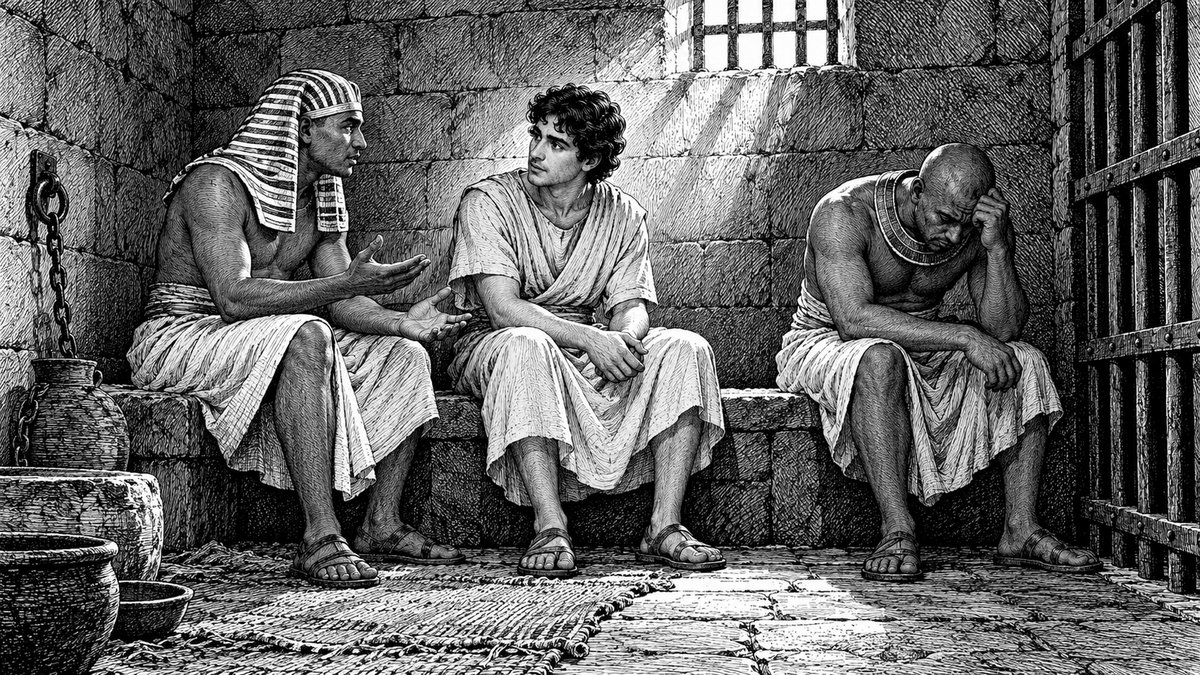
Drawing: Joseph in prison with the butler and the baker
Drawing: Joseph in prison with the butler and the baker. An ink drawing made for Open Scroll, not a picture from the time.

What happened

  • Sold by his brothers: “sold Joseph to the Ishmaelites for twenty pieces of silver” (Genesis 37:28). Open the verse
  • Falsely accused by his master’s wife: “And Joseph’s master took him, and put him into the prison, the place where the king’s prisoners were bound: and he was there in the prison.” (Genesis 39:20). Open the verse
  • “the keeper of the prison committed to Joseph’s hand all the prisoners that were in the prison” (Genesis 39:22). Open the verse
  • A Psalm remembers it: “His feet they hurt with fetters: He was laid in chains of iron,” (Psalms 105:18). Open the verse

How long

  • He was seventeen when he was sold: “Joseph, being seventeen years old” (Genesis 37:2). Open the verse He was thirty when he stood before Pharaoh: “Joseph was thirty years old when he stood before Pharaoh king of Egypt” (Genesis 41:46). Open the verse Thirteen years as a slave and a prisoner.
  • After he read the butler’s dream, he waited two more years: “Yet did not the chief butler remember Joseph, but forgat him.” (Genesis 40:23). Open the verse “at the end of two full years” (Genesis 41:1). Open the verse

What they said or wrote

  • To the butler: “for indeed I was stolen away out of the land of the Hebrews: and here also have I done nothing that they should put me into the dungeon” (Genesis 40:15). Open the verse
  • Years later, to his brothers: “ye meant evil against me; but God meant it for good, to bring to pass, as it is this day, to save much people alive” (Genesis 50:20). Open the verse

How it ended

  • “they brought him hastily out of the dungeon: and he shaved himself, and changed his raiment, and came in unto Pharaoh” (Genesis 41:14). Open the verse
SimeonHeld by Joseph in Egypt as a pledge.

When famine struck Canaan, Joseph’s brothers came to Egypt to buy grain. Joseph, now governor, knew them, but they did not know him. He accused them of being spies and put all of them in custody for three days.

Then he let them go home with grain, but kept one brother, Simeon, bound in front of them. He told them Simeon would stay until they came back with their youngest brother, Benjamin. Their father Jacob refused at first. Only when the grain ran out did he let Benjamin go. When the brothers returned, Simeon was brought out to them.

What happened

  • Joseph first held all his brothers: “And he put them all together into ward three days.” (Genesis 42:17). Open the verse
  • Then kept one: “took Simeon from among them, and bound him before their eyes” (Genesis 42:24). Open the verse
  • Their father: “Joseph is not, and Simeon is not” (Genesis 42:36). Open the verse

How it ended

  • When the brothers came back with Benjamin: “And he brought Simeon out unto them.” (Genesis 43:23). Open the verse
SamsonBlinded and set to grind in the prison at Gaza.

Samson was a judge of Israel, famous for his great strength, which was tied to his vow never to cut his hair. He fought the Philistines, who ruled over Israel at that time. He fell in love with a woman named Delilah. The Philistine leaders paid her to find out the secret of his strength. After many tries she got the truth from him, and while he slept she had his head shaved.

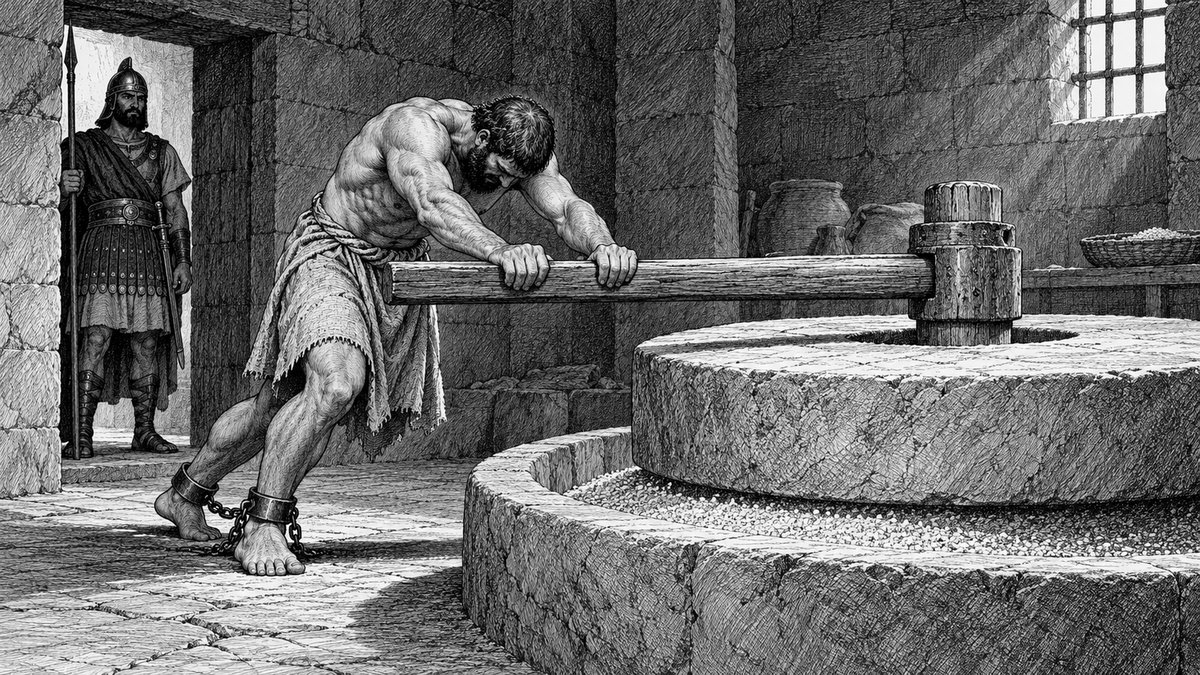
The Philistines seized him, put out his eyes, took him to the city of Gaza, bound him in bronze chains, and made him grind grain in the prison. But slowly his hair began to grow again.

At a great feast for their god Dagon, the Philistines brought Samson out to make fun of him. He asked the boy leading him to let him feel the pillars of the building. He prayed for strength one last time, pushed the pillars apart, and the house fell on everyone inside. He died with them. He had judged Israel twenty years.

Drawing: Samson in chains, grinding at the mill in Gaza
Drawing: Samson in chains, grinding at the mill in Gaza. An ink drawing made for Open Scroll, not a picture from the time.

What happened

  • “And the Philistines laid hold on him, and put out his eyes; and they brought him down to Gaza, and bound him with fetters of brass; and he did grind in the prison-house.” (Judges 16:21). Open the verse
  • “Howbeit the hair of his head began to grow again after he was shaven.” (Judges 16:22). Open the verse

What they said or wrote

  • “remember me, I pray thee, and strengthen me, I pray thee, only this once, O God” (Judges 16:28). Open the verse

How it ended

  • “And Samson said, Let me die with the Philistines. And he bowed himself with all his might; and the house fell upon the lords, and upon all the people that were therein.” (Judges 16:30). Open the verse
  • “And he judged Israel twenty years.” (Judges 16:31). Open the verse
MicaiahA prophet jailed by King Ahab for his message.

Ahab king of Israel wanted Jehoshaphat king of Judah to join him in a war against Syria. Four hundred of Ahab’s prophets all told him he would win. Jehoshaphat asked if there was another prophet. Ahab said there was one, Micaiah, but he hated him, because Micaiah never said anything good about him.

Micaiah was brought in. He said that all the other prophets had a lying spirit, and that Israel would be scattered like sheep without a shepherd. Ahab ordered him put in prison and fed with bread and water of affliction until Ahab came back safely. Micaiah answered: if you come back safely, God has not spoken by me.

Ahab went into battle in disguise. A random arrow struck him between the joints of his armour, and he died that evening.

What happened

  • “Put this fellow in the prison, and feed him with bread of affliction and with water of affliction, until I come in peace” (1 Kings 22:27). Open the verse

What they said or wrote

  • “If thou return at all in peace, Jehovah hath not spoken by me.” (1 Kings 22:28). Open the verse

How it ended

  • The text does not say what became of Micaiah. Ahab died in the battle: “So the king died, and was brought to Samaria” (1 Kings 22:37). Open the verse
Hanani the seerJailed by King Asa.

Asa king of Judah faced an attack from Baasha king of Israel. Instead of trusting God, he took silver and gold from the temple and paid the king of Syria to attack Israel from the north. It worked. Then Hanani the seer came to Asa and told him he had acted foolishly by relying on Syria instead of on God, and that from then on he would have wars.

Asa was furious with Hanani and put him in prison. The Bible adds that at the same time Asa oppressed some of the people.

What happened

  • “Asa was wroth with the seer, and put him in the prison-house” (2 Chronicles 16:10). Open the verse

Back to top

Part II

Kings taken captive

Four kings of Judah and the last king of Israel.

Kings were taken captive too. When a small kingdom rebelled against an empire, its king was often the first to be chained.

This part tells of one king of Israel and four kings of Judah who ended up as prisoners of Assyria, Egypt or Babylon. One of them, Manasseh, came home again. One, Jehoiachin, sat in prison for thirty-seven years before he was released.

Hoshea, king of IsraelShut up by the king of Assyria.

Hoshea was the last king of the northern kingdom of Israel. He had to pay tribute every year to the king of Assyria. Then he stopped paying and secretly sent messengers to the king of Egypt for help.

The king of Assyria found out. He shut Hoshea up and bound him in prison. Then he besieged Samaria for three years, captured it, and carried the people of Israel away to Assyria. That was the end of the northern kingdom.

What happened

  • “therefore the king of Assyria shut him up, and bound him in prison” (2 Kings 17:4). Open the verse

How it ended

  • “the king of Assyria took Samaria, and carried Israel away unto Assyria” (2 Kings 17:6). Open the verse
Manasseh, king of JudahTaken to Babylon in chains, then brought home.

Manasseh became king of Judah at twelve and reigned fifty-five years, longer than any other king of Judah. The Bible says he did great evil: he rebuilt the altars to other gods, put an idol in the temple, and shed much innocent blood.

2 Chronicles tells that the Assyrian army took Manasseh captive in chains and carried him to Babylon. In his distress he humbled himself greatly and prayed. God heard him and brought him back to Jerusalem to his kingdom. Back home, he removed the foreign gods and the idol from the temple and restored the altar of God.

What happened

  • “who took Manasseh in chains, and bound him with fetters, and carried him to Babylon” (2 Chronicles 33:11). Open the verse

What they said or wrote

  • “And when he was in distress, he besought Jehovah his God, and humbled himself greatly before the God of his fathers.” (2 Chronicles 33:12). Open the verse

How it ended

  • “and brought him again to Jerusalem into his kingdom” (2 Chronicles 33:13). Open the verse
  • Back home he removed the idols: “And he took away the foreign gods” (2 Chronicles 33:15). Open the verse
Jehoahaz, king of JudahPut in bonds by Pharaoh Necho.

Jehoahaz became king of Judah at twenty-three, after his father Josiah was killed in battle by Pharaoh Necho of Egypt. He reigned only three months.

Pharaoh Necho put him in chains at Riblah, so that he could not reign in Jerusalem, and placed a heavy tax on the land. Necho made Jehoahaz’s brother king in his place and gave him a new name, Jehoiakim. Jehoahaz was taken to Egypt and died there. He never came home.

What happened

  • “Pharaoh-necoh put him in bonds at Riblah in the land of Hamath, that he might not reign in Jerusalem” (2 Kings 23:33). Open the verse

How it ended

  • “he took Jehoahaz away; and he came to Egypt, and died there” (2 Kings 23:34). Open the verse
Jehoiachin, king of JudahThirty-seven years in a Babylonian prison.

Jehoiachin became king of Judah at eighteen. Three months later the army of Babylon besieged Jerusalem. He surrendered to Nebuchadnezzar with his mother, his servants, his officials and his officers. He was taken to Babylon with the treasures of the temple and thousands of captives.

He spent thirty-seven years in prison in Babylon. Then a new king, Evil-merodach, came to the throne and released him. He spoke kindly to him, gave him a seat above the other captive kings, took off his prison clothes, and let him eat at the king’s table for the rest of his life, with a daily allowance.

2 Kings and Jeremiah both end with this release. They give the day slightly differently: the twenty-seventh of the month in 2 Kings, the twenty-fifth in Jeremiah.

What happened

  • “he carried away Jehoiachin to Babylon” (2 Kings 24:15). Open the verse

How long

  • “in the seven and thirtieth year of the captivity of Jehoiachin king of Judah” (2 Kings 25:27). Open the verse
  • 2 Kings gives the day of his release as the twenty-seventh of the month; Jeremiah gives the twenty-fifth: “in the five and twentieth day of the month” (Jeremiah 52:31). Open the verse

How it ended

  • “And Jehoiachin did eat bread before him continually all the days of his life” (2 Kings 25:29). Open the verse
  • His name has also been found on ration lists in Babylon. See Historical Figures.
Zedekiah, king of JudahBlinded and imprisoned in Babylon.

Zedekiah was the last king of Judah. Nebuchadnezzar put him on the throne after taking his nephew Jehoiachin to Babylon. Zedekiah later rebelled. Babylon besieged Jerusalem until the food ran out. Zedekiah and his soldiers broke out by night and fled, but they were caught near Jericho.

He was brought before Nebuchadnezzar at Riblah. His sons were killed in front of him. Then his eyes were put out, he was bound in bronze chains, and he was taken to Babylon. Jeremiah adds that he was kept in prison until the day he died.

What happened

  • “And they slew the sons of Zedekiah before his eyes, and put out the eyes of Zedekiah, and bound him in fetters, and carried him to Babylon.” (2 Kings 25:7). Open the verse

How it ended

  • “and put him in prison till the day of his death” (Jeremiah 52:11). Open the verse

Back to top

Part III

Prophets and exiles

Jeremiah in Jerusalem; Daniel, Ezekiel and Mordecai far from home.

When Babylon conquered Judah, it took thousands of people away from their homeland and settled them in Babylonia. This is called the exile, or the captivity. Jeremiah said it would last seventy years. It ended when Cyrus of Persia let the Jews go home.

This part tells of a prophet who was jailed in Jerusalem by his own people during the siege, Jeremiah, and of four people who lived as captives far from home: Daniel and his three friends, Ezekiel, and Mordecai.

JeremiahStocks, a dungeon, a muddy cistern and the court of the guard.

Jeremiah was a prophet in Jerusalem during the last years before Babylon destroyed it. For many years he warned that the city would fall. Many people saw him as a traitor, and he was jailed again and again.

First, a priest named Pashhur beat him and put him in the stocks, a wooden frame that locked his feet, at a temple gate overnight. Later, during the siege, officials accused him of deserting to the Babylonians. They beat him and locked him in a dungeon in the house of Jonathan the scribe, where he stayed many days.

King Zedekiah secretly sent for him and asked if there was any word from God. Jeremiah told him he would be handed over to the king of Babylon. Jeremiah begged not to be sent back to the dungeon, where he would die. The king moved him to the court of the guard, and ordered that he be given a loaf of bread every day until the bread in the city ran out.

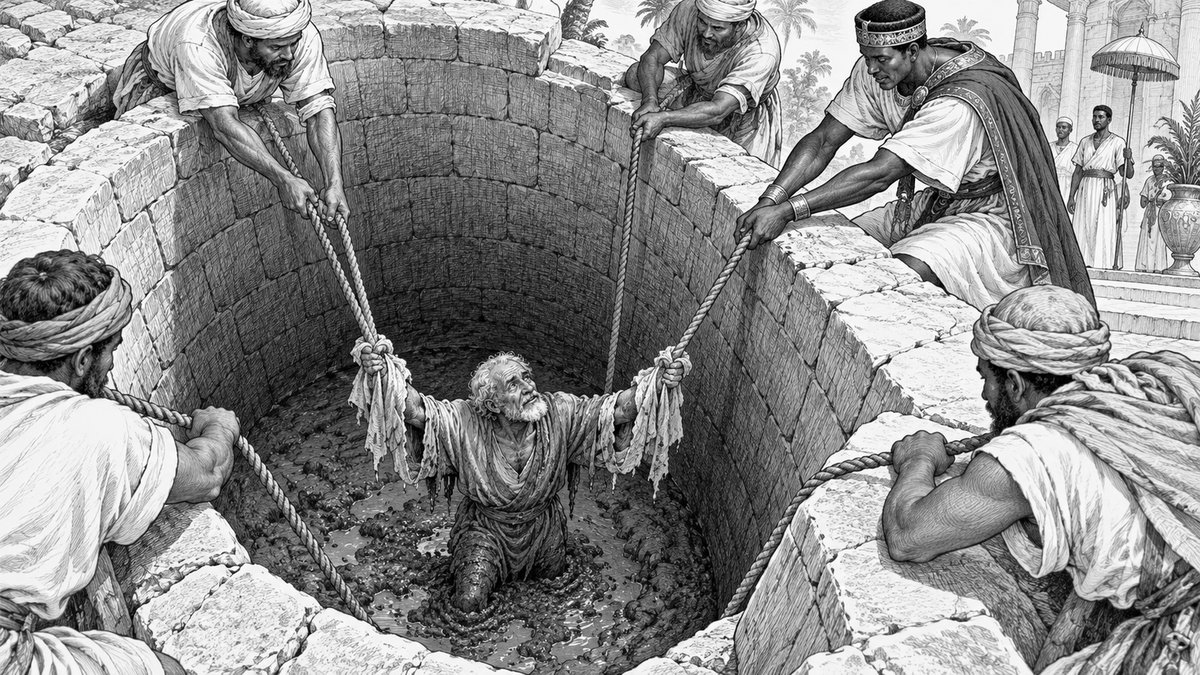
The officials still wanted him dead. They lowered him on ropes into a cistern, a deep pit for storing water. There was no water in it, only mud, and Jeremiah sank into the mud. An Ethiopian named Ebed-melech, a servant in the palace, went to the king and pleaded for him. He took thirty men, and let down old rags and worn-out clothes on ropes so Jeremiah could put them under his arms, and they pulled him out.

Jeremiah stayed in the court of the guard until Jerusalem fell. The Babylonian commander found him among the captives in chains, set him free, and let him choose where to live. Even while held, Jeremiah kept working: he bought a field as a sign that people would one day buy fields in the land again, and he dictated his messages to his scribe Baruch.

Drawing: Jeremiah pulled up from the cistern with ropes and rags
Drawing: Jeremiah pulled up from the cistern with ropes and rags. An ink drawing made for Open Scroll, not a picture from the time.

What happened

  • In the stocks: “put him in the stocks that were in the upper gate of Benjamin” (Jeremiah 20:2). Open the verse
  • In a house made into a prison: “put him in prison in the house of Jonathan the scribe; for they had made that the prison” (Jeremiah 37:15). Open the verse “When Jeremiah was come into the dungeon-house, and into the cells, and Jeremiah had remained there many days;” (Jeremiah 37:16). Open the verse
  • In the court of the guard, fed by the king’s order: “they gave him daily a loaf of bread out of the bakers’ street, until all the bread in the city was spent” (Jeremiah 37:21). Open the verse
  • In the cistern: “And in the dungeon there was no water, but mire; and Jeremiah sank in the mire.” (Jeremiah 38:6). Open the verse

How long

  • “So Jeremiah abode in the court of the guard until the day that Jerusalem was taken.” (Jeremiah 38:28). Open the verse

What they said or wrote

  • From the court of the guard he bought a field, and gave the deed to Baruch “before all the Jews that sat in the court of the guard” (Jeremiah 32:12). Open the verse
  • He could not go to the temple, so Baruch read his words for him: “I am shut up; I cannot go into the house of Jehovah” (Jeremiah 36:5). Open the verse

How it ended

  • Ebed-melech, an Ethiopian servant of the king, pleaded for him and pulled him out: “took thence rags and worn-out garments, and let them down by cords into the dungeon to Jeremiah” (Jeremiah 38:11). Open the verse “So they drew up Jeremiah with the cords, and took him up out of the dungeon” (Jeremiah 38:13). Open the verse
  • After the city fell: “I loose thee this day from the chains which are upon thy hand” (Jeremiah 40:4). Open the verse
Daniel and his three friendsTaken to Babylon as young men.

Daniel and three friends, Hananiah, Mishael and Azariah, were young men from noble families of Judah. They were taken to Babylon and trained to serve in the king’s palace. They were given Babylonian names: Belteshazzar, Shadrach, Meshach and Abed-nego.

From the start, Daniel decided he would not defile himself with the king’s food and wine. He asked to eat vegetables and drink water for ten days, and at the end he and his friends looked healthier than all the others.

Years later King Nebuchadnezzar set up a huge gold statue and ordered everyone to bow to it. The three friends refused. They told the king their God could save them from the fire, and even if he did not, they would not worship the statue. They were tied up and thrown into a blazing furnace. The king looked in and saw four men walking loose in the fire, unharmed.

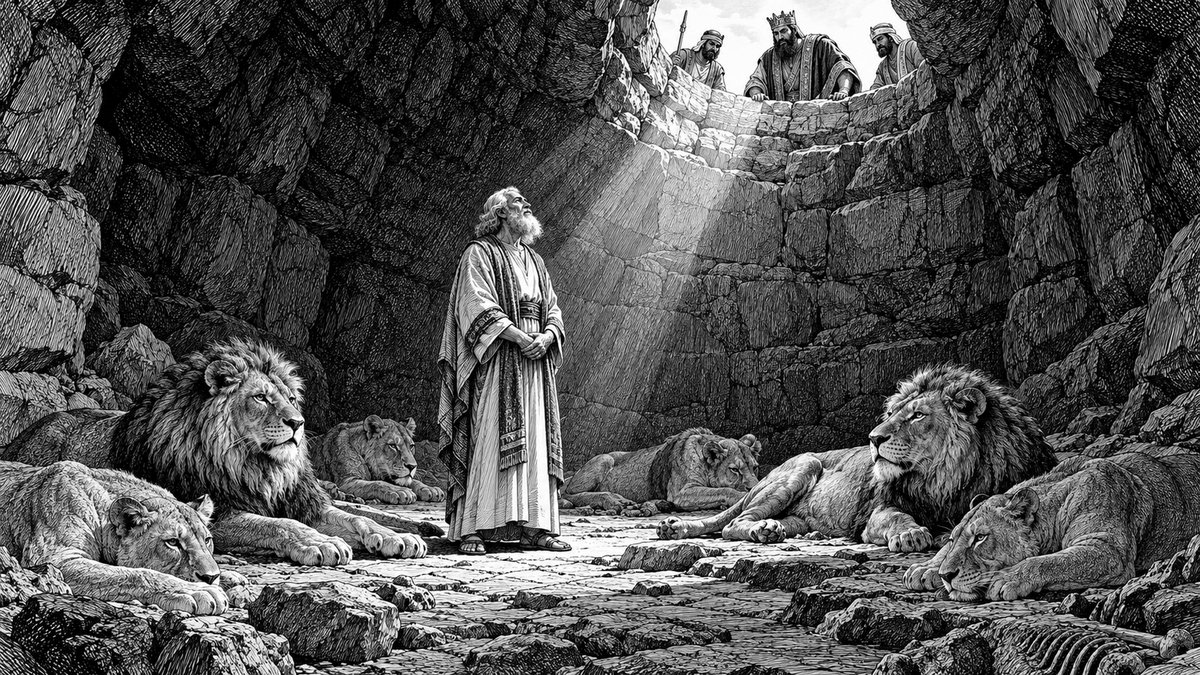
Under a later king, Darius, Daniel’s rivals got the king to pass a law that no one could pray to anyone but the king for thirty days. Daniel went home, opened his window toward Jerusalem, and prayed three times a day as he always had. He was thrown into a den of lions. In the morning the king hurried to the den, and Daniel answered him: God had shut the lions’ mouths.

Daniel served under Babylonian and Persian kings until at least the first year of Cyrus.

Drawing: Daniel standing among the lions at dawn
Drawing: Daniel standing among the lions at dawn. An ink drawing made for Open Scroll, not a picture from the time.

What happened

  • “Now among these were, of the children of Judah, Daniel, Hananiah, Mishael, and Azariah.” (Daniel 1:6). Open the verse
  • The three are bound and thrown into the furnace: “to bind Shadrach, Meshach, and Abed-nego, and to cast them into the burning fiery furnace” (Daniel 3:20). Open the verse “Lo, I see four men loose, walking in the midst of the fire, and they have no hurt” (Daniel 3:25). Open the verse
  • Daniel in the lions’ den: “they brought Daniel, and cast him into the den of lions” (Daniel 6:16). Open the verse

How long

  • “And Daniel continued even unto the first year of king Cyrus.” (Daniel 1:21). Open the verse

What they said or wrote

  • “Daniel purposed in his heart that he would not defile himself” (Daniel 1:8). Open the verse
  • “But if not, be it known unto thee, O king, that we will not serve thy gods” (Daniel 3:18). Open the verse
  • “he kneeled upon his knees three times a day, and prayed, and gave thanks before his God, as he did aforetime” (Daniel 6:10). Open the verse
  • “My God hath sent his angel, and hath shut the lions’ mouths” (Daniel 6:22). Open the verse

How it ended

  • “So this Daniel prospered in the reign of Darius, and in the reign of Cyrus the Persian.” (Daniel 6:28). Open the verse
EzekielA priest among the captives in Babylonia.

Ezekiel was a priest who was carried to Babylon with King Jehoiachin. He lived among the exiles at a place called Tel-abib by the river Chebar in Babylonia.

In the fifth year of the captivity, he saw a vision of God by the river, and became a prophet to the exiles. When he first came to them, he sat among them for seven days, overwhelmed, before he spoke. He prophesied there for more than twenty years.

What happened

  • “as I was among the captives by the river Chebar, that the heavens were opened” (Ezekiel 1:1). Open the verse
  • “Then I came to them of the captivity at Tel-abib, that dwelt by the river Chebar” (Ezekiel 3:15). Open the verse
MordecaiCarried away with King Jeconiah.

Mordecai was a Jew from the tribe of Benjamin whose family had been carried away from Jerusalem with King Jeconiah (Jehoiachin). He lived in Shushan, the Persian capital, and raised his orphaned cousin Esther.

Esther became queen of Persia. When the king’s official Haman plotted to kill all the Jews in the empire, Mordecai urged Esther to go to the king, even though going to him uninvited could mean death. She went, the plot was exposed, and Haman was hanged. Mordecai, the son of captives, became second in the kingdom after the king.

What happened

  • “who had been carried away from Jerusalem with the captives that had been carried away with Jeconiah king of Judah” (Esther 2:6). Open the verse

How it ended

  • “For Mordecai the Jew was next unto king Ahasuerus” (Esther 10:3). Open the verse

Back to top

Part IV

In the New Testament

From John the Baptist to John on Patmos.

The New Testament is full of prisoners. John the Baptist was jailed and killed. Yeshua (Jesus) himself was arrested at night, bound, and passed from one court to another. Peter was chained between soldiers. Paul spent years in custody, and wrote several of his letters from there.

This part follows them one by one, from John the Baptist to John on the island of Patmos. The card on Paul’s letters gathers what he wrote about his chains, what he asked for, and who stood by him.

John the BaptistImprisoned by Herod Antipas.

John the Baptist told Herod Antipas, the ruler of Galilee, that it was not lawful for him to take his brother Philip’s wife, Herodias. Herod put John in prison.

In prison John heard about what Yeshua was doing. He sent two of his disciples to ask him: “Art thou he that cometh, or look we for another?” Yeshua told them to go back and tell John what they had seen: the blind see, the lame walk, the poor have good news preached to them. After they left, Yeshua said that no one born of women was greater than John.

At Herod’s birthday party, Herodias’s daughter danced, and Herod swore to give her whatever she asked. Her mother told her to ask for John’s head on a platter. Herod was sorry, but because of his oath and his guests he sent and had John beheaded in the prison. John’s disciples came, took his body, and buried it, then went and told Yeshua.

What happened

  • “Herod had laid hold on John, and bound him, and put him in prison” (Matthew 14:3). Open the verse

What they said or wrote

  • From prison he sent a question to Yeshua: “Now when John heard in the prison the works of the Christ, he sent by his disciples” (Matthew 11:2). Open the verse “and said unto him, Art thou he that cometh, or look we for another?” (Matthew 11:3). Open the verse

How it ended

  • “and he sent and beheaded John in the prison.” (Matthew 14:10). Open the verse “And his disciples came, and took up the corpse, and buried him” (Matthew 14:12). Open the verse
  • Josephus also tells of John’s death. See Historical Figures.
YeshuaArrested, bound and handed over.

On the night of the Passover meal, Yeshua went with his disciples to a garden across the Kidron valley. Judas came with a band of soldiers and officers from the chief priests, carrying lanterns, torches and weapons. They seized Yeshua and bound him.

He was taken bound to Annas, then to Caiaphas the high priest, and questioned through the night. In the morning the council bound him again and handed him over to Pilate, the Roman governor. Pilate had him scourged and handed him over to be crucified.

Earlier, Yeshua had told a parable about the day of judgment in which the King says to those on his right: “I was in prison, and ye came unto me.”

What happened

  • “seized Jesus and bound him” (John 18:12). Open the verse
  • “Annas therefore sent him bound unto Caiaphas the high priest.” (John 18:24). Open the verse
  • “bound Jesus, and carried him away, and delivered him up to Pilate” (Mark 15:1). Open the verse
  • He had said of the judgement: “I was in prison, and ye came unto me” (Matthew 25:36). Open the verse
BarabbasHeld for insurrection and murder; set free.

Barabbas was in prison with others who had taken part in an uprising in Jerusalem and had committed murder in it. At the Passover, the governor used to release one prisoner chosen by the crowd.

Pilate offered the crowd a choice: Barabbas or Yeshua. The chief priests stirred up the crowd to ask for Barabbas. Pilate, wanting to satisfy them, released Barabbas, the man in prison for insurrection and murder, and handed Yeshua over to be crucified.

What happened

  • “lying bound with them that had made insurrection, men who in the insurrection had committed murder” (Mark 15:7). Open the verse

How it ended

  • “And Pilate, wishing to content the multitude, released unto them Barabbas” (Mark 15:15). Open the verse
The apostlesPut in the public prison in Jerusalem.

After Pentecost, the apostles preached and healed in the temple courts in Jerusalem, and crowds gathered. The high priest and his party were filled with jealousy. They arrested the apostles and put them in the public prison.

During the night an angel opened the prison doors and told them to go and speak in the temple. In the morning the council sent for them, but the officers found the prison locked and the guards standing at the doors, and no one inside. The apostles were found teaching in the temple. They were brought before the council, beaten, and ordered not to speak in Yeshua’s name. They left rejoicing that they had been counted worthy to suffer for the Name.

What happened

  • “and laid hands on the apostles, and put them in public ward.” (Acts 5:18). Open the verse

How it ended

  • “But an angel of the Lord by night opened the prison doors, and brought them out” (Acts 5:19). Open the verse
  • After being beaten: “rejoicing that they were counted worthy to suffer dishonor for the Name” (Acts 5:41). Open the verse
PeterChained between two soldiers.

King Herod Agrippa killed James the brother of John with the sword. When he saw that this pleased the people, he arrested Peter too, during the days of Unleavened Bread. He put him in prison under four squads of four soldiers each, planning to bring him out for trial after the Passover. Meanwhile the church prayed earnestly for him.

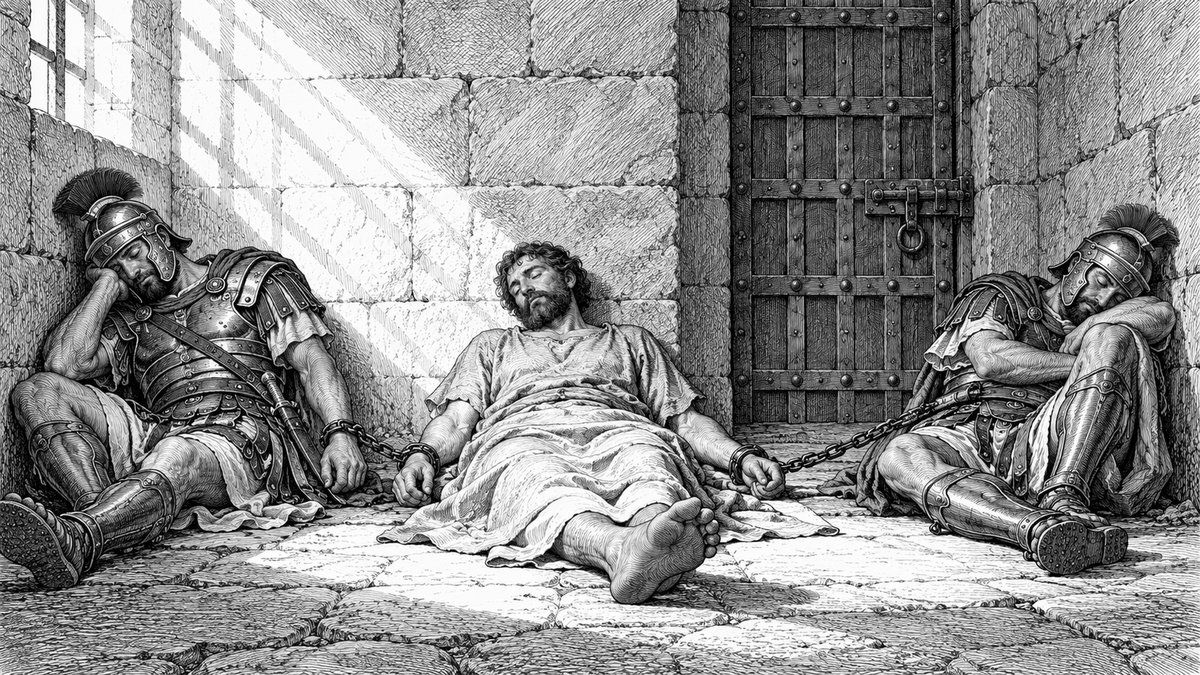
On the night before the trial, Peter was asleep between two soldiers, bound with two chains, with guards at the door. A light shone in the cell, and an angel struck Peter on the side and woke him. The chains fell off his hands. He followed the angel past the first and second guard to the iron gate of the city, which opened by itself. Then the angel left him.

Peter went to the house of Mary, the mother of John Mark, where many were praying. A servant girl named Rhoda was so happy to hear his voice that she ran to tell the others and left him standing at the gate. He told them how the Lord had brought him out, and then went to another place.

Drawing: Peter asleep, chained between two soldiers
Drawing: Peter asleep, chained between two soldiers. An ink drawing made for Open Scroll, not a picture from the time.

What happened

  • “he put him in prison, and delivered him to four quaternions of soldiers to guard him” (Acts 12:4). Open the verse Four squads of four soldiers.
  • “Peter was sleeping between two soldiers, bound with two chains” (Acts 12:6). Open the verse
  • “Peter therefore was kept in the prison: but prayer was made earnestly of the church unto God for him.” (Acts 12:5). Open the verse

How it ended

  • “And his chains fell off from his hands.” (Acts 12:7). Open the verse “they came unto the iron gate that leadeth into the city; which opened to them of its own accord” (Acts 12:10). Open the verse
Paul and Silas at PhilippiBeaten and put in the stocks.

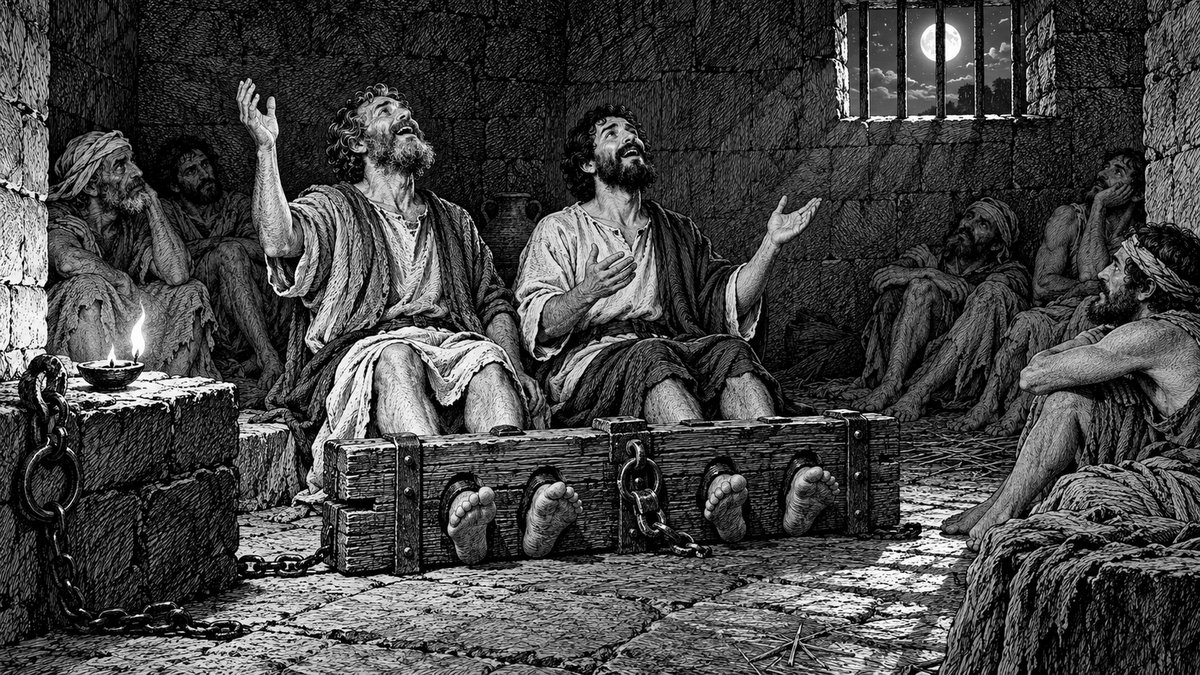
In the Roman city of Philippi, Paul and Silas freed a slave girl from a spirit that let her tell fortunes. Her owners lost their income and dragged Paul and Silas before the city rulers. The rulers had them stripped and beaten with rods, then thrown into prison. The jailer put them in the inner prison and locked their feet in the stocks.

At midnight Paul and Silas were praying and singing hymns, and the other prisoners were listening. Suddenly an earthquake shook the prison. All the doors opened and everyone’s chains came loose. The jailer woke up, saw the doors open, and drew his sword to kill himself, thinking the prisoners had escaped. Paul shouted: “Do thyself no harm: for we are all here.”

The jailer fell trembling before them and asked, “Sirs, what must I do to be saved?” That same night he washed their wounds, he and his household were baptized, and he brought them into his house and gave them food.

In the morning the rulers sent word to let them go quietly. Paul refused. They were Roman citizens, he said, beaten publicly without a trial; let the rulers come and bring them out themselves. The rulers were afraid when they heard they were Romans, came and apologised, and asked them to leave the city.

Drawing: Paul and Silas singing at midnight, their feet in the stocks
Drawing: Paul and Silas singing at midnight, their feet in the stocks. An ink drawing made for Open Scroll, not a picture from the time.

What happened

  • “cast them into the inner prison, and made their feet fast in the stocks” (Acts 16:24). Open the verse

What they said or wrote

  • “But about midnight Paul and Silas were praying and singing hymns unto God, and the prisoners were listening to them” (Acts 16:25). Open the verse
  • When the jailor was about to kill himself: “Do thyself no harm: for we are all here.” (Acts 16:28). Open the verse
  • “Sirs, what must I do to be saved?” (Acts 16:30). Open the verse “And they said, Believe on the Lord Jesus, and thou shalt be saved, thou and thy house.” (Acts 16:31). Open the verse
  • As Roman citizens, they refused to be let out in secret: “They have beaten us publicly, uncondemned, men that are Romans, and have cast us into prison” (Acts 16:37). Open the verse

How it ended

  • “And he brought them up into his house, and set food before them” (Acts 16:34). Open the verse
Paul: Jerusalem, Caesarea and RomeTwo years at Caesarea, a shipwreck, and two years in Rome.

When Paul came back to Jerusalem, a crowd in the temple accused him of bringing Gentiles into the holy place, and tried to kill him. Roman soldiers rescued him and bound him with two chains. The next day the Roman commander learned of a plot by more than forty men to kill Paul, and sent him by night under heavy guard to Caesarea, the seat of the Roman governor.

At Caesarea, Governor Felix heard the case but did not decide it. He hoped Paul would pay him a bribe, and kept him in custody for two years. When a new governor, Festus, wanted to send him to Jerusalem for trial, Paul used his right as a Roman citizen: “I appeal unto Caesar.” King Agrippa heard him too, and said he could have been set free if he had not appealed.

Paul was sent to Rome by ship with other prisoners, under a centurion named Julius. On the way they were caught in a storm for two weeks and wrecked on the island of Malta. All 276 people on board reached land alive. In Rome, Paul was allowed to live in his own rented house, with a soldier guarding him, for two whole years. He welcomed everyone who came to see him. The book of Acts ends there.

What happened

  • Arrested in the temple: “commanded him to be bound with two chains” (Acts 21:33). Open the verse
  • Kept at Caesarea: “he commanded him to be kept in Herod’s palace” (Acts 23:35). Open the verse
  • “I appeal unto Caesar.” (Acts 25:11). Open the verse “This man might have been set at liberty, if he had not appealed unto Caesar.” (Acts 26:32). Open the verse
  • Sent by ship with other prisoners: “they delivered Paul and certain other prisoners to a centurion named Julius” (Acts 27:1). Open the verse
  • In Rome: “Paul was suffered to abide by himself with the soldier that guarded him” (Acts 28:16). Open the verse

How long

  • “But when two years were fulfilled, Felix was succeeded by Porcius Festus; and desiring to gain favor with the Jews, Felix left Paul in bonds.” (Acts 24:27). Open the verse
  • “And he abode two whole years in his own hired dwelling, and received all that went in unto him” (Acts 28:30). Open the verse
  • He also wrote: “in prisons more abundantly” (2 Corinthians 11:23). Open the verse

What they said or wrote

  • “because of the hope of Israel I am bound with this chain” (Acts 28:20). Open the verse
  • “might become such as I am, except these bonds” (Acts 26:29). Open the verse

How it ended

  • Acts ends with Paul still in Rome: “with all boldness, none forbidding him” (Acts 28:31). Open the verse
Paul’s letters from prisonEphesians, Philippians, Colossians, Philemon, 2 Timothy.

Paul wrote several of his letters while he was a prisoner: Ephesians, Philippians, Colossians and Philemon, and his last letter, 2 Timothy. In them he calls himself “the prisoner of Christ Jesus” and “an ambassador in chains.”

He writes that his chains became known to the whole Roman palace guard, and that seeing him in chains made other believers bolder. He asks his readers to “remember my bonds.” In prison he met a slave named Onesimus, who had left his master Philemon. Onesimus became a believer, and Paul sent him back to Philemon with a letter asking him to receive him as a brother.

In 2 Timothy, written near the end of his life, Paul asks Timothy to come before winter and bring the cloak he left at Troas, and his books and parchments. Only Luke is with him. At his first hearing no one stood with him. He thanks a man named Onesiphorus, who searched for him in Rome and was not ashamed of his chain.

How the letters name his chains

  • “I Paul, the prisoner of Christ Jesus in behalf of you Gentiles” (Ephesians 3:1). Open the verse
  • “for which I am an ambassador in chains” (Ephesians 6:20). Open the verse
  • “so that my bonds became manifest in Christ throughout the whole praetorian guard” (Philippians 1:13). Open the verse “especially they that are of Caesar’s household” (Philippians 4:22). Open the verse
  • “being confident through my bonds, are more abundantly bold to speak the word of God without fear” (Philippians 1:14). Open the verse
  • “The salutation of me Paul with mine own hand. Remember my bonds. Grace be with you.” (Colossians 4:18). Open the verse
  • “I beseech thee for my child, whom I have begotten in my bonds, Onesimus” (Philemon 10). Open the verse
  • “wherein I suffer hardship unto bonds, as a malefactor; but the word of God is not bound” (2 Timothy 2:9). Open the verse

What he asked for

  • “The cloak that I left at Troas with Carpus, bring when thou comest, and the books, especially the parchments.” (2 Timothy 4:13). Open the verse
  • “Only Luke is with me.” (2 Timothy 4:11). Open the verse
  • “for he oft refreshed me, and was not ashamed of my chain” (2 Timothy 1:16). Open the verse
  • “At my first defence no one took my part, but all forsook me: may it not be laid to their account.” (2 Timothy 4:16). Open the verse

What he wrote from there

  • “I have learned, in whatsoever state I am, therein to be content” (Philippians 4:11). Open the verse
  • “I can do all things in him that strengtheneth me.” (Philippians 4:13). Open the verse
  • “I have fought the good fight, I have finished the course, I have kept the faith:” (2 Timothy 4:7). Open the verse
Paul’s fellow prisonersNamed in his letters.

Paul was not alone in prison. In his letters he names several “fellow-prisoners”: Aristarchus, a man from Thessalonica who travelled with him; Epaphras, who brought the gospel to the town of Colossae; and Andronicus and Junias, two relatives of Paul who were believers before he was.

Names

  • “Aristarchus my fellow-prisoner saluteth you” (Colossians 4:10). Open the verse
  • “Epaphras, my fellow-prisoner in Christ Jesus, saluteth thee” (Philemon 23). Open the verse
  • “Salute Andronicus and Junias, my kinsmen, and my fellow-prisoners” (Romans 16:7). Open the verse
John on PatmosOn an island for the word of God.

John writes that he was on the island of Patmos “for the word of God and the testimony of Jesus.” Patmos is a small rocky island in the Aegean Sea, off the coast of what is now Turkey.

There, on the Lord’s day, he heard a voice like a trumpet telling him to write what he saw in a book and send it to seven churches in Asia. What he wrote is the book of Revelation.

What happened

  • “I John, your brother and partaker with you in the tribulation and kingdom and patience which are in Jesus, was in the isle that is called Patmos, for the word of God and the testimony of Jesus.” (Revelation 1:9). Open the verse

What they said or wrote

  • There he was told: “What thou seest, write in a book and send it to the seven churches” (Revelation 1:11). Open the verse

Back to top

Part V

Verses that speak of prisoners

In the verses’ own words.

These verses speak about prisoners and captives. They are printed here as the American Standard Version gives them, without comment, each with a link to read it in its chapter.

Back to top

↑Top